
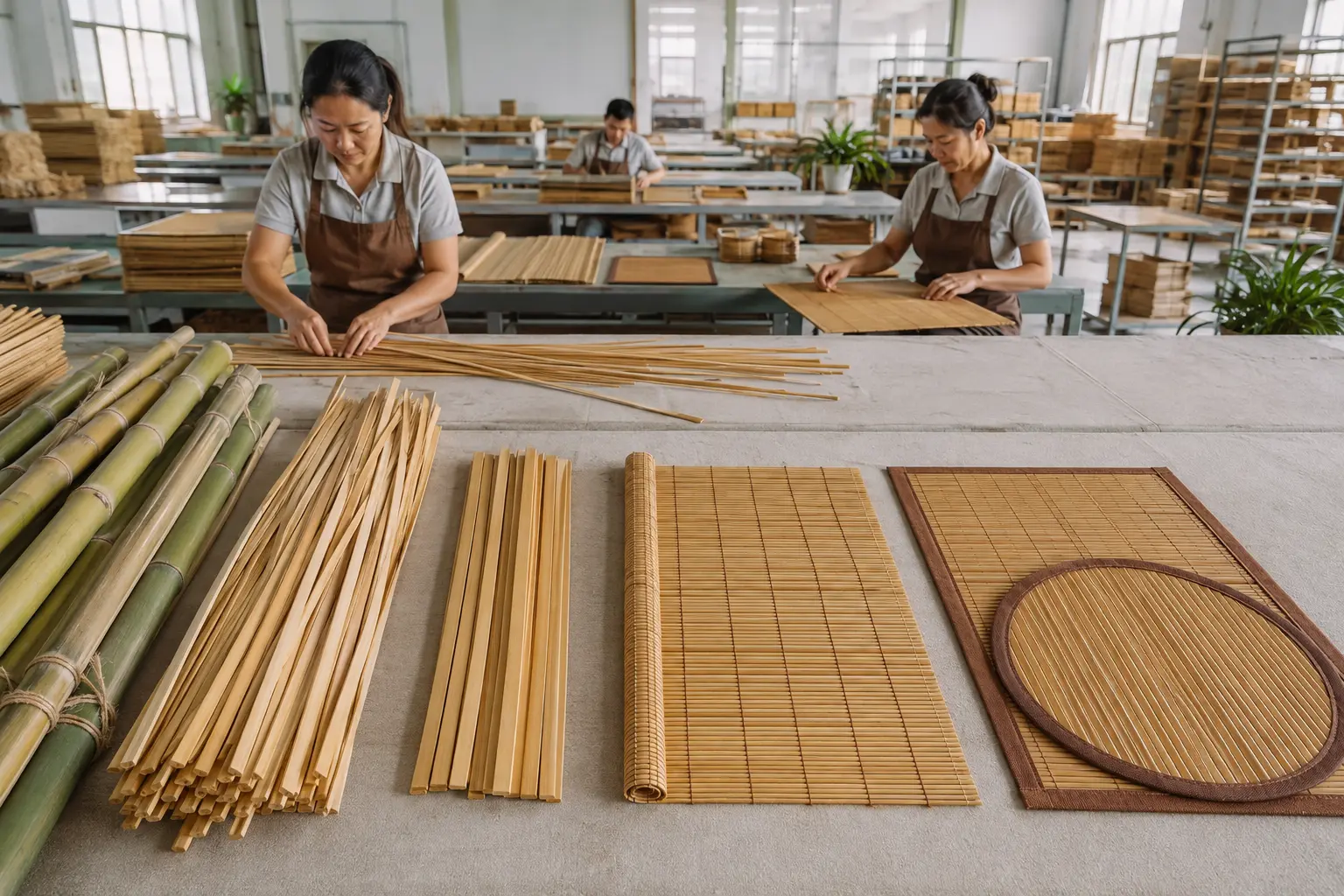
How to make bamboo placemats depends on the product construction. A woven mat, a roll-up bamboo slat placemat and a rigid laminated panel may look related on a dining table, but they require different material preparation, assembly methods, finishing controls and packaging. For brands and importers, understanding those differences makes it easier to approve samples, compare quotations and prevent quality problems during mass production.
This factory-focused guide follows bamboo placemats from raw material selection through cutting, drying, weaving or threading, sanding, coloring, inspection and packing. It also explains which decisions belong in an OEM/ODM specification. It is not a simplified craft tutorial for unsafe home machining; industrial cutting, drying and coating should be handled with appropriate equipment, training and controls.
Step 1: Define the placemat construction
Production starts with the intended structure. A bamboo slat placemat uses flat, narrow strips connected in parallel. A bamboo stick placemat uses rounder or narrower components and often rolls tightly. Bamboo woven placemats use flexible strips in an interlaced pattern. Bamboo tile and beaded placemats connect many small pieces, while solid bamboo placemats may use a rigid laminated panel.
The construction determines almost every later decision: bamboo thickness, moisture target, cutting method, connection material, edge treatment, coating, storage format and carton design. A buyer should therefore approve a structural sample before concentrating on color or logo decoration.
| Style | Main components | Typical production focus |
|---|---|---|
| Slat placemat | Flat bamboo strips and thread or backing | Uniform width, alignment and edge smoothness |
| Stick placemat | Rounded bamboo sticks and connecting thread | Diameter consistency, spacing and roll behavior |
| Woven placemat | Thin flexible bamboo strips | Strip flexibility, weave density and finished shape |
| Tile or beaded mat | Small shaped bamboo components | Piece consistency, joints, gaps and backing |
| Rigid bamboo panel | Laminated bamboo board | Bonding, flatness, machining and moisture balance |
Step 2: Select and prepare the bamboo
Material selection should be based on the required component, not simply the phrase “natural bamboo.” Factories evaluate usable wall thickness, straightness, color, defects and suitability for splitting or machining. The selected stock must support the finished width and thickness without excessive waste or weak sections.
After initial cutting, bamboo is split into manageable sections and processed into strips, sticks or blanks. Outer and inner layers may behave differently during machining and finishing, so the component specification should define which portions are permitted. Visible node marks and grain variation can be acceptable natural features, but mold, decay, contamination and structural cracks are not.
Moisture management
Moisture control is central to stable bamboo wood placemats. Material that is too wet may shrink, warp or encourage finish problems after production. Material that becomes unevenly dry can crack or distort. The appropriate target depends on construction, climate, factory process and destination, so buyers should request a documented control method rather than copy one number from an unrelated product.
Drying may take place before final machining and may be followed by conditioning so components reach a more uniform state. The factory should protect prepared bamboo from reabsorbing moisture during storage and between production steps.
Step 3: Cut strips, sticks, tiles or panels
For bamboo slat placemats, strips are cut to controlled width, thickness and length. Variation that looks minor in one component becomes obvious when dozens of strips are aligned. Jigs, gauges and in-process checks help keep the finished rectangle or square consistent.
Bamboo stick placemats require stable diameter and smooth ends. Tile placemats need repeated shapes that form an even grid without creating uncomfortable raised edges. Rigid panel placemats are cut from laminated stock and may be CNC-machined or shaped with templates, followed by careful edge rounding.
Cutting tolerances should connect to the final product tolerance. If an individual strip is allowed to vary too much, finished mats can become skewed, wavy or difficult to pack. Approved drawings should state the finished mat dimensions and the critical component dimensions that control them.
Step 4: Sand and smooth every food-adjacent surface
Machined bamboo can produce rough fibers, sharp corners or splinters. Sanding removes machining marks and prepares the surface for finishing. The process may include several abrasive stages, with special attention to cut ends, outside edges and areas customers handle frequently.
A smooth sample is not enough; the factory needs repeatable workmanship criteria. Inspection can include visual checks under good lighting and a careful tactile check with safe handling procedures. Loose fibers, sharp transitions, torn edges and residue should be treated as defects according to the agreed standard.
Step 5: Assemble slat, stick and woven placemats
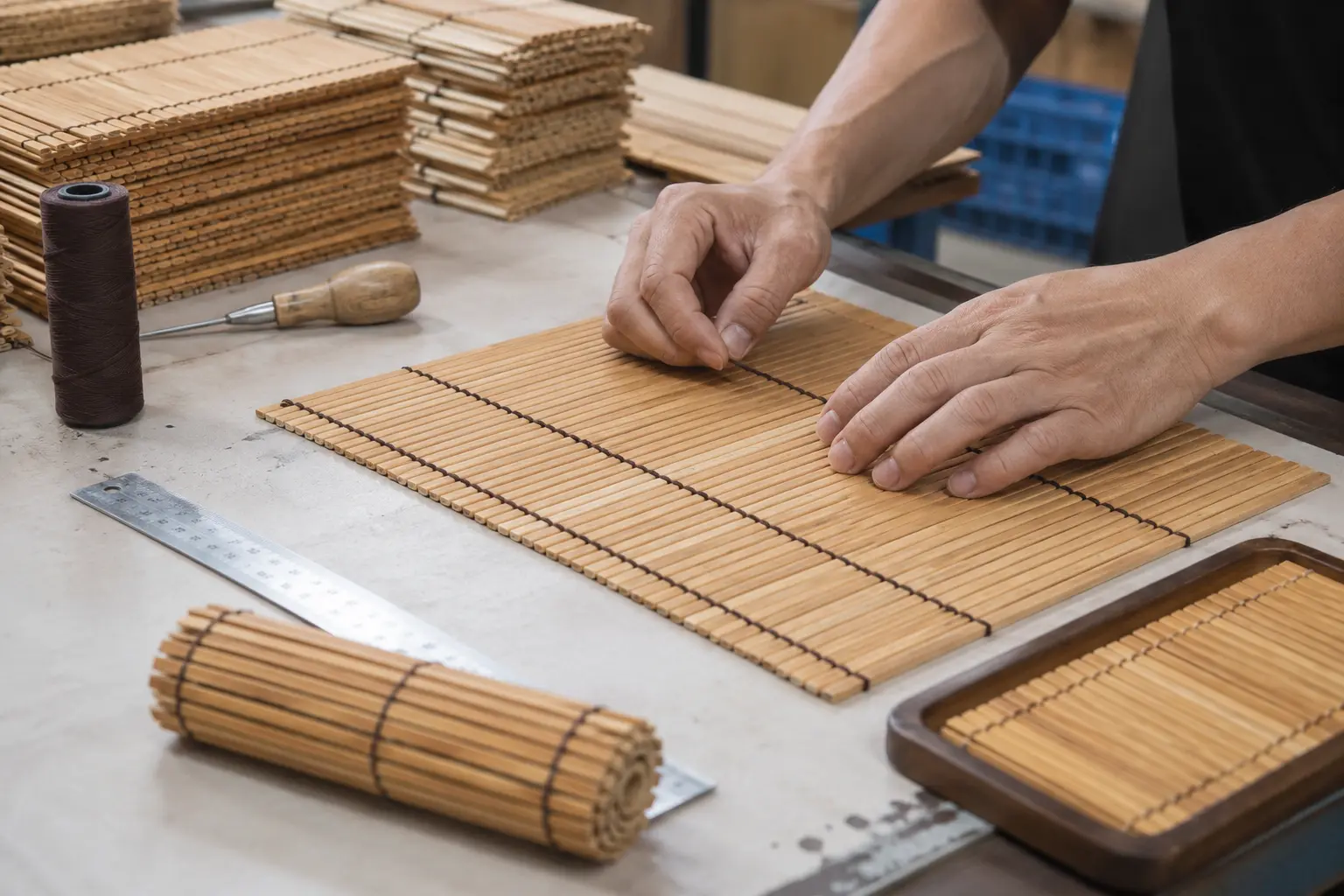
Threaded roll-up placemats
In a roll-up design, prepared slats or sticks are arranged in a jig and connected with thread at controlled intervals. Thread type, color, tension and knot or end-security method all influence performance. If tension is too loose, components move and the mat loses shape. If it is too tight, the mat may curl or place stress on the thread.
Spacing should be wide enough to allow rolling and cleaning but not so wide that plates feel unstable. Production samples should be rolled, unrolled and laid flat repeatedly to check memory, broken pieces and thread movement.
Woven bamboo placemats
Woven construction requires strips thin and flexible enough to interlace without cracking. The pattern may be plain, diagonal or decorative, but it must stay dimensionally controlled. Edge binding or a folded border can prevent the weave from opening. Round and oval bamboo placemats need shaping templates so the outline remains symmetrical.
Tile, beaded and rigid designs
Small tiles or beads may be connected by cord or placed on a backing. The finished underside must not scratch the table. Rigid placemats may use laminated bamboo and require adhesive and coating specifications appropriate to the intended market and use. Buyers should request a complete component declaration rather than assume that “bamboo” means a single-material product.
Step 6: Create shapes and set sizes
Rectangle bamboo placemats are efficient to align and pack, while square, round and oval formats require additional templates or cutting controls. Wedge placemats for round tables need a verified angle and dimensions based on table diameter and seat count.
For a bamboo placemat set of 4 or bamboo table mats set of 6, the factory must control more than individual quality. Mats within the same retail set should have compatible color, dimensions and pattern direction. If coasters or square tea-cup mats are included, set composition and pack-out order should be clearly documented.
Step 7: Apply natural, dark or colored finishes
Natural bamboo placemats may be unfinished, oiled, stained, lacquered or otherwise sealed. “Natural” should not be used as a substitute for a material declaration. The chosen finish affects appearance, wiping behavior, odor, color change and care instructions.
Colored bamboo placemats may use stain, paint, pigment, print or a coated thread. Black, brown, dark brown, white, grey, blue, green, red and cranberry collections require approved physical color standards. Bamboo grain can change visual contrast, and screen references alone are not sufficient for production approval.
Color and coating materials should be selected for the intended market and product use. Decoration must be compatible with cleaning expectations, and claims such as “chemical-free” or “non-toxic” should not be used without a clear definition and supporting evidence.
Step 8: Add branding and packaging
OEM branding can appear on a tag, sleeve, carton, backing, edge detail or selected bamboo component. Laser marking, printing and labels each produce a different result. The specification should define artwork, dimensions, position, orientation, contrast and acceptable variation.
Packaging must protect the shape. Roll-up placemats need a securing method that does not create permanent curl. Flat mats require corner and surface protection. Sets of four or six must be packed in the correct count, with instructions and accessories verified before the carton is closed.
Export-carton design should consider product weight, compression, humidity exposure and handling. A packaging trial is useful because a visually attractive retail box can still fail if mats rub, shift or bend during transport.
Step 9: Inspect bamboo placemats before shipment
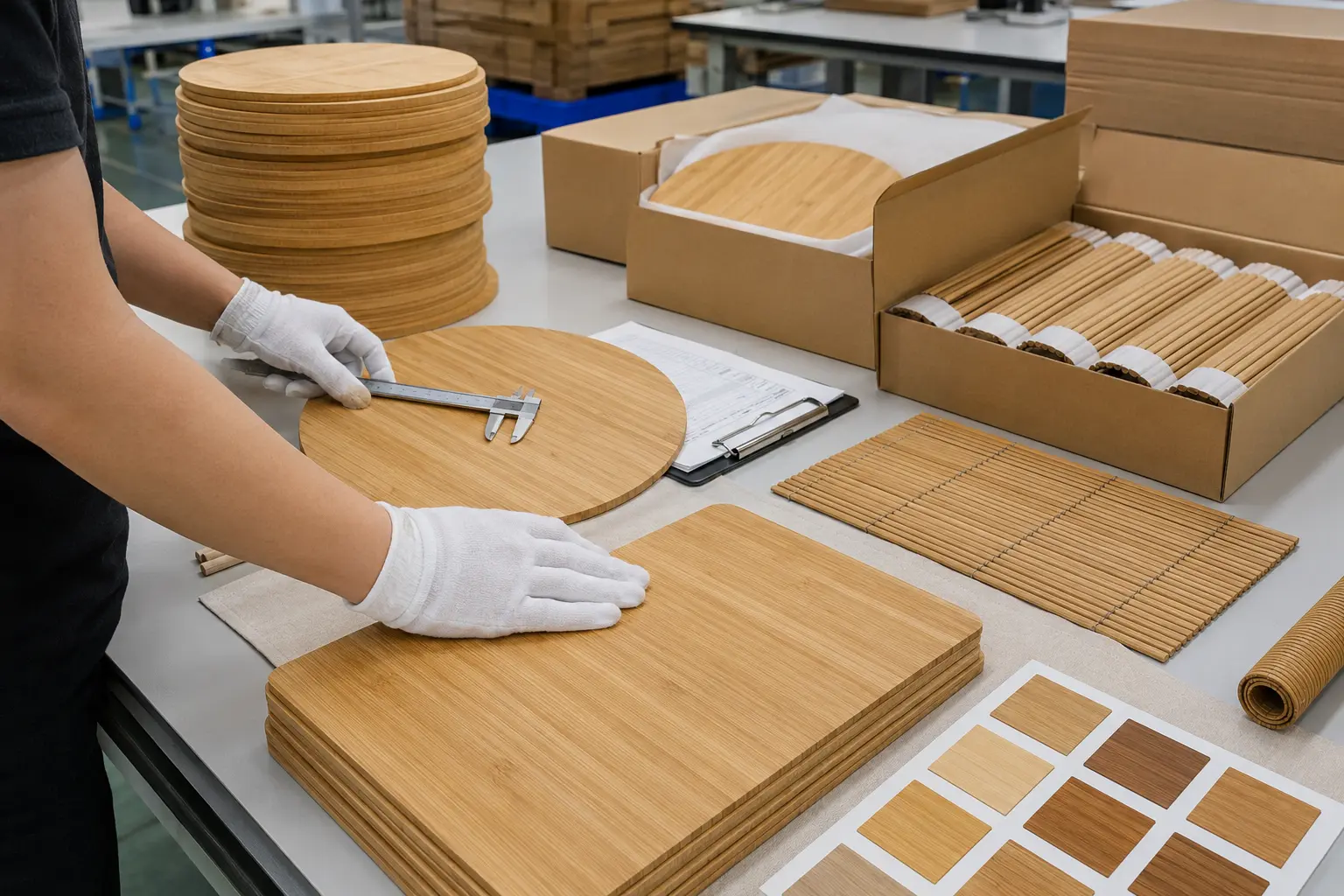
Quality control should compare production with approved drawings, material specifications and signed samples. Checks commonly include:
- Finished length, width, diameter, thickness and shape
- Strip or stick alignment and spacing
- Flatness and ability to roll and unroll where applicable
- Surface smoothness, edge condition and absence of splinters
- Thread tension, knots, binding and backing security
- Color range, coating consistency and decoration position
- Odor, cleanliness and visible moisture-related defects
- Set count, labels, care instructions and packaging
Defect classifications should separate safety or contamination concerns from functional defects, commercial defects and acceptable natural variation. A sampling plan should be agreed for the order instead of relying on a vague promise of “100% good quality.”
How buyers should specify wholesale bamboo placemats
A useful RFQ for wholesale bamboo placemats includes the construction, shape, finished dimensions, component size, permitted color range, finish, connecting materials, backing, logo, set count, packaging, target market and estimated order quantity. Reference images are helpful, but they do not replace a controlled specification.
Ask the manufacturer which parameters require a custom sample, which materials can be documented, and which tests apply to the final configuration. A color change, backing change or new coating can affect the evidence required for the product.
Factory development and OEM/ODM support
Fujian Xianxu Bamboo & Wood Co., Ltd. develops custom bamboo and wooden products through manufacturing operations in China and Vietnam. Founded in 2018, the company supports wholesalers, retailers, importers and brand owners with concept evaluation, sampling, production and quality control.
Buyers can review the bamboo placemats buying guide, learn more about the company, explore its Vietnam factory operations, or send an OEM/ODM brief.
Frequently asked questions
Are all bamboo placemats woven?
No. They may be woven, threaded from slats or sticks, assembled from tiles, or made from rigid laminated bamboo panels.
Can bamboo placemats be made in custom shapes?
Yes, subject to construction and tooling. Rectangle, square, round, oval and wedge shapes require different templates, tolerances and packing plans.
What causes a bamboo placemat to curl?
Possible causes include uneven moisture, thread tension, component variation, finish imbalance or prolonged rolled storage. The exact cause must be diagnosed from the construction and production history.
How are colored bamboo placemats controlled?
Factories should use an approved physical sample or color reference, define acceptable grain visibility and check production under agreed lighting.
What should importers inspect?
Inspect dimensions, flatness, surface smoothness, component security, color, set contents, marking, cleanliness and packaging against the approved specification.
A reliable placemat begins with a controlled process
Making bamboo placemats is a chain of connected decisions. Material preparation affects machining; machining affects assembly; assembly affects flatness; and finish affects both appearance and care. The strongest factory program converts those decisions into drawings, samples, process controls and inspection criteria.
For buyers, the practical lesson is simple: define the construction first, approve the materials and sample, and make quality requirements measurable before mass production. After production, use the companion guide How to Clean Bamboo Placemats to align daily care, drying and storage instructions with the final construction.