
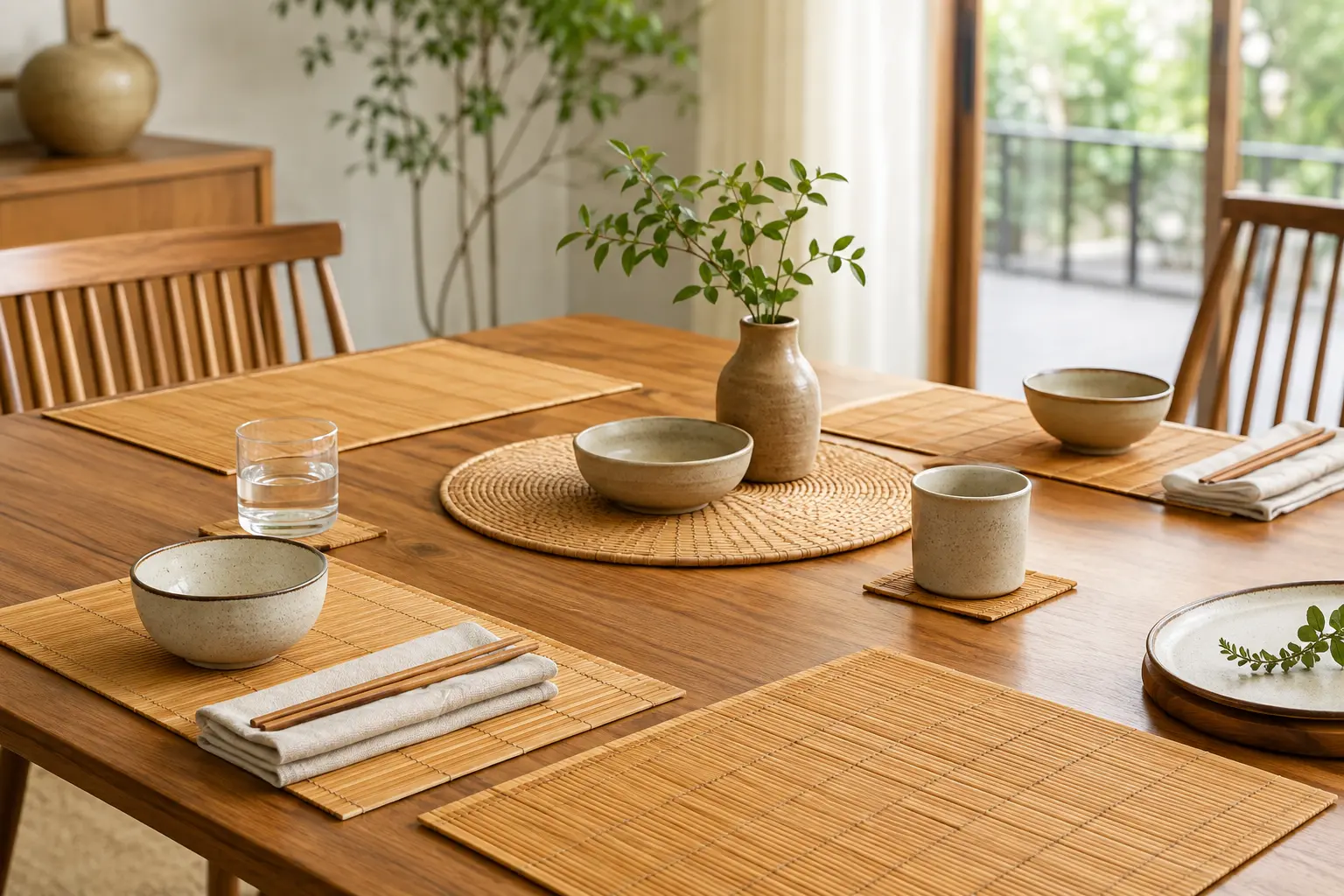
Bamboo placemats bring natural texture, structure and practical table protection to everyday dining. Yet products sold under names such as bamboo place mats, bamboo table mats and bamboo dining mats can differ greatly in material, construction, size and finish. Some are woven from narrow strips, some use parallel bamboo slats, and others are assembled from sticks, beads or small tiles. Choosing well means looking beyond a natural color and matching the construction to the table, dishes, cleaning routine and intended market.
This guide explains the main styles of bamboo placemats for dining tables, how to select shapes and sizes, how colors influence table decoration, and what importers should specify when ordering wholesale bamboo placemats. It also separates genuine bamboo constructions from bamboo-look prints and clarifies common shopping phrases without forcing every search variation into the same product description.
What is a bamboo placemat?
A bamboo placemat is a table covering made wholly or partly from processed bamboo. A typical mat uses thin slats or round sticks connected with thread, while a woven bamboo placemat may combine narrow bamboo strips in a flexible pattern. A bamboo tile placemat uses multiple shaped pieces connected to a backing or cord. Products described as a placemat of bamboo wood or bamboo wooden placemat often refer to these solid bamboo components, even though bamboo is botanically a grass rather than wood.
Not every bamboo print placemat contains bamboo. A printed textile or polymer mat may simply show a bamboo-leaf pattern. Likewise, the phrase placemat bamboo leaf may describe either the decoration or a leaf-shaped outline. Product pages should state the actual material composition rather than relying on appearance.
Common bamboo placemat constructions
| Construction | Typical characteristics | Points to check |
|---|---|---|
| Bamboo slat placemats | Flat parallel strips create a clean, architectural look | Edge smoothness, strip alignment, backing and flexibility |
| Bamboo stick placemats | Rounded or narrow pieces create visible linear texture | Diameter consistency, secure threading and rolling behavior |
| Woven bamboo placemats | Flexible surface with softer visual texture | Weave density, loose ends, edge finishing and stain resistance |
| Bamboo beaded placemat | Small shaped pieces linked into a decorative grid | Joint strength, gaps, weight and tabletop contact points |
| Bamboo tile placemats | Rectangular or geometric pieces form a mosaic surface | Uniform thickness, backing, edge comfort and flatness |
| Solid bamboo placemats | Rigid panels or larger laminated components | Warping control, adhesive system, thickness and storage space |
Many roll-up bamboo placemats use sticks or slats linked with cotton or synthetic thread. They store compactly and are easy to pack, but buyers should test whether the edges lift after repeated rolling. A rigid solid-bamboo design may sit very flat, yet it takes more storage space and needs careful moisture control.
Choosing the right shape for a dining table
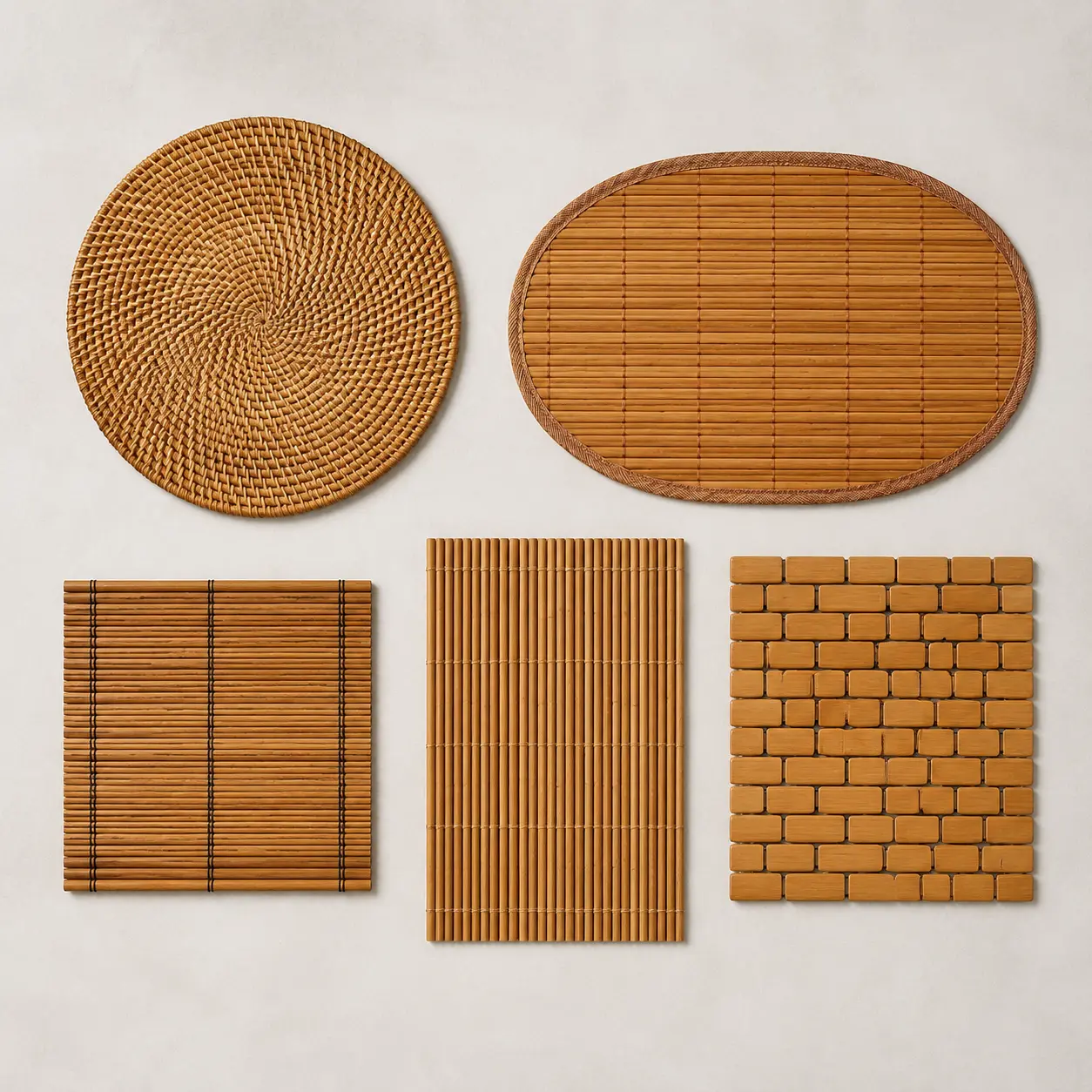
Shape affects both appearance and usable space. The best choice follows the plate diameter, cutlery position, table width and number of settings rather than a trend alone.
Rectangular and square bamboo placemats
Rectangle bamboo placemats and bamboo placemats rectangular in format are the most familiar option for a standard place setting. They provide space for a plate, fork, knife and glass while visually organizing each seat. Square bamboo placemats suit compact settings, café tables and contemporary plate arrangements, but dimensions should be checked carefully so neighboring mats do not overlap.
Round, oval and wedge shapes
Round bamboo placemats complement round plates and soften a table with many straight lines. Round bamboo table mats are also useful beneath a centerpiece or serving bowl, although a centerpiece mat should not be confused with an individual place setting. Bamboo round placemats need sufficient diameter to keep the plate from covering the entire design.
Oval bamboo placemats provide a softer outline while preserving more horizontal room for cutlery. Bamboo wedge placemats are designed for circular tables: the narrower inner edge faces the center, helping several settings fit around the circumference. Buyers should confirm the table diameter and intended seat count before approving a wedge angle.
Large bamboo placemats
Large bamboo placemats work for oversized dinnerware, layered chargers or generous restaurant settings. Bigger is not automatically better: on a narrow table, large mats may collide or leave little room for shared dishes. A useful specification lists finished length, width, thickness and dimensional tolerance, plus the maximum plate size the mat is designed to support.
Bamboo placemat set sizes: four, six or custom counts
A bamboo placemat set should reflect how customers actually dine. A bamboo placemat set of 4 is practical for small households and compact retail packaging. Bamboo placemats set of 6 address larger dining tables and gift-oriented assortments. A bamboo table mats set of 6 may also include matching coasters, but the product listing must make the contents explicit.
For bamboo placemats and coasters, match construction, color and edge treatment across the set. Coasters need a stable base and dimensions suitable for common cups and glasses. A small bamboo tea cup mat square can be sold as a coordinated accessory, but it should not be pictured in a way that makes customers mistake it for a full placemat.
Natural and colored bamboo placemats
Natural bamboo placemats highlight grain and warm golden tones. Variation is part of the material, but factories and buyers should define the acceptable range so natural variation is not confused with water stains, scorch marks, mold or uneven coating.
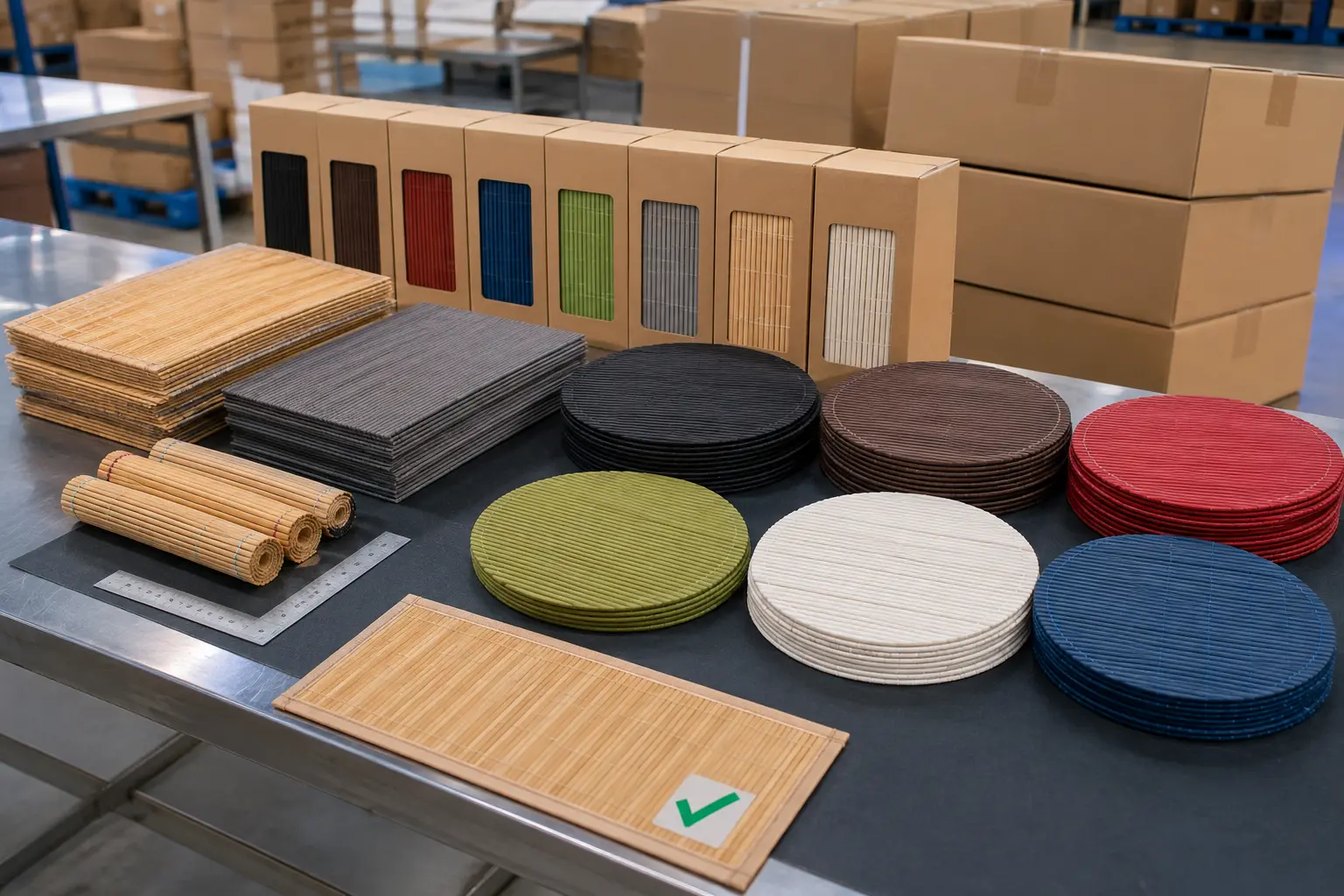
Colored products extend the category beyond a neutral table. Black bamboo placemats and dark bamboo placemats create contrast with white dinnerware. Brown and dark brown bamboo placemats suit warm wood interiors. White, grey and blue bamboo placemats can support coastal or minimalist collections, while red, cranberry, green and multi-colored bamboo placemats work for seasonal and event programs.
Color requires a complete finish specification. State whether the finish is a stain, paint, pigment, print or surface coating; define the target color reference; identify food-contact and restricted-substance requirements; and approve a physical sample. Search phrases such as bamboo placemats cranberry or large bamboo placemats cranberry describe a color family, not a standardized shade. Screen images alone are not adequate for color approval.
Decorating with bamboo table mats and runners
Decorative bamboo placemats can add rhythm and material contrast without making the table feel crowded. A simple natural mat works well with ceramic dinnerware and linen napkins. Dark mats can frame pale plates, while colored designs can connect a table setting to seasonal flowers or textiles.
When combining a bamboo table runner and placemats, keep enough separation between the runner and each place setting. Bamboo table mats with a runner should share either color, construction or edge detail, but they do not need to be identical. If both layers are highly textured, plates and glasses must still stand securely.
Bamboo placemats for table decoration may also be used beneath vases, serving bowls or tea sets. Those uses involve different dimensions and loads from dining settings. Product photography should show the intended purpose and avoid placing very hot cookware on a mat unless the construction has been validated for that temperature.
Kitchen, dining and outdoor use
Bamboo kitchen placemats often face spills, oil and frequent handling, so easy wiping and fast drying matter. A bamboo plate mat or bamboo food mat should be large enough to catch ordinary crumbs while remaining easy to lift and clean. The term bamboo dish mat can be ambiguous: it may mean a placemat under dinnerware or a drying mat beside a sink. Sellers should specify which function the product supports.
An outdoor bamboo placemat should be treated as a portable table accessory, not permanent outdoor furniture. Prolonged rain, strong sun and damp storage can change color, weaken thread or encourage distortion. Bring the mats indoors after use, remove food residue and dry them before stacking or rolling.
How to clean bamboo table mats
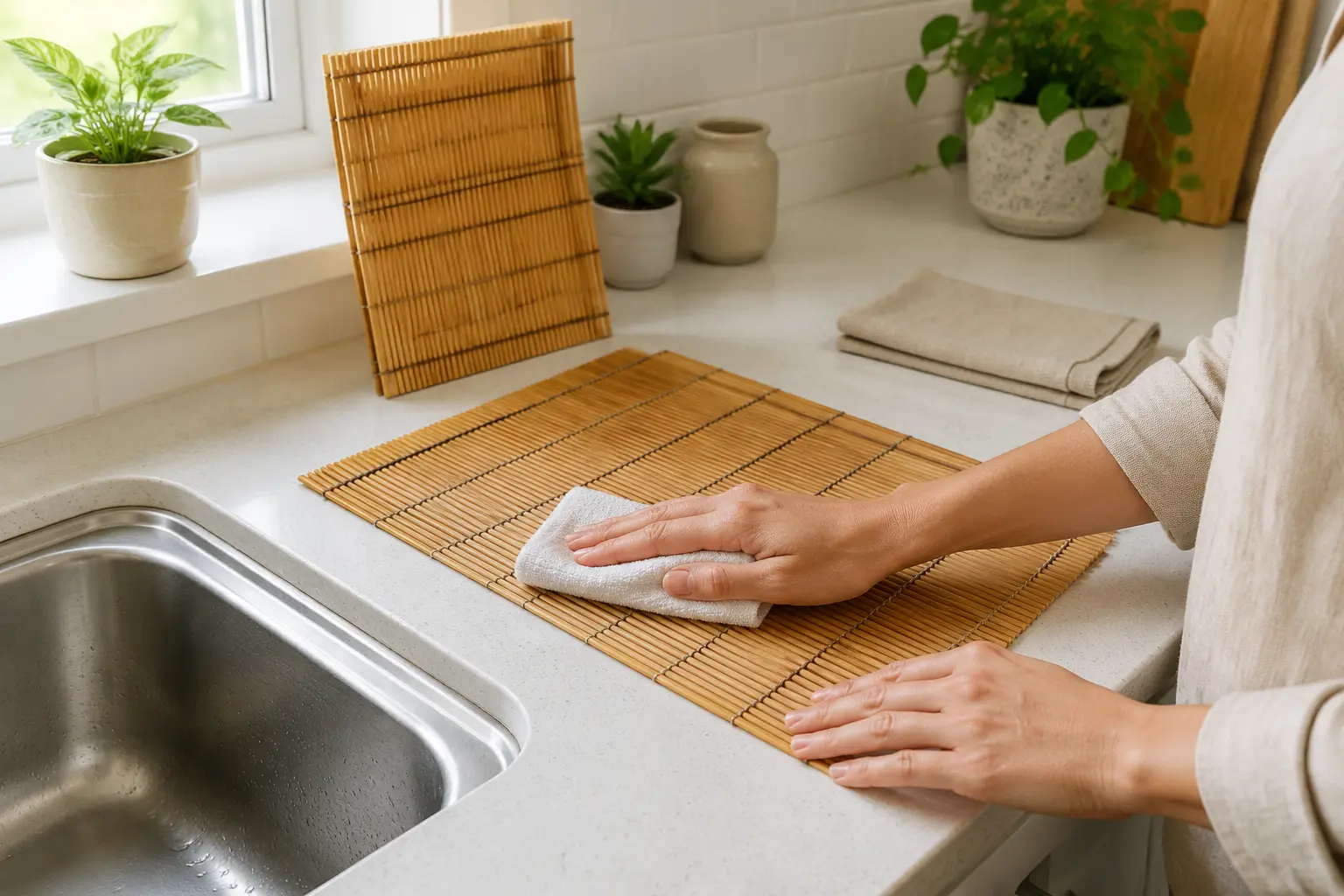
Care instructions must match the exact construction and finish. For most slat, stick and tile designs, remove crumbs, wipe with a soft damp cloth and a mild cleaning solution appropriate for the finish, then wipe away residue and allow the mat to dry fully. Clean both sides because moisture and food can collect between components or against the tabletop.
- Do not leave bamboo table mats soaking unless the manufacturer explicitly allows it.
- Do not assume dishwasher or washing-machine compatibility.
- Avoid folding a design intended only to roll.
- Dry flat or in the supplier-recommended position with air reaching both sides.
- Store only when completely dry and keep away from persistent humidity.
Replace a mat if it develops persistent mold, broken sticks, sharp splinters, loose pieces or a failing coating that cannot be restored safely. A dedicated article in this series will cover cleaning, drying and storage in greater detail.
What does “cheap bamboo placemats” really mean?
Customers searching for cheap bamboo placemats are usually comparing price, but the lowest unit cost can hide differences in dimensions, strip thickness, finishing, thread strength, coating, packaging and inspection. “Affordable” is more useful when connected to a clear specification. A simple natural roll-up design may reduce cost through efficient materials and compact packing; a colored tile mat with complex edging will require more processing.
Retail searches such as buy bamboo placemats, bamboo table mats online India, bamboo table mats UK or bamboo placemats Bed Bath & Beyond express regional or retailer-specific shopping intent. They should not be treated as proof of availability or affiliation. Buyers should compare actual material, size, set count, care instructions and seller information in their own market.
Wholesale bamboo placemats: what buyers should specify
For wholesale bamboo placemats or bulk bamboo placemats, a useful RFQ goes beyond a reference photo. It should state:
- Construction: woven, slat, stick, beaded, tile or solid panel
- Finished shape and dimensions with tolerances
- Bamboo component size, thickness and surface finish
- Thread, backing, adhesive, coating, stain and printing materials
- Natural color range or target custom color
- Set count, coaster inclusion and packaging format
- Logo method, position, artwork and acceptable variation
- Destination market and required supporting documents
- Workmanship criteria, inspection plan and carton requirements
A buyer evaluating bamboo placemats bulk should request an approved sample and define critical, major and minor defects. Serious concerns may include contamination, mold, sharp splinters or detached components. Commercial defects may include incorrect dimensions, missing pieces, unstable color, poor print placement or mismatched set contents. Natural grain differences should be separated from true defects.
Packaging and shipping considerations
Roll-up bamboo placemats can reduce package volume, but the roll diameter and securing method should not create permanent curl. Flat-packed products need protection from bent corners and abrasion. Moisture control, carton strength, barcode placement, drop testing and pack-out order should be reviewed for the actual shipping route.
A bamboo placemats set of 4 may suit a compact retail carton, while six-piece sets need stronger handling controls because of added weight. Window boxes can display color and texture, but exposed surfaces require protection from dust and rubbing.
OEM and custom bamboo placemat development
OEM/ODM programs can coordinate shape, dimensions, color, weaving pattern, edge binding, logo, coaster set and packaging. Development should begin with the target table, dishes, retail channel and price level. A factory can then recommend feasible strip sizes, connection methods and packing formats instead of simply copying a photograph.
Fujian Xianxu Bamboo & Wood Co., Ltd. supports custom bamboo and wooden product development through manufacturing operations in China and Vietnam. Founded in 2018, the company serves wholesalers, retailers, importers and brand owners in more than 40 countries and regions. Buyers can learn more about the company, review its Vietnam factory operations, explore related bamboo kitchenware, or send a product brief for OEM/ODM evaluation.
Frequently asked questions
Are bamboo placemats heatproof?
Do not assume they are heatproof. Heat resistance depends on bamboo thickness, backing, thread, adhesive and finish. Use trivets for hot cookware unless the specific mat has validated temperature guidance.
Can bamboo placemats be washed in water?
Many designs are intended for wiping rather than soaking. Follow the instructions for the exact product, clean both sides and dry completely before storage.
Which shape is best for a round table?
Round, oval and wedge mats can work well. The correct choice depends on table diameter, seat count, plate size and the space required between settings.
What is the difference between woven and slat bamboo placemats?
Woven mats use interlaced narrow material and tend to be flexible. Slat mats use parallel flat strips connected by thread or backing and create a more linear surface.
Should I choose a set of four or six?
Choose the count that matches the household or dining table. Wholesale buyers should also consider retail price, package dimensions and whether matching coasters are included.
Can bamboo placemats be customized?
Yes, subject to construction and material feasibility. Common options include dimensions, shape, stain or color, weaving detail, edge finish, logo, set composition and packaging.
Choose by construction, use and verifiable specification
The best bamboo table placemats are not defined by a single shape or color. They combine a suitable construction, comfortable dimensions, stable tabletop performance, practical care and accurate material claims. Consumers should select a design that fits their table and cleaning habits. Professional buyers should translate those same needs into samples, specifications and inspection criteria.
Whether the project calls for natural rectangular mats, round woven settings, colored seasonal collections or custom wholesale sets, a clear specification creates a better product than a long list of loosely related keywords. Continue with How to Make Bamboo Placemats for manufacturing methods and How to Clean Bamboo Placemats for detailed care, drying and storage procedures.