
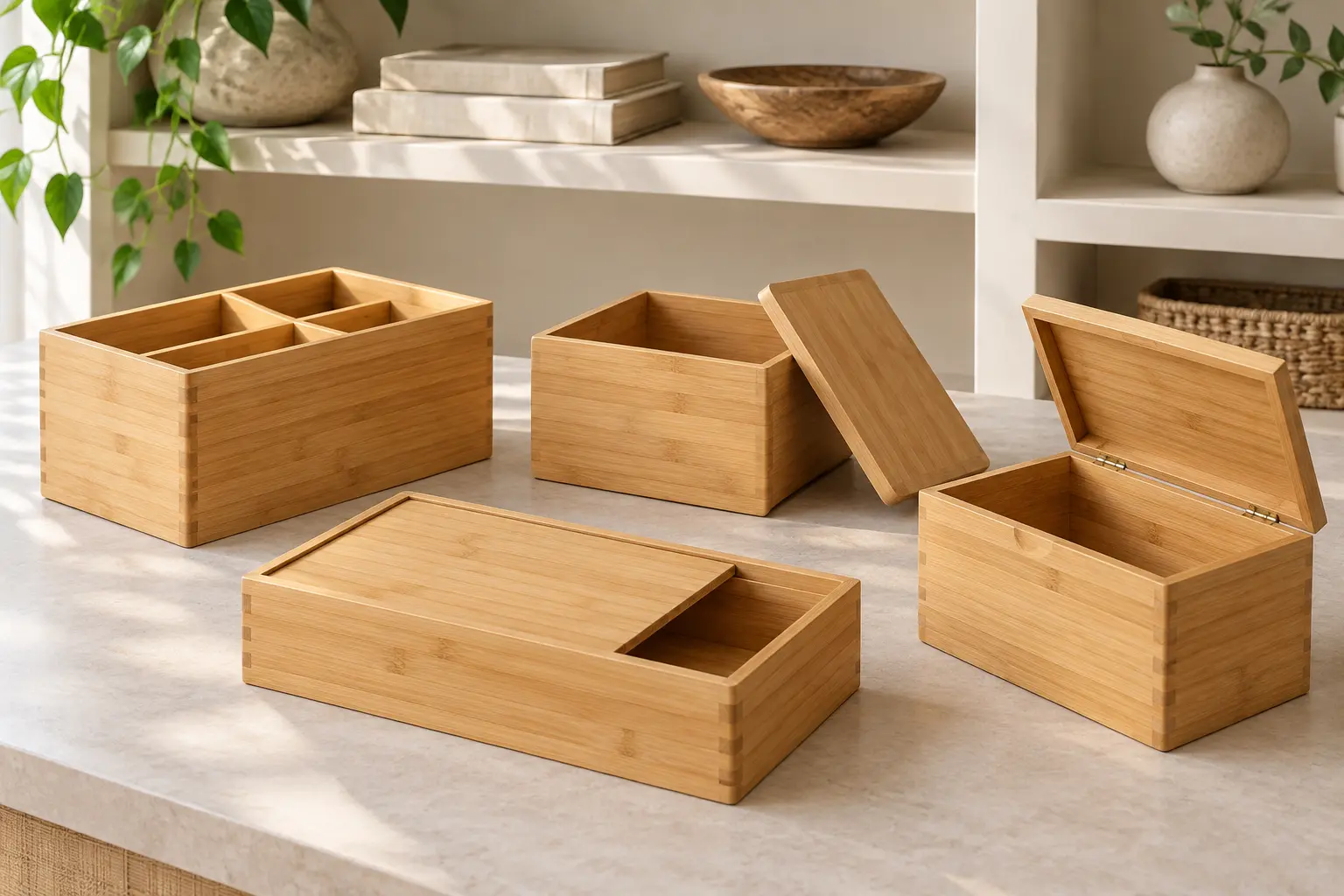
A well-chosen bamboo storage box does more than hide clutter. Its dimensions determine whether it actually fits a shelf, its lid changes how quickly the contents can be reached, and its construction affects where it can be used. Search results for bamboo boxes often mix solid organizers, woven bins, lidded keepsake cases, cube baskets and plastic boxes with bamboo tops. They may look related, but they solve different storage problems.
This guide explains the main types of bamboo boxes for storage, how to read their dimensions, and when to choose an open box, removable lid, sliding lid or hinged lid. It focuses on household and office organization rather than food containers. Use it to plan a single organizer, a coordinated bamboo storage box set, or a modular system for shelves and drawers.
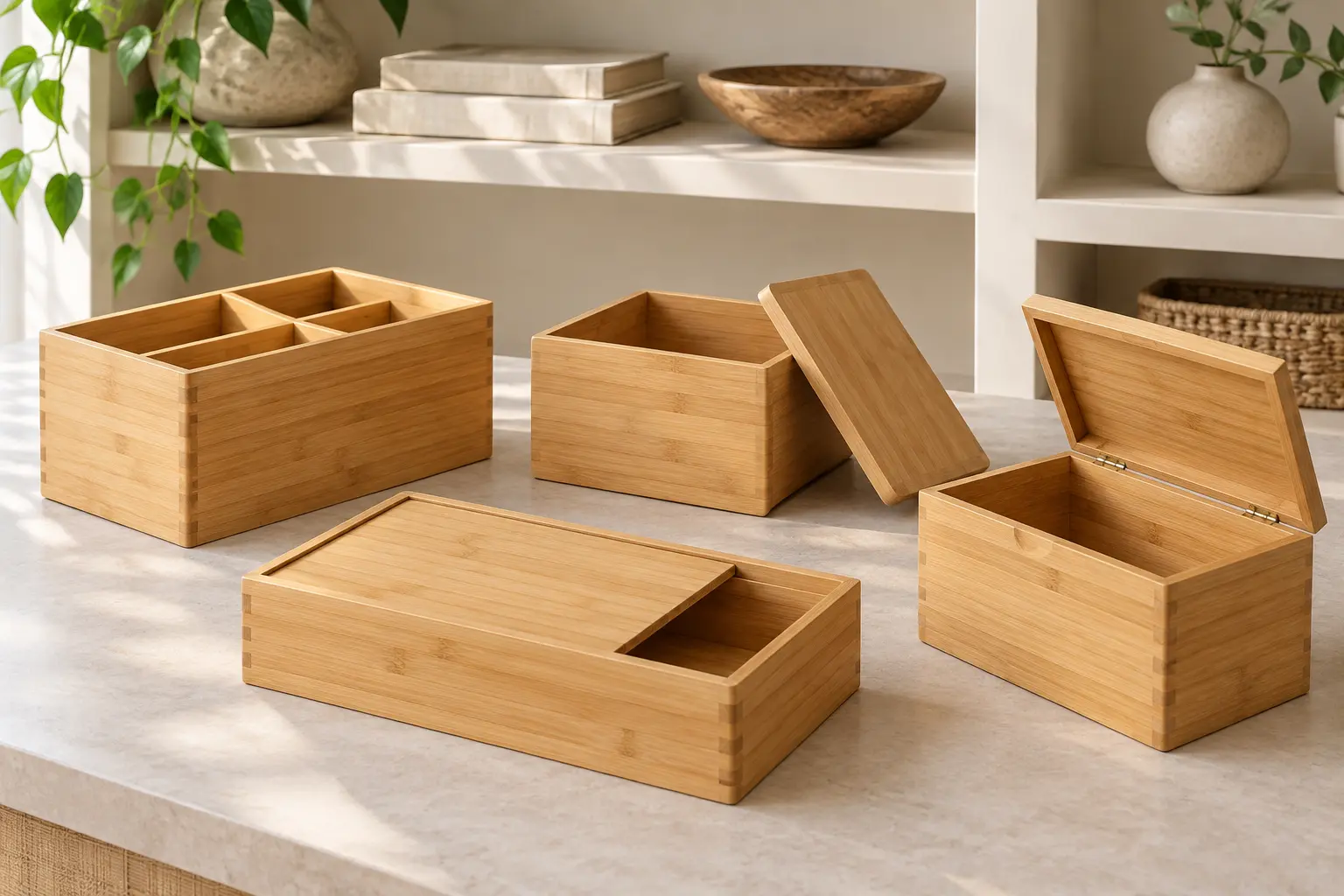
What Counts as a Bamboo Storage Box?
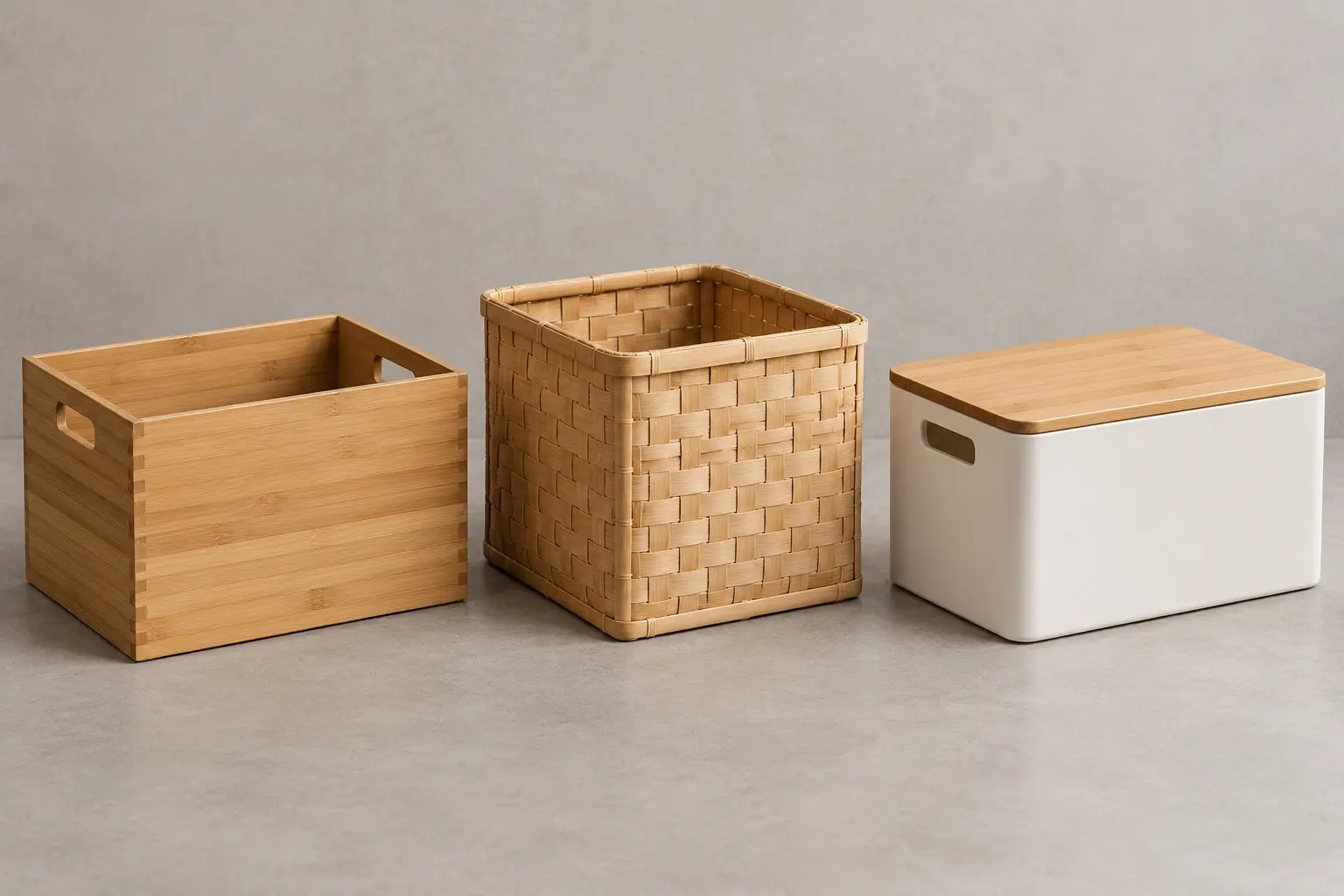
The phrase bamboo box is broader than it first appears. Some products use laminated bamboo panels for the walls and lid. Others use woven bamboo strips around a supporting frame. A third group combines a plastic, metal or engineered-wood body with a bamboo veneer or bamboo lid. Read the material breakdown instead of assuming that every item described as bamboo is made entirely from solid bamboo.
Construction also changes the character of the product. Panel-built boxes generally provide straight sides and a firm base, useful for desktop accessories, keepsakes and compartmented storage. Woven boxes feel lighter and more visually textured, making them suitable for soft items, magazines or open shelving. A mixed-material storage box with bamboo lid offers a different look and should not be confused with a bamboo wood storage box.
The most useful product description therefore answers four questions: Which parts are bamboo? What are the internal dimensions? How does the lid or opening work? Is the box designed to be stacked? Those details are more meaningful than a generic phrase such as “natural organizer.”
Common Types of Bamboo Boxes for Storage
Open bamboo organizer boxes
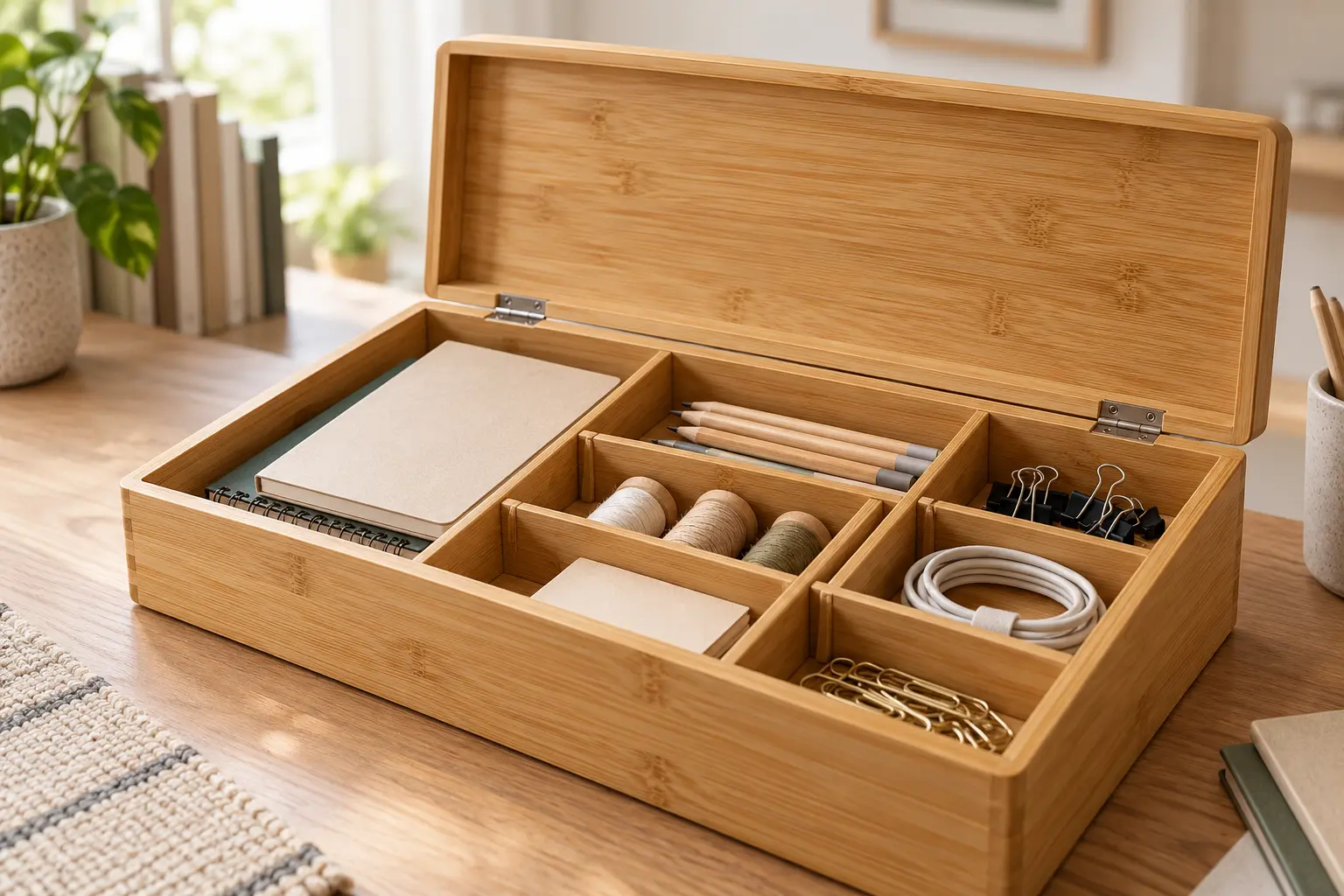
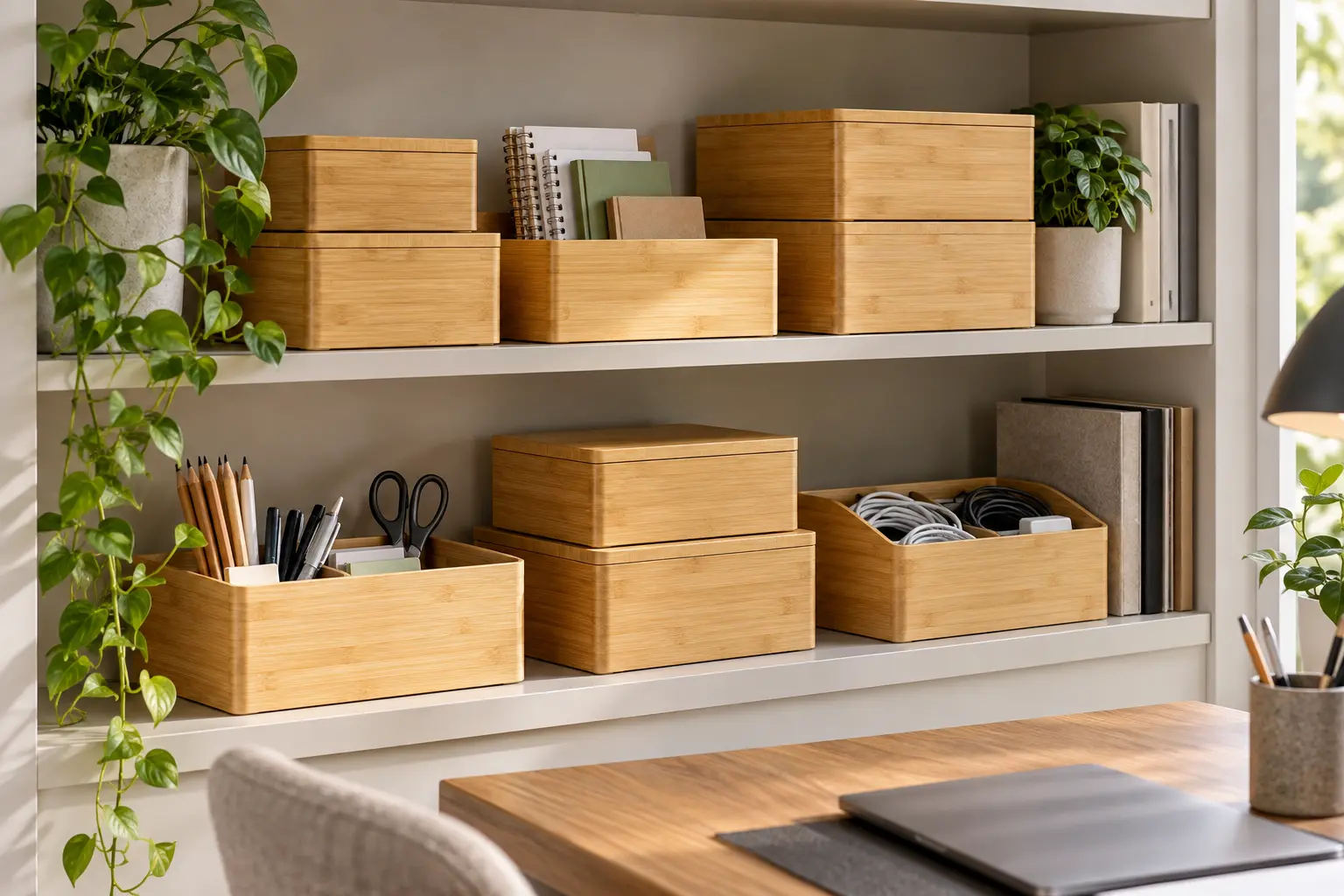
An open bamboo organizer box keeps frequently used items visible and reachable. Shallow versions work well for stationery, cables, remote controls and grooming accessories. Taller versions can group notebooks, bottles or folded textiles. Some bamboo organizer boxes include fixed or removable dividers; removable dividers provide more flexibility when the stored objects change.
Bamboo boxes with lids
Bamboo boxes with lids reduce visual clutter and help keep dust off occasional-use items. A lift-off lid is simple and clean-looking, but the box above it must be moved before opening if several units are stacked. A sliding lid needs clearance at one end. A bamboo box with hinged lid keeps the lid attached and is convenient for a memory box, craft case or presentation box, provided there is enough space above and behind it to open fully.
Stackable and cube storage
Stackable bamboo storage boxes use vertical space, but “stackable” should describe a real locating feature—not merely two flat surfaces. Look for a recessed base, rim, groove or tested nesting relationship that helps the upper box stay aligned. Bamboo cube storage boxes are intended for square cubbies, so both the opening and the usable depth of the furniture must be measured. Handles and lid overhangs can add width beyond the main body.
Nested sets and specialty boxes
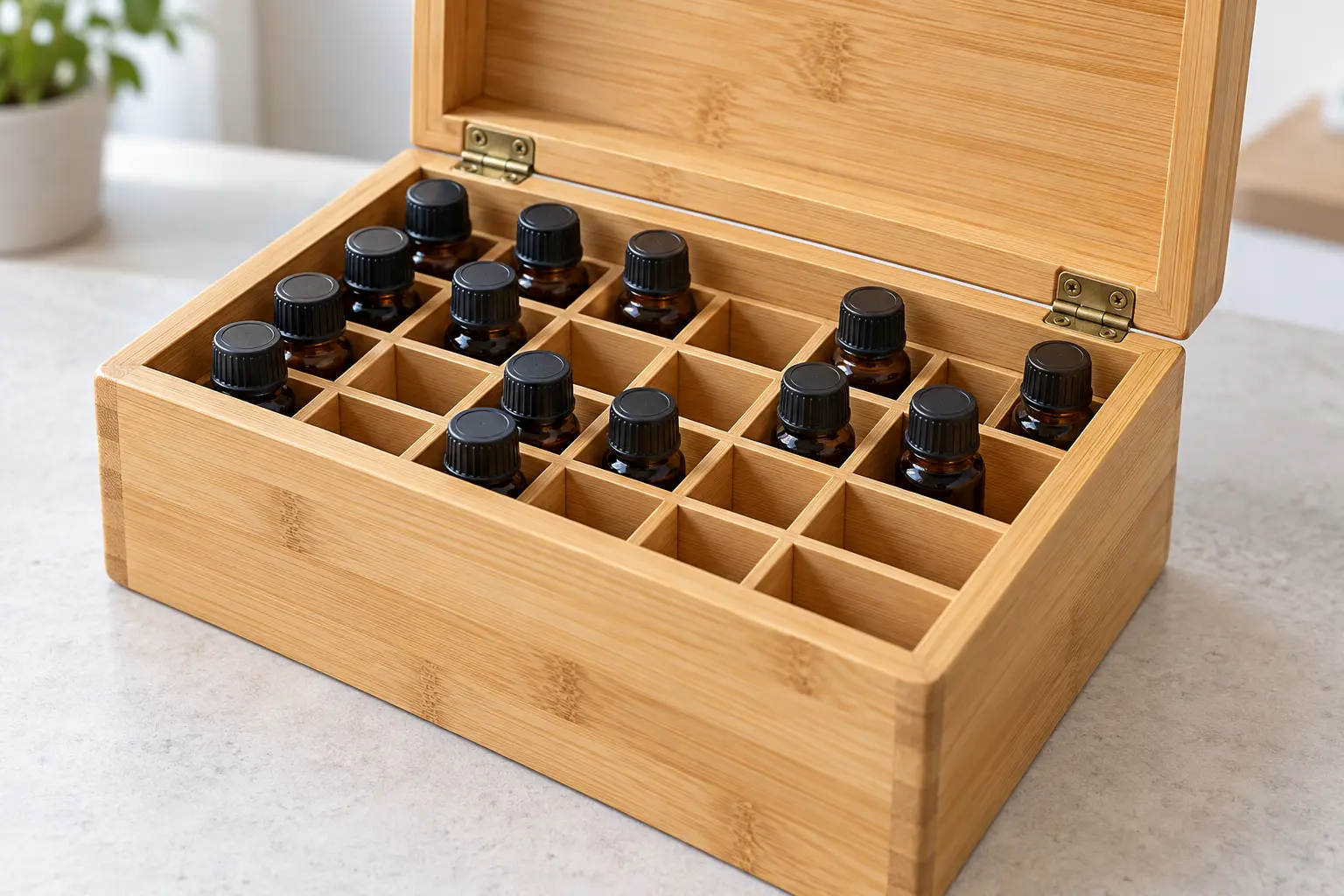
A bamboo storage box set may contain different footprints for different categories, or several boxes with a shared footprint that stack together. Nested sets save space before use; modular sets create a more consistent shelf layout. Specialty designs include a bamboo essential oil storage box with individual bottle positions, a tea or sachet organizer, a jewelry box, and a cable-management box. Each requires a different internal layout, so the intended object should guide the design.
How Lid Style Changes Everyday Use
| Lid or opening | Best for | Check before choosing |
|---|---|---|
| Open top | Daily-use objects and quick sorting | Contents remain visible and exposed to dust |
| Lift-off lid | Keepsakes, spare accessories and clean shelf displays | The lid needs a place to rest while the box is open |
| Hinged lid | Memory boxes, craft supplies and compartment cases | Allow rear and overhead opening clearance |
| Sliding lid | Low-profile boxes and presentation storage | Allow side clearance and inspect the track fit |
| Drop-on bamboo top over another material | Coordinated mixed-material storage | Confirm body material and whether the lid locks the boxes together |
A bamboo lidded box is not automatically sealed, lockable or moisture-resistant. Those are separate performance features that require their own design details and testing. For general room organization, a well-fitted lid may be sufficient. For delicate, valuable or hazardous contents, choose a product specifically designed for that purpose rather than relying on the material name.
Choosing the Right Bamboo Container Size
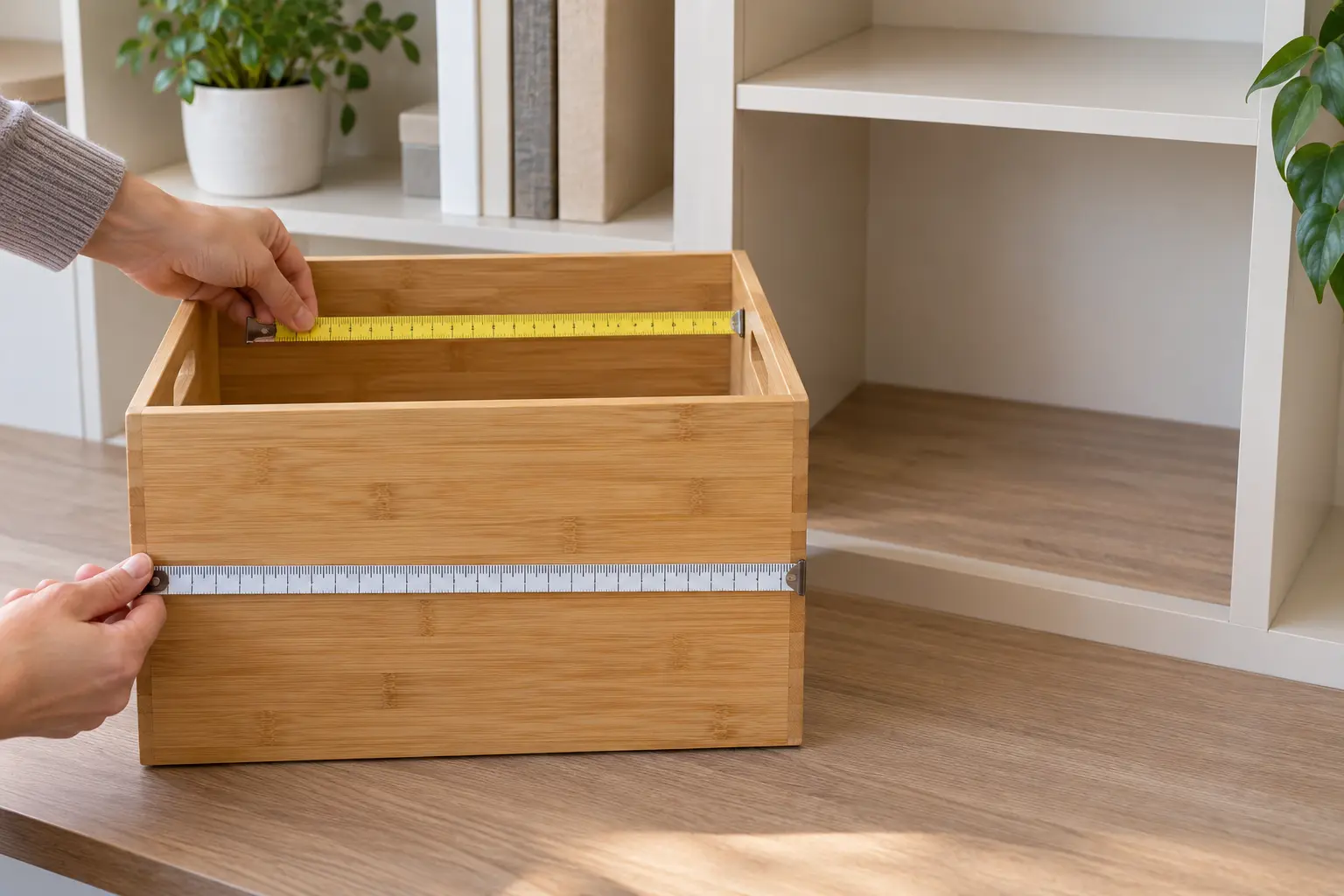
Start with the available space, then check the object being stored. Measure shelf width, usable depth and vertical clearance at the narrowest points. Hinges, cabinet frames and shelf supports can reduce the opening even when the interior is wider. For a drawer, measure below any overhanging frame and leave enough clearance to lift the organizer out.
Next, distinguish external from internal dimensions. Product listings normally lead with outside length × width × height, while the usable interior is smaller because of wall thickness, the base, lid hardware and dividers. A box that is exactly as wide as the target object may not fit it. Ask for internal dimensions when the fit matters.
A query such as “bamboo storage 15 x 5” is incomplete until three things are known: the unit, the dimension order and whether a third measurement is missing. Fifteen by five inches describes a very different product from 15 by 5 centimeters. It might refer to length and width, diameter and height, or a shelf opening rather than the box itself. Treat it as a starting point, not a purchase specification.
- Write the maximum external footprint the shelf or drawer can accept.
- Measure the largest item or grouped category that will go inside.
- Add hand clearance if objects must be lifted out from above.
- Add operating clearance for a hinged, sliding or removable lid.
- Confirm whether handles, feet or lid lips are included in the listed size.
- For a stack, calculate the total assembled height rather than multiplying body height blindly; lids, feet and nesting features may change it.
A small bamboo storage box is usually best for one tightly defined category. A large bamboo storage box can hold more, but it becomes less useful when small objects disappear at the bottom. Large boxes work better with trays, dividers or smaller modules inside. For a large bamboo storage box with lid, also consider the filled weight and how the box will be lifted.
Shape: Rectangular, Square or Round?
Rectangular boxes generally use shelf space efficiently and align easily in rows. Square boxes suit cube furniture and balanced compartment layouts. A round bamboo box with lid can be attractive on a dresser or open shelf and works well for small loose accessories, but multiple round boxes leave gaps when placed side by side. Choose round for display and access; choose straight-sided formats when density and modular planning matter more.
The same principle applies at smaller scales. A small bamboo box with lid can isolate a specific category such as spare keys, sewing notions or watch straps. Several matching small boxes may create a cleaner system than one oversized container, especially if each unit is labeled on the side that remains visible.
Organization Ideas for Every Room
Entryway
Use a shallow open box for items that enter and leave the home every day, such as keys, sunglasses and transit cards. A second lidded box can hold less frequently used accessories. Keep the categories narrow so the organizer does not become another unsorted catch-all.
Home office
Group cables by device type and secure each one before placing it in a box. Use dividers for adapters, memory cards and small tools. A shallow bamboo storage box can fit beneath a monitor stand, while a taller organizer can separate notebooks and envelopes. Avoid packing chargers that are in use inside a closed box unless the product is specifically designed for powered cable management.
Bedroom and wardrobe
Shallow bamboo storage boxes are useful for belts, scarves, jewelry pouches and seasonal accessories. Place daily items in open or easy-slide formats and archival items in covered boxes. If boxes are stored above eye level, use side labels because top labels will be difficult to read.
Bathroom and dressing area
Small organizer boxes can separate dry toiletries, hair accessories and unopened supplies. Keep bamboo away from standing water and wipe splashes promptly. Under a sink, inspect for leaks before using any bamboo organizer and do not place it directly against a wet surface. A removable liner or raised feet can simplify cleaning, but suitability still depends on the product’s actual finish and construction.
Living room and hobby space
Bamboo box storage systems can group remote controls, game accessories, craft tools, photos and charging cables without making open shelves look busy. Use one box per activity rather than one box per object. A project box makes it easier to carry all related items to a table and return them together afterward.
How to Build a System That Stays Organized
Buying more containers does not automatically create order. First remove broken, expired or unused items. Then group what remains by how and where it is used. Select box sizes only after the categories are visible. This sequence prevents a common mistake: choosing beautiful boxes first and forcing unrelated objects into them later.
- Keep frequently used items accessible. Place them in open boxes or on the front row.
- Use lids selectively. Covered storage is useful for dust control and visual calm, while open storage is faster for daily routines.
- Leave some spare capacity. A completely full organizer is difficult to use and cannot absorb new items.
- Label by category. Use removable labels if the system may change.
- Standardize footprints. A small family of compatible sizes is easier to rearrange than many unrelated shapes.
- Review the system. If items repeatedly end up beside a box instead of inside it, the opening, position or category is probably wrong.
Quality Details to Check Before Choosing
- Material description: Identify solid laminated bamboo, veneer, woven bamboo and any non-bamboo components.
- Joint quality: Corners should meet evenly without obvious gaps, sharp edges or protruding fasteners.
- Base support: The bottom should suit the expected contents without visible bowing.
- Lid alignment: Hinged lids should open smoothly; sliding lids should travel without binding; removable lids should sit evenly.
- Usable dimensions: Ask for internal measurements and divider spacing, not only the overall size.
- Stacking interface: Confirm how boxes locate and whether the intended stack has been evaluated for stability.
- Surface finish: The coating should match the intended environment and cleaning method. Request supporting information for any special performance claim.
- Handling: Large formats benefit from comfortable cutouts or handles that do not reduce the usable interior unexpectedly.
Natural variation in grain and color is normal. However, variation should not be used to excuse rough finishing, unstable joints or a lid that does not align. For a matching set, agree on an acceptable appearance range before ordering.
Care for Bamboo Storage Boxes
Follow the care instructions supplied with the specific product, because finishes and mixed materials vary. For routine cleaning, remove loose dust with a soft cloth. If the manufacturer permits damp cleaning, use a lightly damp cloth and dry the surface promptly. Do not soak the box, leave it in standing water or use abrasive cleaners that may damage the finish.
Keep the box in a reasonably stable indoor environment, away from persistent leaks and intense direct heat. Empty it periodically so the base, corners and lid hardware can be inspected. Felt pads can protect a delicate shelf, while a washable liner can help when the contents shed dust or fibers.
Frequently Asked Questions
Are all bamboo storage boxes made from solid bamboo?
No. Products may use laminated bamboo panels, bamboo veneer, woven strips or a bamboo lid combined with another body material. Check the material specification for each component.
Are bamboo boxes with lids always stackable?
No. A flat lid may physically support another empty box without providing safe alignment. Choose a design described and constructed for stacking, and follow any load or height guidance from its supplier.
Should I choose one large bamboo box or several small boxes?
Use a large box for bulky, related items. Use smaller boxes when categories need separation or when objects would become buried. A coordinated set can combine both approaches.
What should an essential oil storage box include?
Check the actual bottle diameter, height and cap clearance, then choose holes or dividers that match. The box should remain upright on a stable surface, and any product-specific storage instructions for the oils still apply.
How do I specify a custom bamboo storage box?
Provide the intended use, target external and internal dimensions, material construction, lid type, divider layout, finish, logo position, packaging needs and reference quantity. A drawing or physical sample reduces ambiguity. Confirm manufacturability and samples before approving production.
Plan the Storage Before Selecting the Box
The best bamboo storage boxes are not simply the largest or the most decorative. They fit the available space, match the access pattern, hold a clearly defined category and remain easy to maintain. Measure first, distinguish internal from external dimensions, and select the lid and construction for the way the box will actually be used.
For a custom storage-box project, contact Fujian Xianxu Bamboo & Wood Co., Ltd. to discuss your drawings, target dimensions, lid structure, compartment layout, finish and packaging requirements. A clear specification and approved sample provide a stronger starting point than a generic product name alone.