
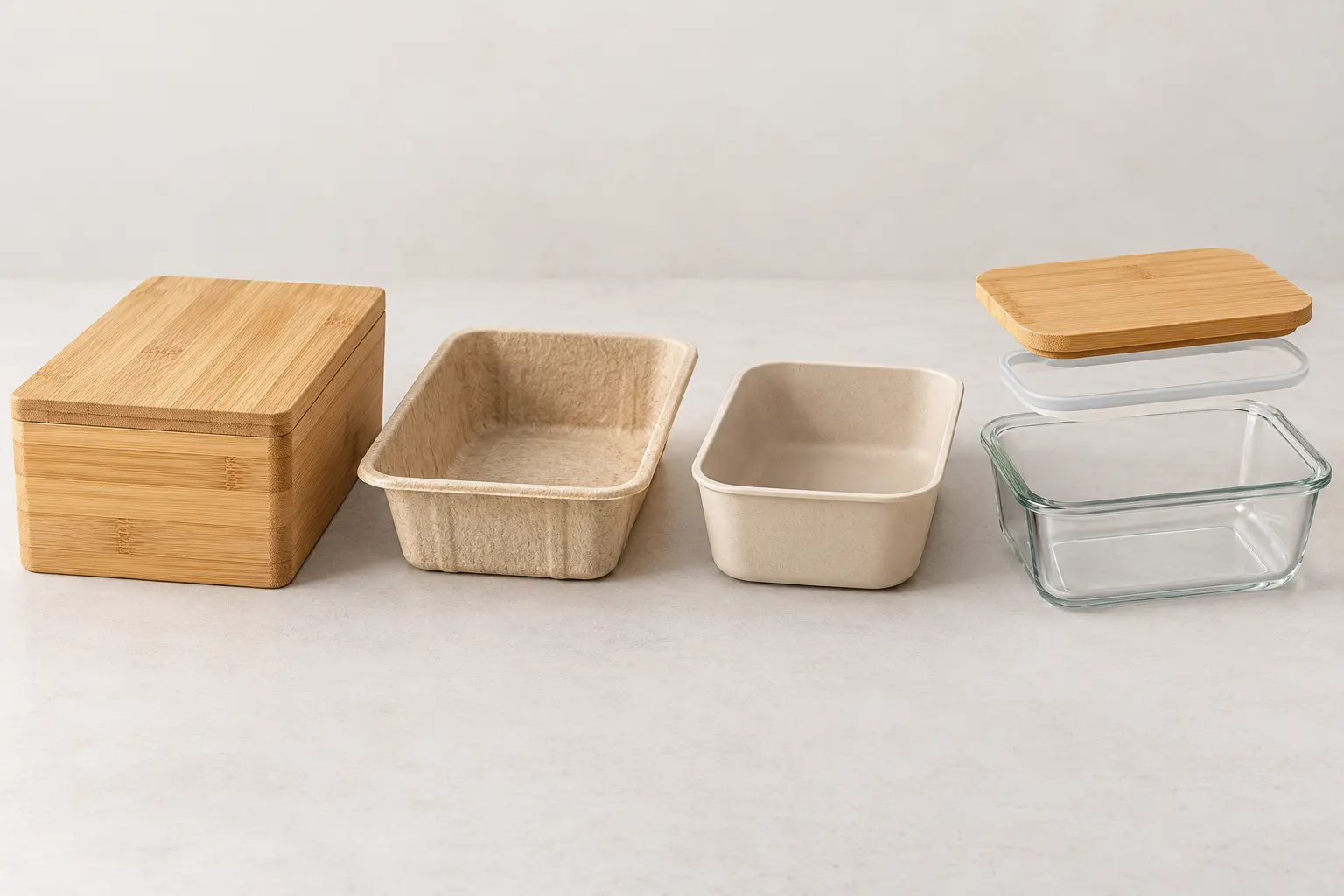
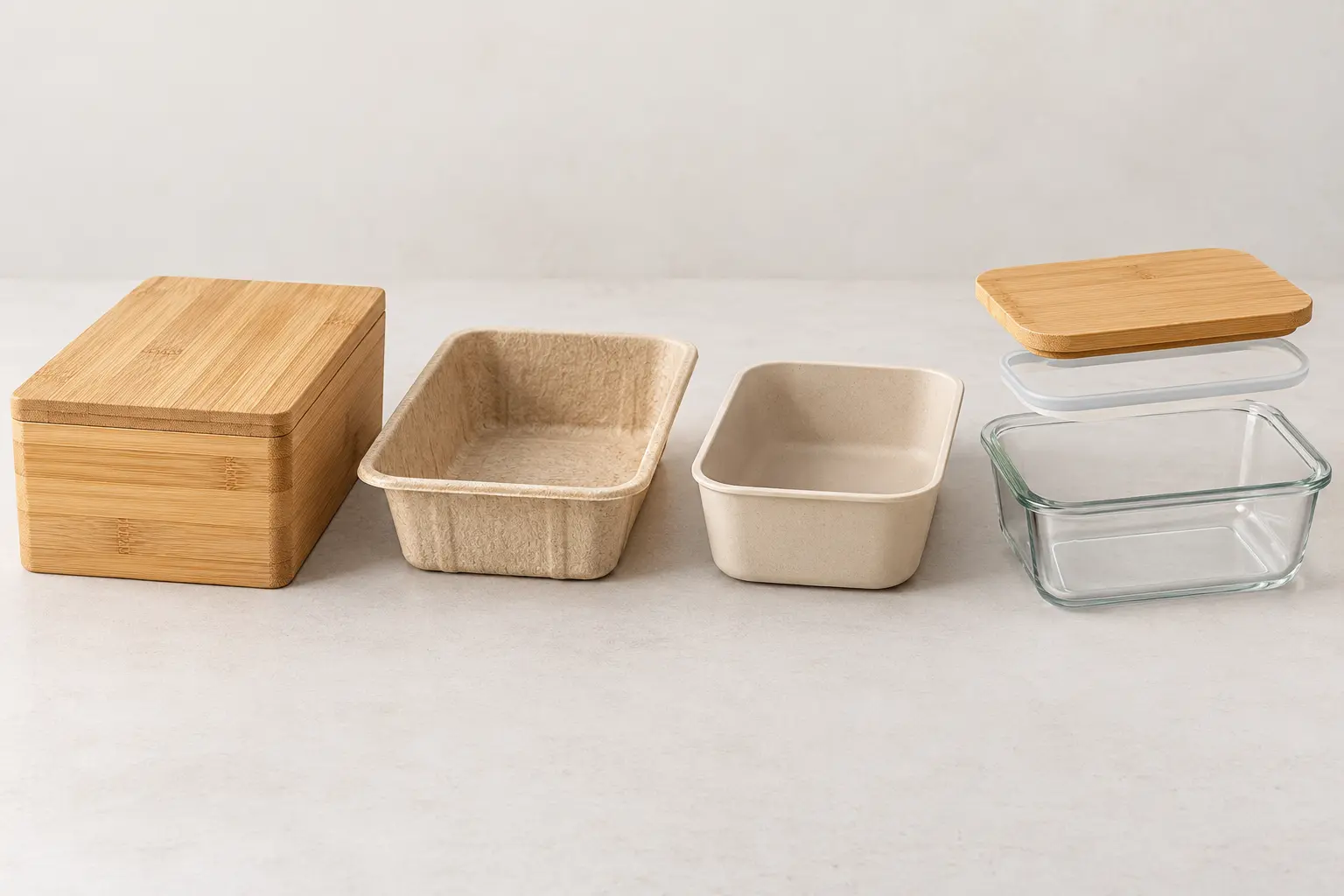
Are bamboo food containers safe? There is no responsible one-word answer, because “bamboo container” describes several fundamentally different products. It may mean a box made from solid or laminated bamboo, a moulded plastic composite containing bamboo fibre, a bamboo-pulp package, or a glass, stainless-steel or plastic vessel fitted with a removable bamboo lid. These constructions do not share the same food-contact status, microwave limits, freezer performance or care instructions.
The safest approach is to identify the complete material structure first, then verify the exact product’s intended food types, temperatures and appliances. A natural-looking surface, an “eco” label or the word bamboo cannot replace a material declaration, compliance documents and product-specific directions.
The Short Answer: Safety Depends on the Whole Product
A food container is suitable only when its complete construction is appropriate for the intended contact conditions. That includes the bamboo, adhesive, coating, resin, gasket, ink and any other component that may contact food. It also includes how the article will be used: dry or moist food, hot or cold contents, short contact or long storage, repeated washing, microwave heating or freezing.
Official rules treat packaging, kitchenware and storage vessels as food-contact materials. The European Commission explains that these articles must not release substances into food at levels that endanger health, change the food’s composition, or alter its taste or smell. In the United States, the FDA regulates substances used in packaging, cookware and containers that store food. Compliance therefore concerns the finished article and its conditions of use—not the reputation of bamboo as a plant.
Four Products Commonly Called “Bamboo Containers”
| Construction | What bamboo does | Main questions to verify |
|---|---|---|
| Solid or laminated bamboo box | Forms all or part of the container body | Food-contact finish, adhesive, intended food, moisture and temperature limits |
| Bamboo-fibre plastic or melamine composite | Ground fibre or powder is added to a moulded resin | Exact formulation, market legality, migration compliance and heat restrictions |
| Bamboo-pulp container | Processed bamboo fibre forms a paper-like package | Barrier coating, single- or repeated-use status, food and temperature conditions |
| Glass, steel or plastic container with bamboo lid | Bamboo is a separate lid or accent | Vessel instructions, lid finish, gasket material and whether the lid must be removed |
1. Solid and laminated bamboo containers
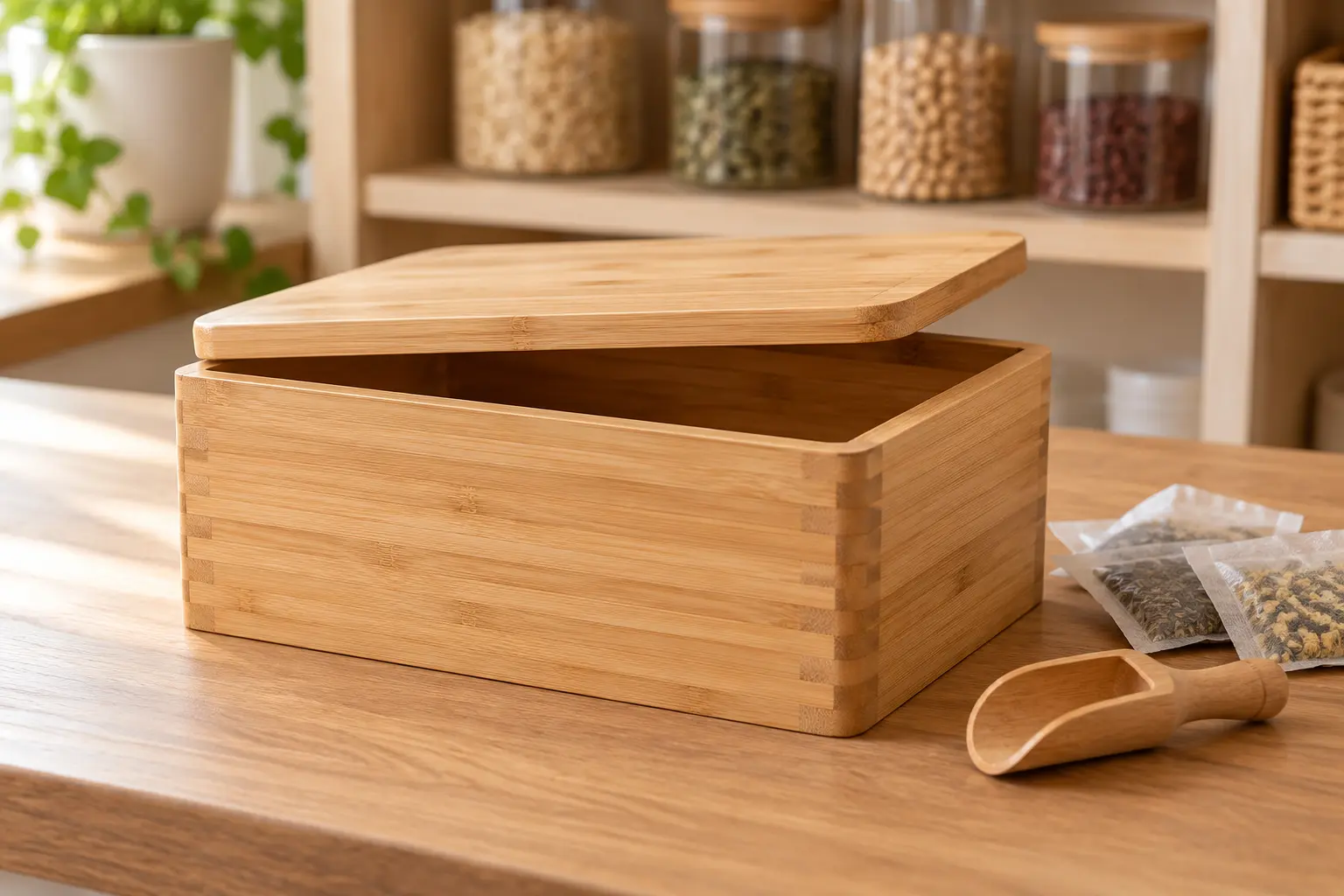
A solid-bamboo or laminated-bamboo box retains visible grain and is normally machined from culm sections, strips or panels. It may work well for dry goods, tea bags, wrapped snacks, utensils or countertop organization when designed and documented for that application. But bamboo is moisture-sensitive, while laminated constructions also contain adhesive. Some products use a coating or liner to create the food-contact surface.
Do not infer that every bamboo food container is suitable for liquids, oily foods, long-term refrigerated storage or reheating. Confirm whether food touches bamboo directly, what finish is applied, which foods were considered, and how the supplier tells users to wash and dry it. A decorative bamboo storage box is not automatically a food container.
2. Bamboo-fibre plastic and melamine composites
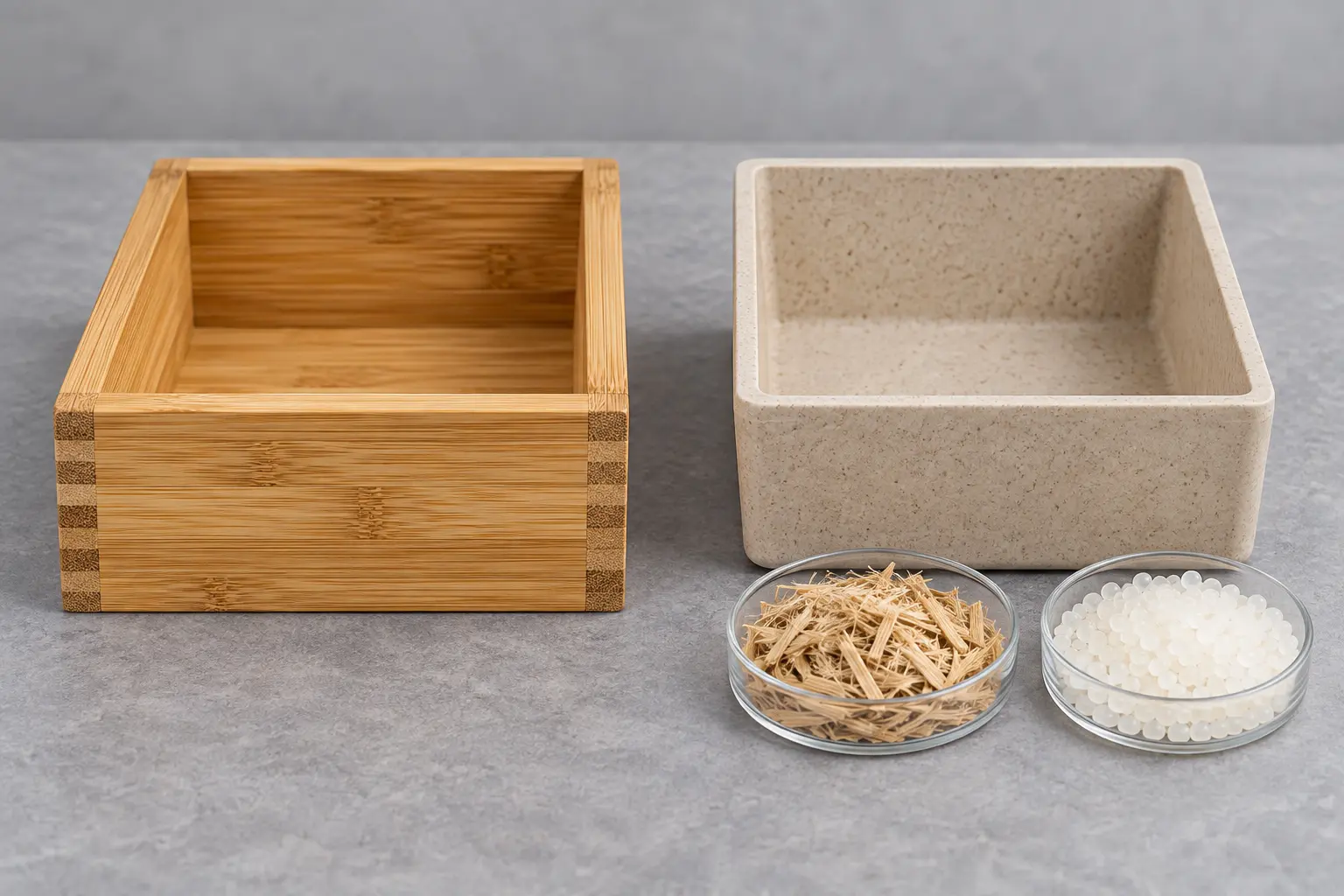
A smooth, colourful moulded item advertised as “bamboo fibre” may be a plastic or melamine-formaldehyde resin filled with ground bamboo. It is not the same material as a box cut from bamboo. This distinction has serious regulatory importance.
The European Commission’s Bamboo-zling enforcement information states that bamboo and similar plant additives are not authorised for use in plastic food-contact materials under the EU plastics rules. The Commission reports that degradation of some articles can increase migration of melamine and formaldehyde into food. Its page distinguishes unauthorised plastic articles containing bamboo additive from items made entirely from bamboo.
For Great Britain, the Food Standards Scotland and Food Standards Agency updated notice advises consumers not to use plastic containers or utensils containing bamboo or other unauthorised plant material for food-related purposes. This advice does not mean that every product containing a solid bamboo component is prohibited. It specifically addresses plastic composites in which plant material is incorporated into the plastic.
Buyers should therefore avoid vague formulations such as “natural bamboo material.” Request a full material declaration and determine whether the article is solid bamboo, a pulp product, or a resin composite. For EU and Great Britain projects, do not treat a test report as permission to market a composition that is not authorised in the first place.
3. Bamboo-pulp food packaging
Bamboo pulp can be formed into trays, bowls, cartons and takeaway packaging. These fibre-based articles are different again from both wooden bamboo boxes and bamboo-filled plastic. Their performance depends on fibre processing, additives and any barrier layer used to resist oil or moisture.
A pulp container must be assessed as a complete package. Ask whether it is intended for hot, cold, wet, oily or acidic food; whether it is single-use or reusable; and what maximum contact time and temperature apply. Claims such as microwave-safe, freezer-safe, home-compostable or plastic-free should be supported for the exact finished article. The presence of bamboo pulp alone proves none of them.
4. Glass, steel or plastic containers with bamboo lids
Many products called bamboo food storage are actually glass, stainless-steel or plastic containers with a bamboo top. This construction can keep the food-holding vessel familiar while using bamboo for the lid’s visible surface. A silicone gasket may provide the seal.
Treat every part separately. A glass base may be approved for a microwave, but its bamboo lid may not be. A stainless-steel lunch box must not go in a microwave even if its lid is removed. A plastic base needs its own microwave and freezer directions. The bamboo top and gasket also need care instructions, especially if moisture can collect around the seal.
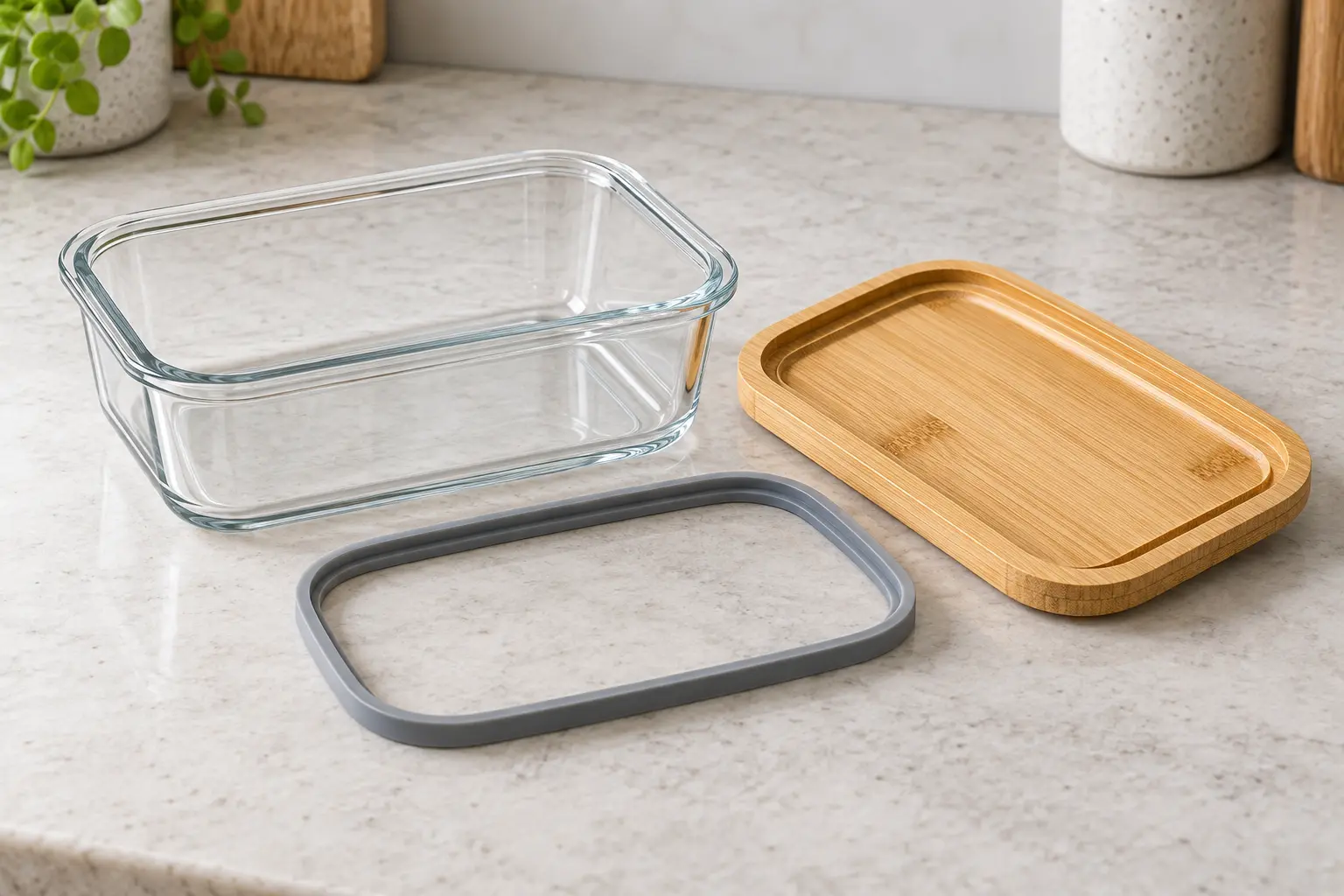
Are Bamboo Food Storage Containers Microwave Safe?
Never assume a bamboo food storage container is microwave safe. Use it in a microwave only when the instructions for that exact model explicitly permit the complete configuration you plan to heat.
- Solid or laminated bamboo: microwave heat and steam can dry, distort, split or damage bamboo, coatings and bonded joints. Unless the manufacturer expressly approves microwave use, choose another vessel.
- Bamboo-filled plastic or melamine composite: do not microwave it. The FDA says foods and drinks should not be heated on melamine-based dinnerware in microwave ovens. EU and UK authorities raise additional concerns about unauthorised bamboo-plastic composites.
- Bamboo pulp: microwave suitability depends on the formed-fibre recipe, barrier and tested use conditions. Look for an explicit time and power limit.
- Glass or plastic base with bamboo lid: check the base marking and normally remove the bamboo lid unless the instructions explicitly say otherwise. Venting requirements also matter.
- Steel base: do not place it in a microwave.
The FDA notes that glass, paper, ceramic and some plastics can be used for microwave cooking, but certain plastic containers can melt from the heat of the food. It directs users to the appliance and container instructions. “Microwaves pass through it” is not the same as “this finished product is approved for microwave heating.”
Can You Freeze Bamboo Containers?
The question can you freeze bamboo containers also requires a model-specific answer. Freezing introduces moisture, expansion and temperature changes. Solid or laminated bamboo may absorb condensation or experience dimensional movement. Adhesives, finishes and seals may behave differently at low temperatures. Unless freezer use is documented, do not make it the default.
For a glass container with a bamboo lid, freezer suitability belongs first to the glass vessel. Use only a base identified as freezer-safe, allow appropriate headspace for expanding food and avoid abrupt temperature changes. The lid may need to be removed or left unlatched during freezing, depending on the product instructions. Plastic bases and pulp packages likewise need an explicit freezer rating. A bamboo lid does not confer freezer performance on the vessel below it.
Are Bamboo Containers Dishwasher Safe?
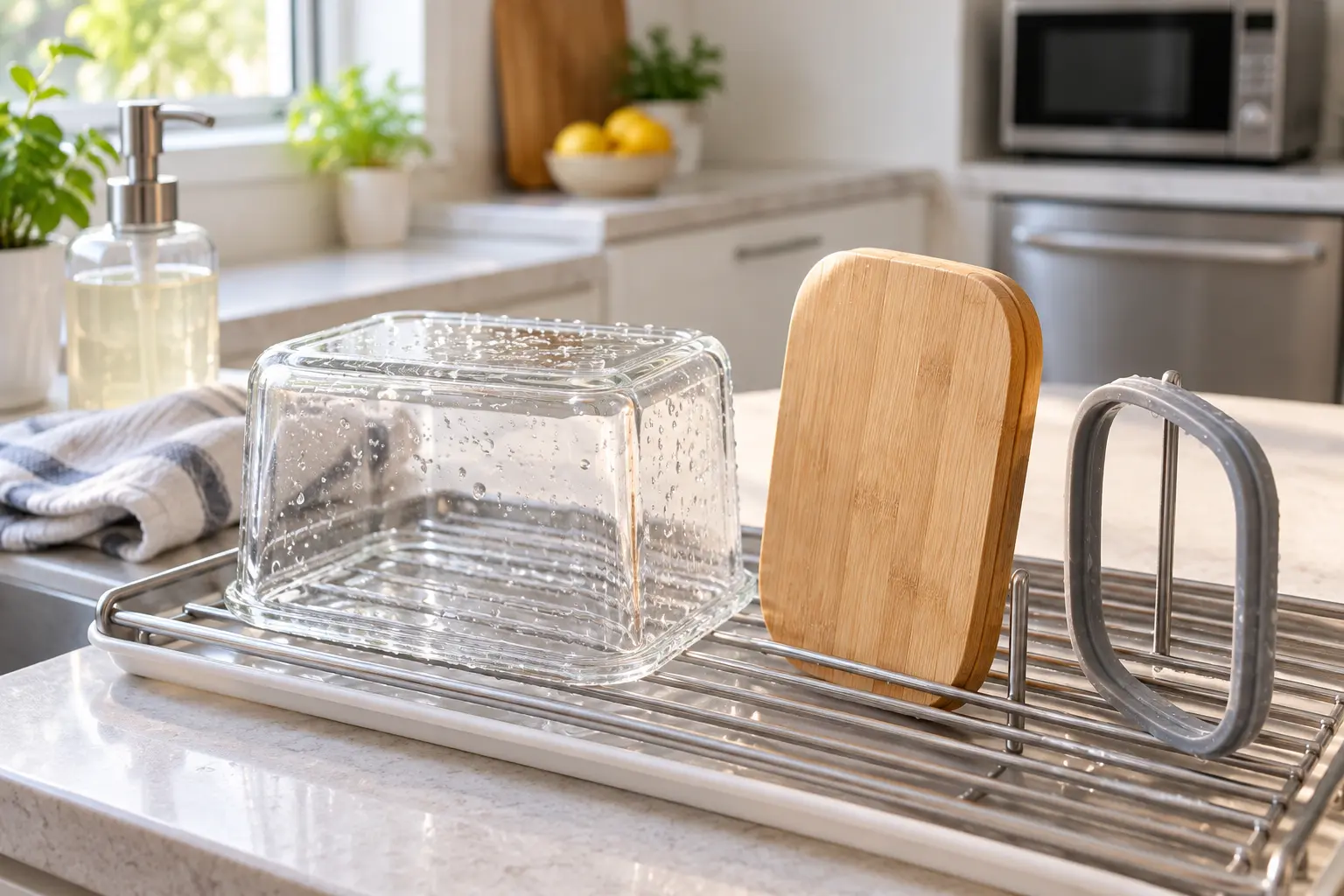
Repeated hot water, detergent and prolonged humidity can roughen, swell, warp or crack bamboo and may degrade some finishes or joints. Unless the supplier specifically approves dishwasher cleaning, hand-wash the bamboo component with mild detergent, avoid long soaking, rinse promptly and dry it fully in a ventilated position.
Mixed-material sets often have split instructions: the glass base may be dishwasher-safe while the bamboo lid is hand-wash only. Remove a gasket only if the design and instructions permit it, clean the groove, and reinstall the seal after every part has dried. Never place an unauthorised bamboo-plastic composite in a dishwasher; the European Commission warns that heating and dishwasher washing may increase migration from such articles.
How to Evaluate Reusable Bamboo Food Containers
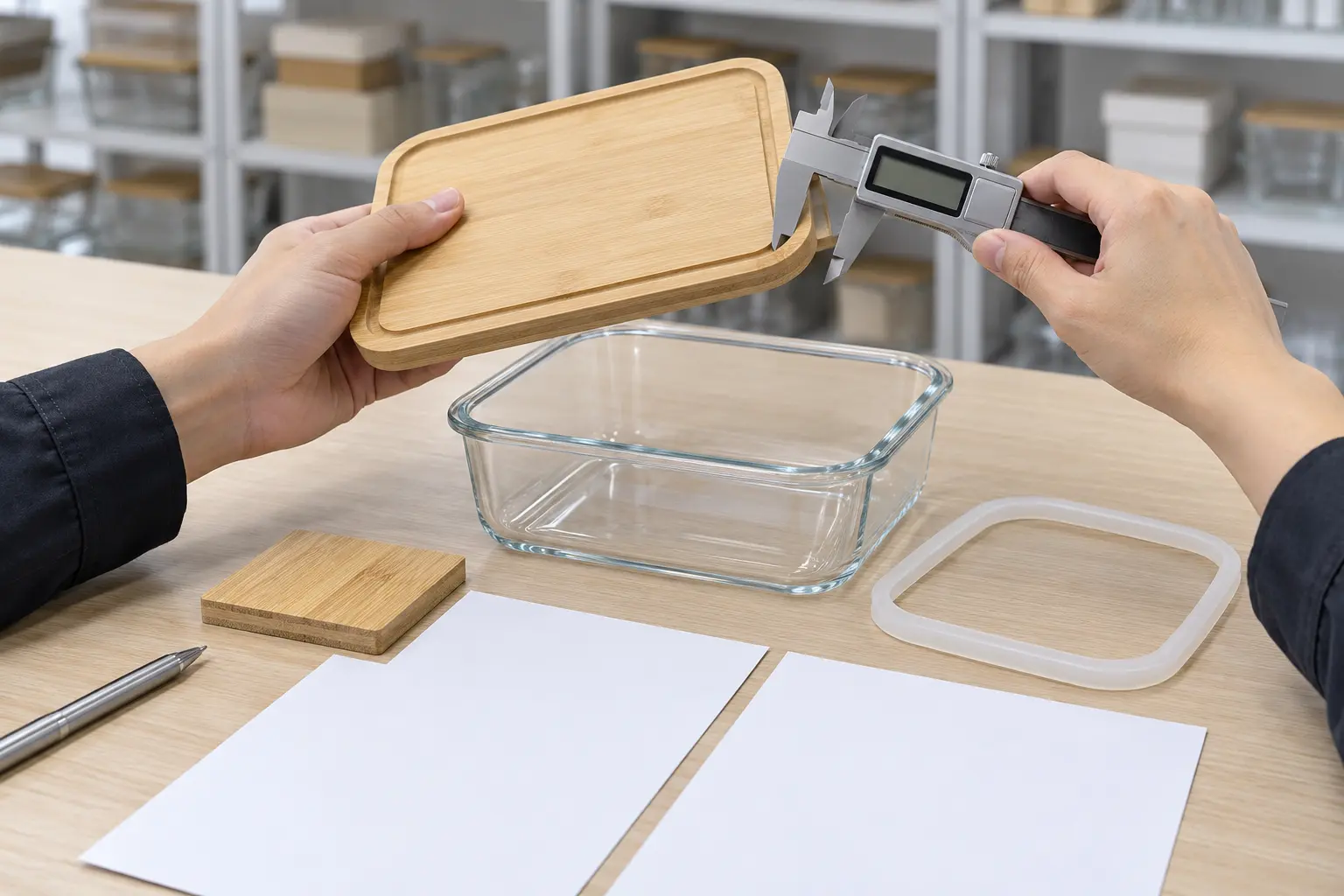
A credible reusable bamboo food container specification should define far more than the visible material. For a sourcing project, use this checklist:
- Identify every material. List the body, lid, food-contact coating, adhesive, gasket, valve, printing and decorative layer. Do not accept “bamboo” as a complete bill of materials.
- Define the intended use. Specify food type, contact time, minimum and maximum temperature, repeated-use cycle and whether microwave, refrigerator, freezer or dishwasher use is required.
- Match documentation to the destination market. EU, Great Britain, the United States and other markets may apply different legal frameworks. Verify current requirements with a qualified compliance professional.
- Confirm the tested sample. Reports should identify the same composition, coating, colours, dimensions and supplier as the production article. A report for a different material is not transferable evidence.
- Review the closure. “Airtight” should describe tested performance, not the mere presence of a lid. Examine gasket compression, odour retention, leak resistance and replaceability.
- Make the instructions visible. Users need clear limits for heat, freezing, washing, soaking, drying and replacement. Mixed-material parts should be addressed separately.
- Validate durability before environmental claims. A reusable item is useful only if it performs through its claimed service life. Avoid unsupported statements such as biodegradable, compostable, toxin-free or zero-plastic.
Practical Use and Care Guide
For a documented food-contact product, good daily care can reduce avoidable damage. Follow the supplied instructions first, then apply these general precautions where they do not conflict:
- Use the container only for the food types and temperatures stated by the manufacturer.
- Do not leave a bamboo body or lid submerged in water.
- Dry bamboo promptly and completely before closing or stacking the container.
- Keep bamboo parts away from direct flame, stovetops and uncontrolled high heat.
- Do not use a container with cracks, delamination, a peeling finish, persistent odour, mould, severe staining or a closure that no longer fits correctly.
- Replace damaged gaskets and follow the supplier’s refinishing guidance; do not apply an unknown oil, varnish or coating to a food-contact surface.
These steps help preserve the product but do not turn an unsuitable material into a suitable one. Care instructions complement compliance and correct construction; they cannot replace them.
Frequently Asked Questions
Is bamboo safe for food storage?
Some properly designed and documented bamboo products can be suitable for specified food-storage uses. The answer depends on whether the article is solid or laminated bamboo, pulp, a plastic composite, or a different vessel with a bamboo lid. Verify the complete material declaration and intended conditions. Do not use EU- or UK-market plastic food-contact articles containing unauthorised bamboo filler.
Are bamboo food containers safe for hot food?
Only when the exact container is approved for the food, temperature and contact time involved. Hot and acidic conditions can be especially important for migration from some materials. Never infer hot-food suitability from a natural appearance.
Can a glass food container with a bamboo lid go in the microwave?
The glass base may be microwave-safe if it is marked and documented accordingly, but the bamboo lid usually needs separate consideration and often must be removed. Follow the model’s instructions, including any venting and heating limits.
Is a bamboo container naturally airtight?
No. Airtightness normally depends on the lid geometry and a correctly fitted gasket. Ask for closure testing if an airtight claim matters, particularly for pantry goods or odour control.
Does “bamboo fibre” mean the container is plastic-free?
No. Bamboo fibre can be used in pulp products, but it can also be mixed into plastic or melamine resin. A material declaration is required to know the actual construction.
Develop a Clearly Specified Bamboo Container
The best answer to “are bamboo containers safe?” begins with transparent engineering: define the construction, market, food type, temperature, service life and care method before selecting materials. Fujian Xianxu Bamboo & Wood Co., Ltd. supports OEM and ODM bamboo product development with material review, prototyping and production planning. Contact the team with your intended use and destination market so the project can be evaluated around a clear, verifiable specification.