
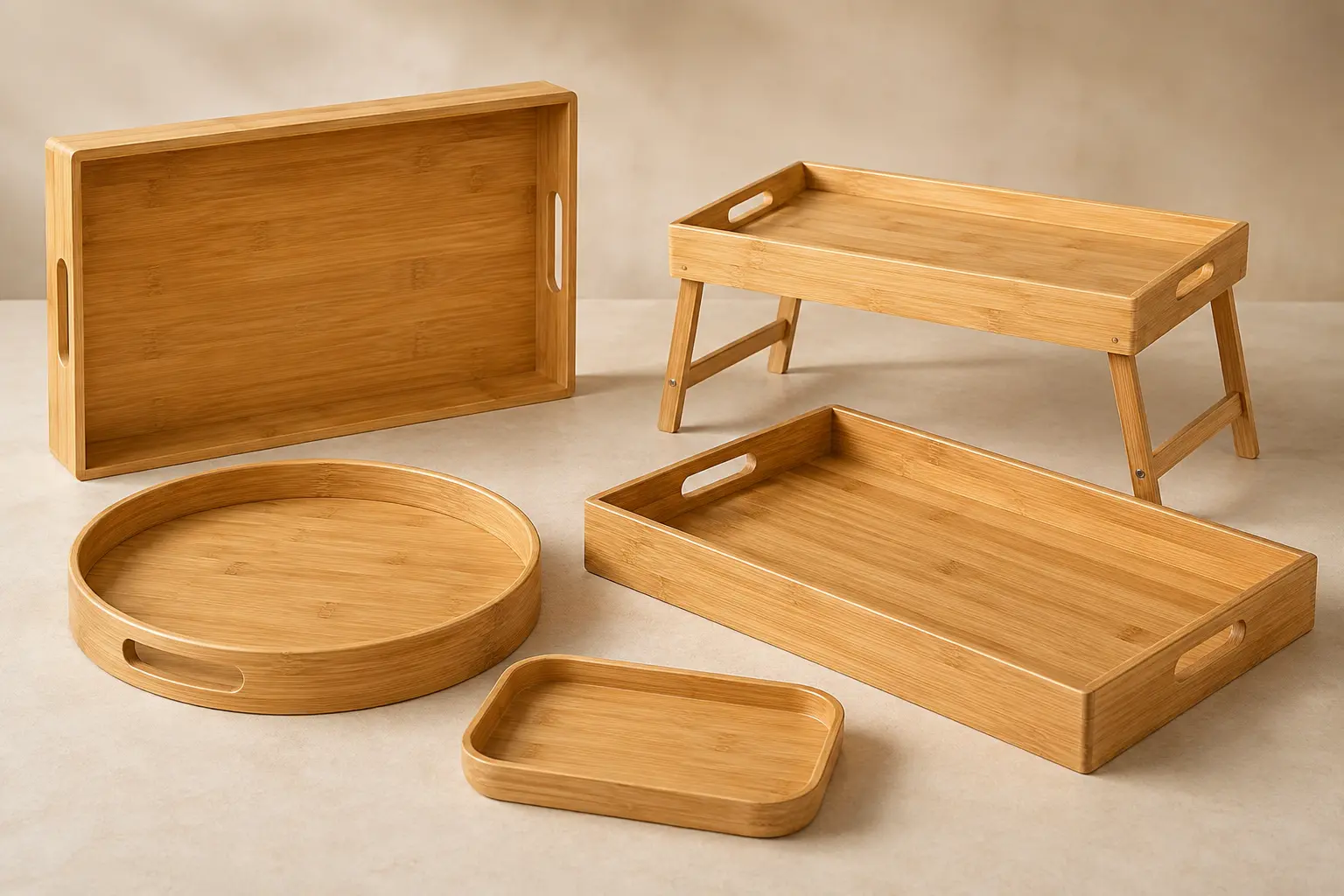
For importers, distributors, hospitality suppliers and private-label brands, sourcing bamboo trays wholesale involves much more than selecting an attractive shape from a catalog. The tray must suit its intended load, market, cleaning instructions, packaging method and target price. Its dimensions also need to fit retail shelves, cartons and the way end users carry or serve food.
This buying guide explains the main bamboo tray types, materials, size decisions and cost drivers without treating every project as identical. It also covers samples, minimum order quantities, lead times, OEM branding, packaging and quality control. Buyers developing a wider bamboo kitchenware range can explore our bamboo and wooden kitchenware collection for related product ideas.
What Does “Bamboo Trays Wholesale” Include?
The phrase can describe a broad product family rather than one standard item. A buyer searching for a bamboo tray wholesale supplier may be planning a homeware collection, a hotel serving program, a promotional product or an organizer line. The right specification depends on the use case.
Serving and hospitality trays
Serving trays normally have raised edges and either integrated cutout handles or attached handles. They may carry drinks, breakfast, appetizers or tableware. Hospitality buyers often prioritize stable handling, cleanable surfaces, stackability and repeatable dimensions. A dedicated guide to bamboo food serving trays can help buyers compare catering, restaurant and home-serving applications in more detail.
Breakfast and folding-leg trays
Breakfast trays may include folding legs, a tilting surface, cup recesses or side handles. Moving components introduce additional inspection points: hinge alignment, leg stability, locking action and the clearance between folded parts. They also affect carton depth and assembly labor.
Tea trays
Bamboo tea trays range from simple dry-serving trays to designs with slatted tops, drainage channels or removable water reservoirs. A tea ceremony tray and a standard beverage tray should not share an assumed specification. Buyers considering this category should review our planned bamboo tea trays wholesale guide.
Decorative, display and storage trays
Decorative trays can organize cosmetics, candles, plants, desk items or retail displays. These applications may require a different balance of appearance and moisture resistance than food service. Storage and stacking trays may use straighter walls, interlocking details or tighter dimensional tolerances.
Choose the Material and Construction Before Comparing Quotes
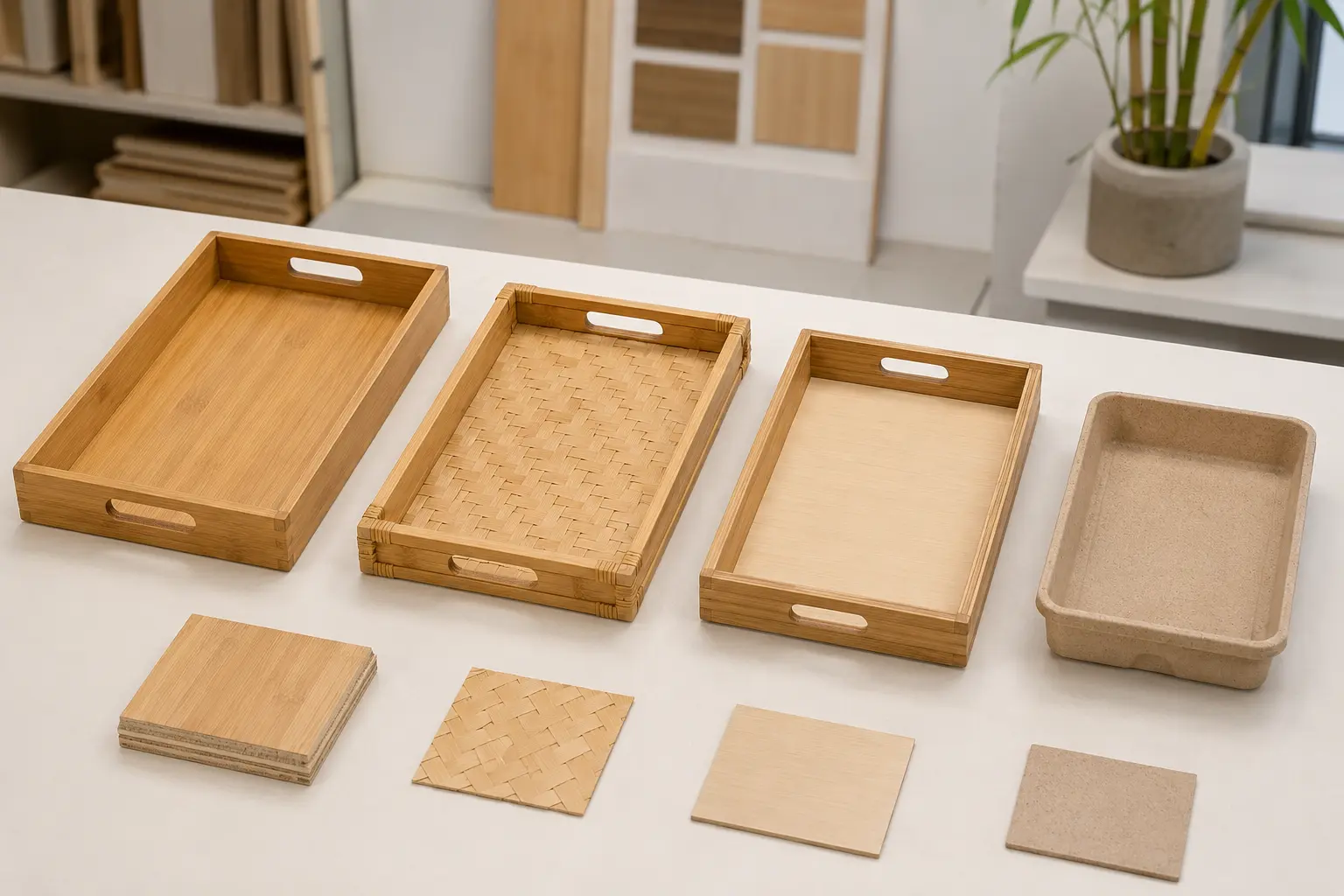
“Bamboo tray” is a product description, not a complete material specification. Two visually similar trays can use different structures, adhesives, coatings and production methods. Request a material breakdown with every quote so that comparisons remain meaningful.
Laminated bamboo panels
Many solid-looking trays use bamboo strips laminated into panels. The direction of the grain, panel thickness, edge profile and bonding method affect visual consistency and structural performance. A tray may be machined from a thicker panel or assembled from a base and separate side rails. Ask which method is proposed instead of assuming that “solid bamboo” describes a single construction.
Bamboo frames with inset bases
A bamboo frame can surround an inset bamboo, wood-based or other panel. This structure can reduce weight and create design flexibility, but the base material must be disclosed. Its moisture behavior, finish, food-contact suitability and testing requirements may differ from those of the bamboo frame.
Woven bamboo and bamboo-rattan styles
Woven bases and wrapped edges create a handmade or decorative appearance. Variation is part of the visual character, so buyers should define acceptable color, weave spacing, loose ends and shape tolerance. These products may require protective packing that prevents abrasion or crushing.
Bamboo fibre and blended materials
Products described as bamboo fibre, bamboo fiber or bamboo melamine are not automatically equivalent to laminated bamboo. They may contain binders or other components and can fall under different regulatory and end-of-life considerations. Obtain an exact composition, intended-use statement and relevant test plan before marketing any material claim.
Bamboo Serving Tray Sizes, Shapes and Functional Details
Common shapes include rectangular, round, square and oval trays. Size labels such as small, large or extra large are too subjective for purchasing documents. Record dimensions in millimeters and include usable internal area, total external size and height.
| Specification area | Details to confirm | Why it matters |
|---|---|---|
| Overall dimensions | Length, width or diameter, and total height | Retail fit, carton size and freight efficiency |
| Usable surface | Internal flat area and corner radius | Fit for plates, cups or display products |
| Base and wall | Thickness, edge height and construction | Weight, rigidity and appearance |
| Handles | Opening size, placement and edge comfort | Safe, comfortable carrying |
| Load expectation | Typical contents and test method | Appropriate construction and validation |
| Stacking | Nesting direction and stacked height | Storage, packing and hospitality operations |
Handles should allow enough finger clearance and have smooth, rounded contact edges. Lids or covers require a defined fit tolerance and care instructions. Folding legs need a stability requirement on a flat surface. If a design holds cups or bowls, provide the actual item dimensions rather than relying on a generic recess.
What Determines Bamboo Tray Wholesale Pricing?
Responsible suppliers cannot provide a reliable unit price from a keyword alone. Pricing for bamboo serving trays wholesale is built from the full specification, order quantity and commercial terms. Instead of requesting a fixed price for “one bamboo tray,” send a concise request for quotation with the following variables.
- Material and construction: laminated bamboo thickness, frame assembly, inset base, woven components or blended material.
- Dimensions and weight: larger or thicker products consume more material and can reduce carton efficiency.
- Machining complexity: handles, grooves, recesses, lids, legs, curved edges and tight tolerances add operations.
- Surface finish: sanding grade, coating system, color matching and intended exposure affect processing and testing.
- Order quantity: setup costs, material purchasing and packaging runs are distributed differently at different volumes.
- Branding and packaging: logo method, printed inserts, retail sleeves, color boxes, protective structures and barcode application all influence cost.
- Quality and compliance plan: inspection level, laboratory testing, sample approvals and documentation should be budgeted from the start.
- Incoterm and delivery point: EXW, FOB and delivered quotations include different responsibilities and should not be compared as if identical.
For an accurate comparison, ask every shortlisted supplier to quote the same revision of the drawing, packaging specification, quantity tiers and trade term. A lower unit price can become more expensive if it excludes protective packaging, testing or essential machining.
MOQ, Samples and Lead Time Are Project-Specific
Minimum order quantity is influenced by whether the model already exists, whether a new tool or fixture is required, the logo process, material purchasing and the packaging print run. A plain existing tray may support a different MOQ from a fully customized set with printed retail packaging.
Lead time also starts only after clear milestones are defined. Development, sample approval, material preparation, production, inspection and transport each require time. Seasonal factory loading and packaging availability can change the schedule. Buyers should request a dated production plan for their actual order instead of relying on a universal lead-time promise.
A practical sample sequence
- Confirm the product brief, drawing, materials, finish, branding and packaging concept.
- Review a stock or reference sample when useful for basic construction and workmanship.
- Approve a customized pre-production sample with documented comments.
- Freeze a signed or otherwise controlled approval sample and specification revision.
- Use those references for production inspection and shipment approval.
OEM and ODM Options for Custom Bamboo Trays
OEM programs reproduce a buyer-defined specification, while ODM support may adapt an existing concept or develop a new one around a target market and price. In both cases, the buyer should provide the intended use, target dimensions, expected volume, required packaging, destination markets and desired launch date.
Custom shape and features
Customization may include dimensions, wall height, corner radius, cutout handles, separate handles, dividers, stacking details, legs, lids or drainage features. Every added feature should have a functional reason and a measurable acceptance criterion.
Logo application
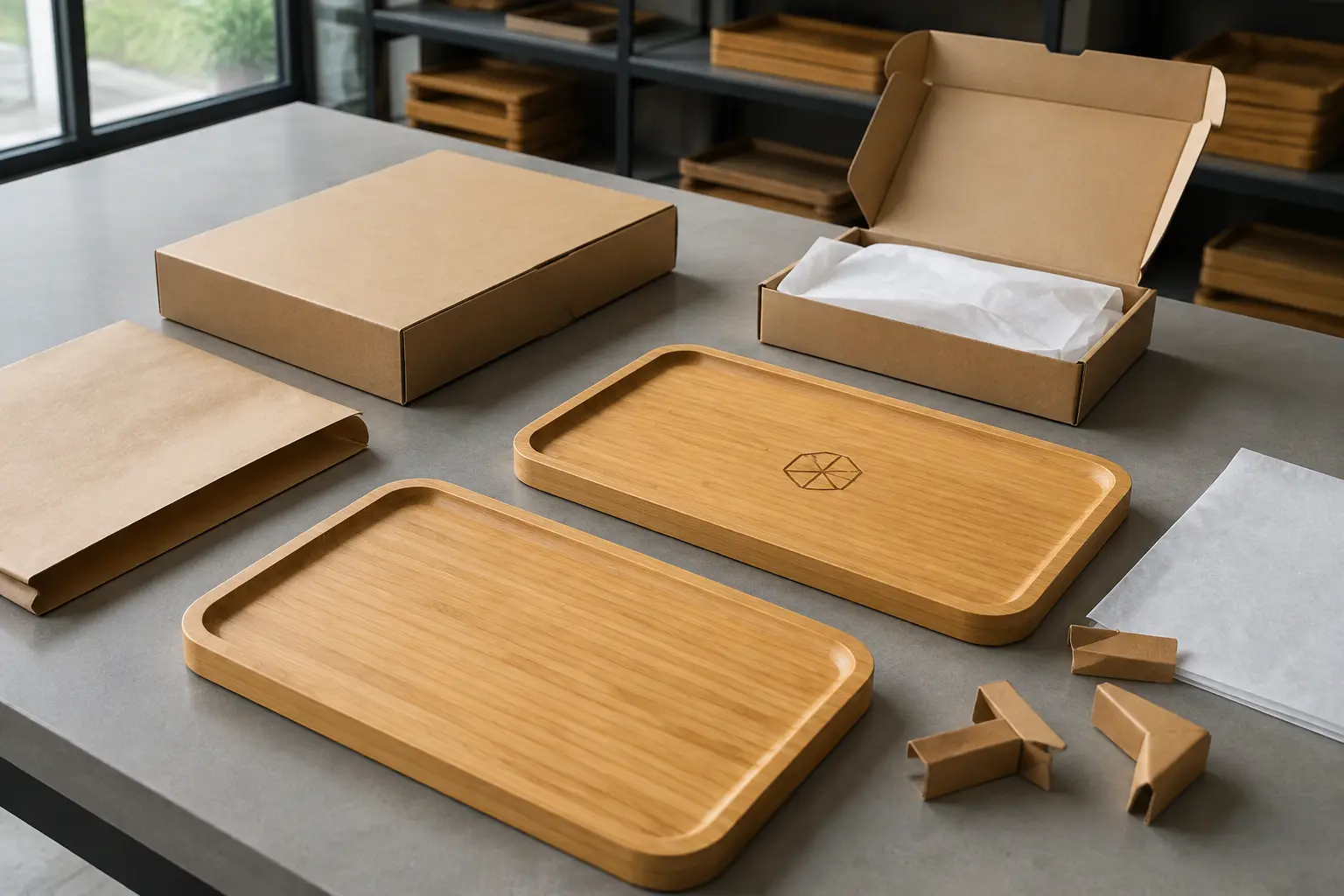
Laser engraving is common for subtle, permanent marks on bamboo, although its color can vary with material and settings. Screen or pad printing can add color when the ink system and adhesion are suitable. Metal badges, burned marks or packaging-only branding may suit other concepts. Approve the logo size, position, color tolerance and sample appearance before production.
Private-label packaging
Packaging can range from a protective sleeve or kraft box to a printed retail carton or multipiece set. The structure should prevent edge damage, surface abrasion and movement inside the carton. Retailers should also define barcode placement, country-of-origin marking, warning or care information and any market-specific labeling they require.
Our company overview explains our broader bamboo and wooden product development focus, while the Vietnam factory page provides buyers with additional manufacturing context when evaluating sourcing options.
Quality Control for Bamboo Serving Tray Wholesale Orders
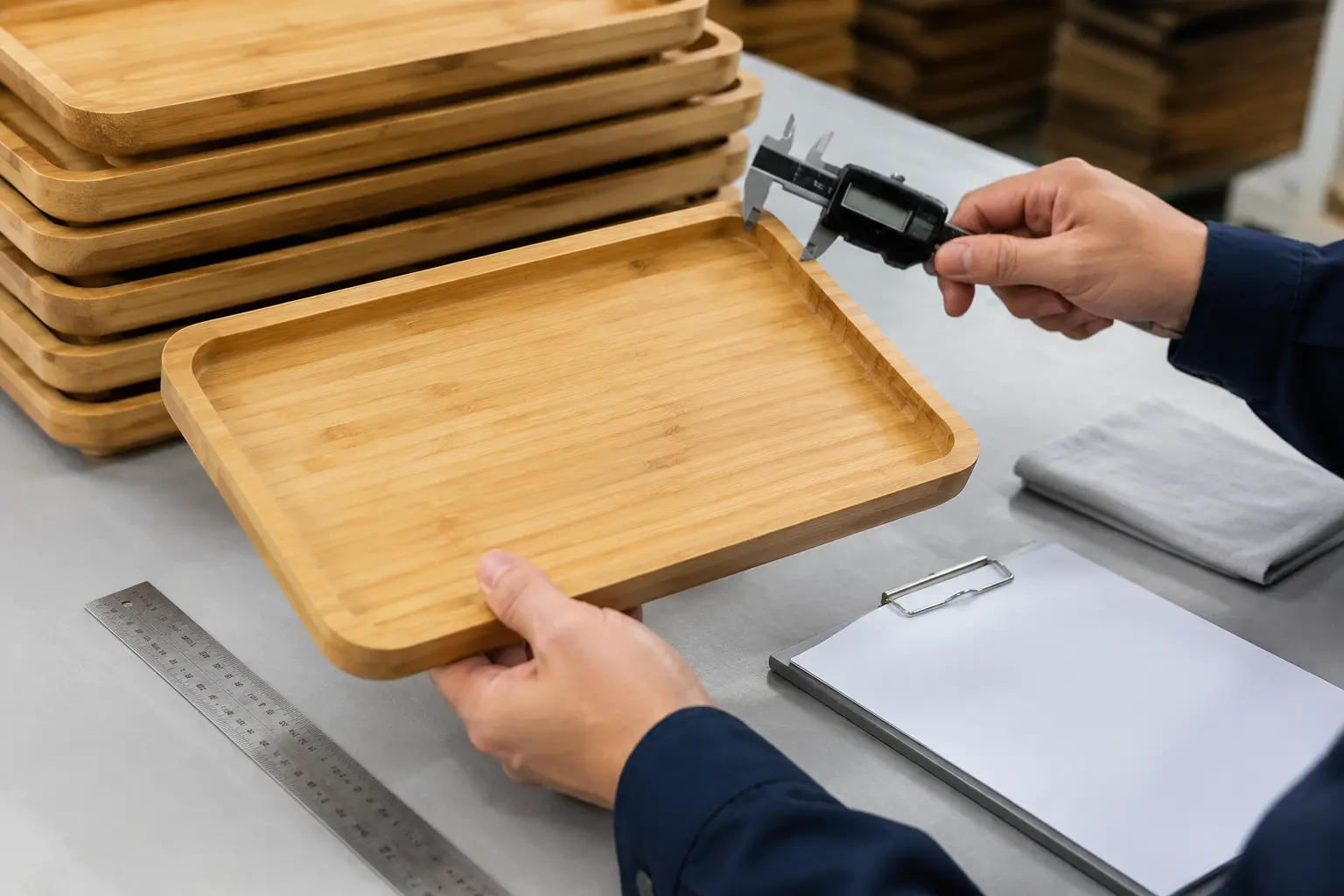
A usable quality plan converts general expectations such as “good quality” into checks that can be repeated. The approved sample and latest specification should be available to production and inspection teams. For a bamboo serving tray wholesale order, typical checkpoints include incoming material, in-process machining, finishing, assembly, final inspection and packaging.
Appearance and workmanship
Define acceptable color and grain variation, sanding quality, finish coverage, glue residue, scratches, dents, cracks, splinters and sharp edges. Natural bamboo varies, so a visual range or controlled sample is more useful than an undefined request for identical grain.
Dimensions, function and stability
Measure critical dimensions and handle openings with agreed tools and tolerances. Check the tray on a flat surface for rocking. Test fitted lids, folding legs, dividers and stacking functions. If load performance matters, agree on the load, distribution, duration and pass criteria rather than improvising during inspection.
Finish, odor and packaging
The finish should match the approved sample and intended care method. Buyers may include adhesion, moisture or stain-resistance checks when relevant to the design. Unusual odor, trapped moisture or inadequate curing should be investigated. A packing trial and carton-drop or transit test can be considered according to product fragility and shipping route.
FSC, Social Audits and Product Compliance
Certification and compliance claims must match the actual supplier, material, product scope and transaction documents. If FSC-certified sourcing or an FSC claim is required, confirm that the relevant organization has valid scope and that the chain is maintained for the specific order. The official FSC chain-of-custody overview explains how certified material is tracked through the supply chain. Do not assume that every bamboo item or every supplier transaction is automatically FSC certified.
BSCI participation or an amfori BSCI audit relates to social-performance assessment at a production site; it is not a product safety certificate. Buyers should verify the current audit details and whether the intended production location is covered. Any wording used in marketing or supplier approval should reflect the available evidence.
Product testing depends on destination market, material composition, coating, food-contact scenario and retailer requirements. Agree on applicable protocols before sampling and production. For food-serving products, this may include evaluation of coatings, adhesives, migration or other chemical requirements, but the precise test plan should be set by the buyer, laboratory or qualified compliance adviser for the intended market. Avoid broad claims such as “FDA approved” or “REACH certified” unless the statement is accurate, supportable and properly scoped.
How to Evaluate a Bamboo Tray Manufacturer
A supplier review should connect capability to the proposed product. Ask for material details, process flow, representative samples, available equipment, quality records and packaging experience. Clarify whether key operations are performed at the quoted facility or subcontracted. If production can occur at more than one location, identify which site, quality system and audit documents apply to the order.
A useful request for quotation includes:
- product drawing or reference photos with target dimensions;
- material, finish and color requirements;
- intended use and destination countries;
- estimated order quantity and annual forecast;
- branding artwork and preferred application method;
- unit packaging, master-carton and labeling requirements;
- testing, audit or certification expectations;
- target delivery date, port and requested Incoterm.
For related product planning, buyers can also compare bamboo cutlery trays and drawer organizers. Keeping serving and organization specifications in separate product briefs reduces ambiguity even when both are sourced as part of one collection.
Frequently Asked Questions About Bamboo Trays Wholesale
What is the normal MOQ for bamboo trays?
There is no universal MOQ. It depends on whether the tray is an existing model, material purchasing, customization, logo setup and printed packaging. Send the exact specification and quantity tiers to receive a project-specific answer.
Can I order custom dimensions and handles?
Often yes, subject to design review and manufacturing feasibility. Provide a dimensioned drawing, expected load and handle requirements. New tooling, fixtures or sample iterations may affect cost and schedule.
Are bamboo serving trays suitable for direct food contact?
Suitability depends on the complete material and coating system, intended food and use conditions, and the rules of the destination market. Confirm the construction and an appropriate test plan before making food-contact claims.
Can bamboo trays be washed in a dishwasher?
Many laminated bamboo products are intended for wiping or gentle hand cleaning rather than prolonged soaking or dishwasher cycles. Care instructions must be based on the tested construction and finish of the specific model.
Which logo method is best for private-label bamboo trays?
Laser engraving offers a restrained natural appearance; printing can support color; packaging-only branding avoids altering the tray surface. The best choice depends on artwork, finish, budget, durability expectation and applicable product requirements.
How should wholesale bamboo trays be packed?
Use protection appropriate to the shape and finish, such as tissue, sleeves, corner protection, dividers or fitted cartons. Confirm unit packing, master-carton limits and transit testing through a packing trial before mass shipment.
How long does a custom bamboo tray order take?
Timing is project-specific. Product complexity, samples, material readiness, packaging, testing, factory loading and transport all affect the schedule. Request a milestone-based plan after the specification is confirmed.
Request a Project-Specific Bamboo Tray Quotation
The best wholesale result starts with a precise product brief. Fujian Xianxu Bamboo & Wood Co., Ltd. supports B2B buyers developing bamboo and wooden homeware for wholesale, retail and hospitality programs. Review our bamboo and wooden products manufacturing website, then contact our team with your tray dimensions, material preference, quantity, logo, packaging, destination market and delivery needs. We can then evaluate the design and prepare a project-specific OEM or ODM proposal rather than a generic price.