
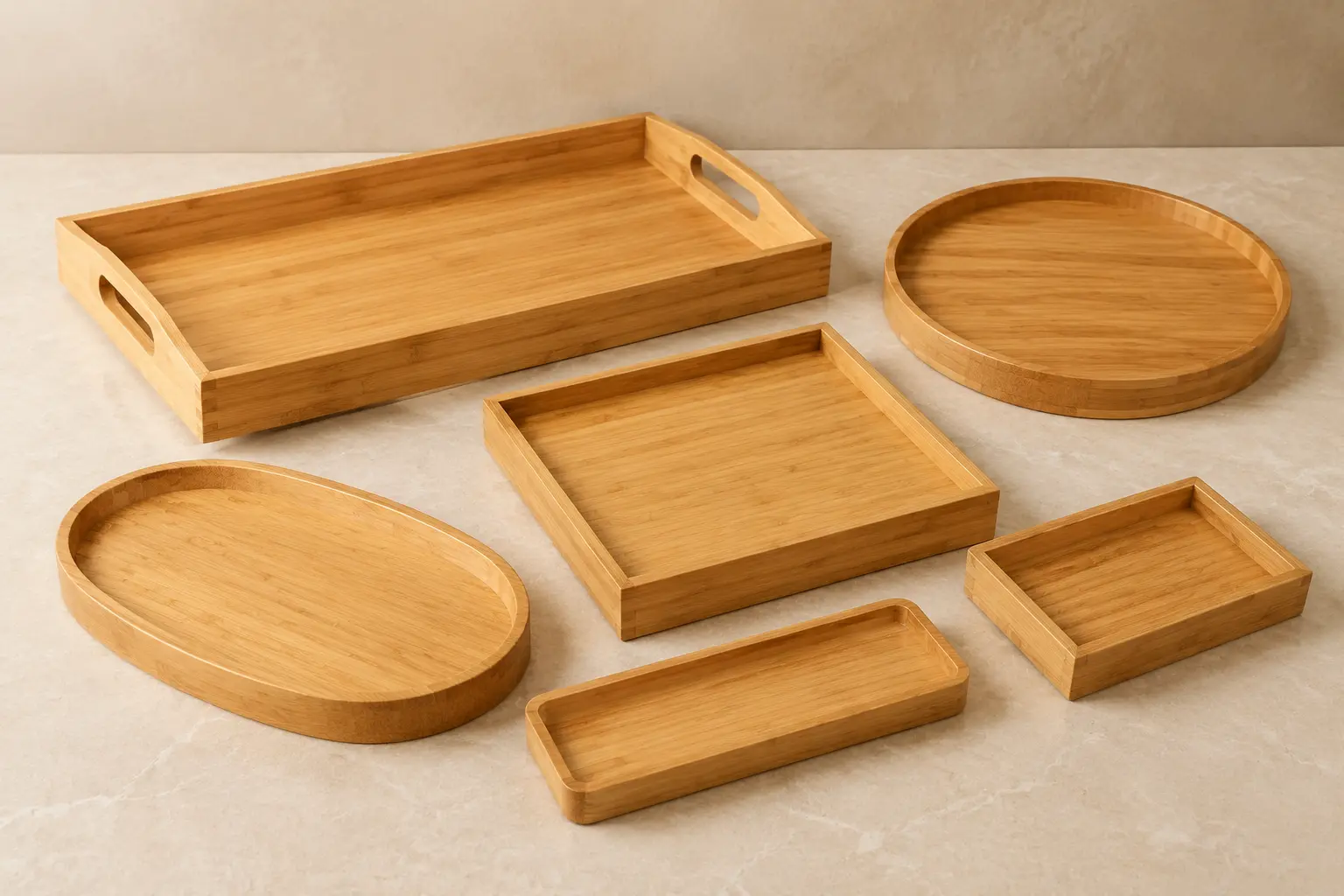
Choosing a bamboo tray by a generic label such as “small,” “large” or “round” can create expensive misunderstandings in a wholesale order. Importers, retailers, hospitality suppliers and private-label brands need a dimensioned specification that connects shape and size to the tray’s actual use. Overall length alone does not reveal the usable serving area, handle clearance, edge height, nesting behavior or carton volume.
This guide explains how to evaluate a round bamboo tray, rectangular bamboo tray, square or oval design for B2B sourcing. It also shows how to measure functional dimensions, define loading and stacking requirements, prepare packaging and create objective quality checks. For a broader overview of types, pricing factors and supplier evaluation, begin with our bamboo trays wholesale buying guide.
Start With the Use Case, Not the Shape Name
A tray for two coffee cups, a hotel breakfast service and a retail candle display can all be described as bamboo trays, yet they need different footprints and edge details. Before asking a supplier for drawings, define what the tray will hold, where it will be stored, who will carry it and whether it must stack, nest or fit inside another product.
Buyers planning food-service collections can compare specific applications in our bamboo food serving trays guide. Tea service introduces other requirements, including teaware footprints and possible drainage structures; those are covered separately in our bamboo tea trays wholesale guide.
Round, Rectangular, Square or Oval: What Changes?
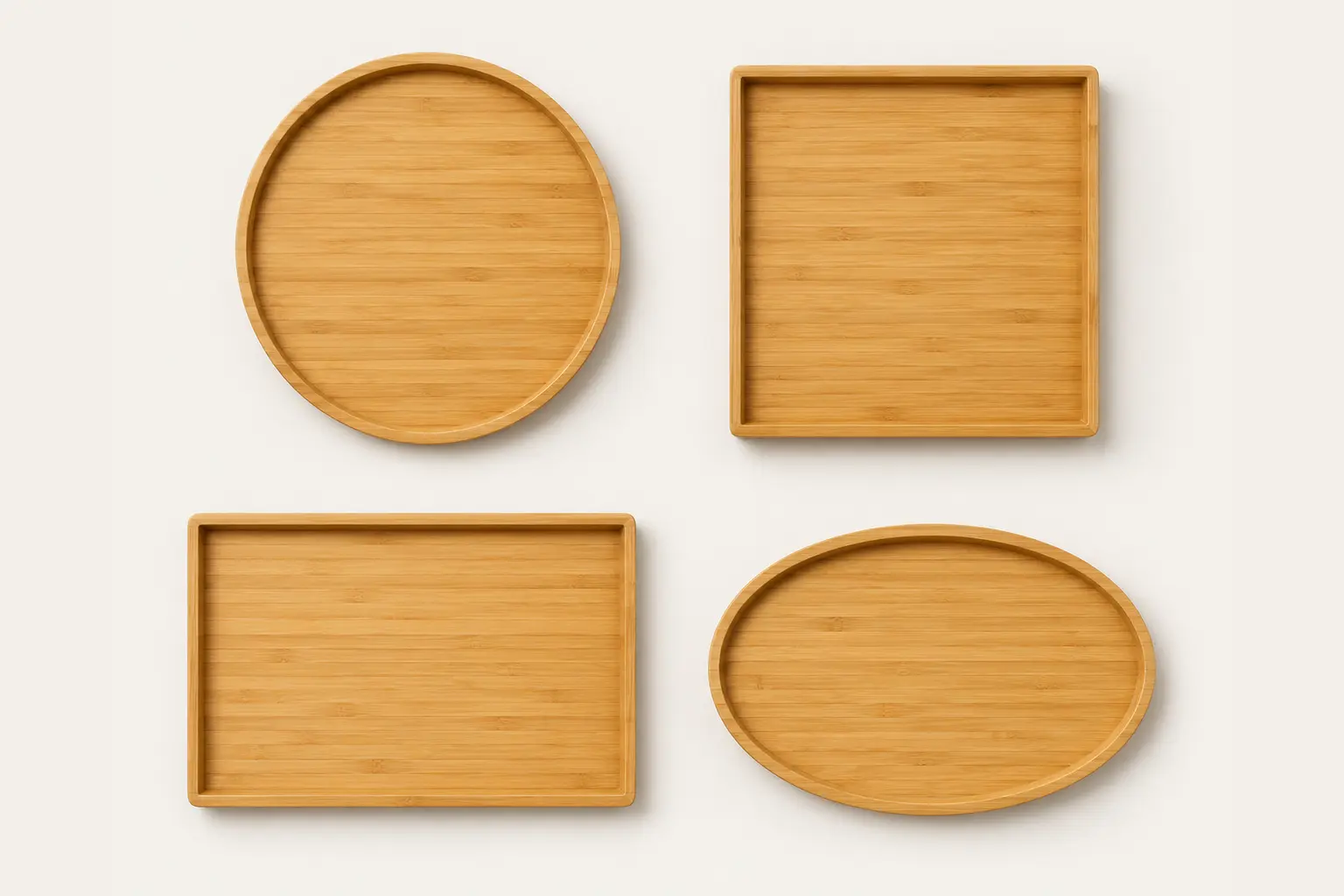
Round and circular bamboo trays
A round bamboo tray presents food, tea accessories, cosmetics or decorative objects from every direction. The absence of corners can make it comfortable to move around a table, but diameter alone is not enough. Specify the internal flat diameter, overall diameter, wall height and any handle projection. A circular bamboo tray with cutout handles may need wider side sections than a handle-free version.
A large round bamboo tray creates a strong display area, but its circular footprint can leave more unused space inside a rectangular export carton. Buyers should compare presentation value with packing density. If the tray must rotate, fit on a table or sit under a particular item, provide the mating dimensions and clearance.
Rectangular trays
The rectangular bamboo tray is versatile for drink service, breakfast, retail display and countertop organization. Its straight sides align efficiently with shelves and cartons, while the longer axis supports cups or dishes arranged in rows. Search phrases such as bamboo tray rectangle refer to the same general geometry, but buyers should still state the exact length, width, internal area and corner radius.
A long bamboo tray can suit narrow tables, condiment sets or bathroom accessories. A narrow bamboo tray may improve space use, but an extreme length-to-width ratio can affect stiffness and handling. Construction and expected load must be reviewed together.
Square trays
A square bamboo tray creates a balanced retail display and can organize cups, bottles or small packaged products. Its equal sides simplify orientation, although rounded corners reduce the flat area available near each corner. Confirm whether “square” describes the overall footprint or the internal base and specify the corner radius.
Oval trays
An oval bamboo tray offers a softer profile than a rectangle while providing more directional serving space than a circle. It can support bread, appetizers, tea accessories or decorative collections. Accurate drawings are important because “oval” can mean a true ellipse, a capsule shape with straight sides, or a free-form rounded rectangle. These shapes may require different machining or forming methods.
Small, Large and Extra Large Are Not Universal Standards
Retail descriptions such as mini, small, medium and large are relative to a brand’s range. They are useful for merchandising but should never replace metric dimensions in a purchase order. The reference bands below are only a planning aid based on a tray’s longest external dimension; they are not universal industry standards, and suppliers may categorize the same product differently.
| Informal size label | Reference longest dimension | Possible applications | Specification caution |
|---|---|---|---|
| Mini | Below about 180 mm | Condiments, jewelry, tea tools, single-item display | Small radii and wall thickness can greatly reduce usable area |
| Small | About 180–280 mm | One cup, snacks, cosmetics or accessories | Confirm grip method and intended contents |
| Medium | About 280–400 mm | Drink sets, appetizers, home organization | External size does not equal flat serving area |
| Large | About 400–520 mm | Breakfast, group service or larger displays | Review load, handle span and carton efficiency |
| Extra large | Above about 520 mm | Hospitality service or statement display | Construction, deflection and shipping protection become critical |
A listing described as bamboo tray large should therefore be converted into millimeter dimensions before quoting. The same applies to bamboo serving tray large or extra large bamboo serving tray. At the other end of the range, a mini bamboo tray, small bamboo tray or bamboo serving tray small must still have enough internal area for its intended contents and enough edge material for durable construction.
How to Measure a Bamboo Tray Correctly
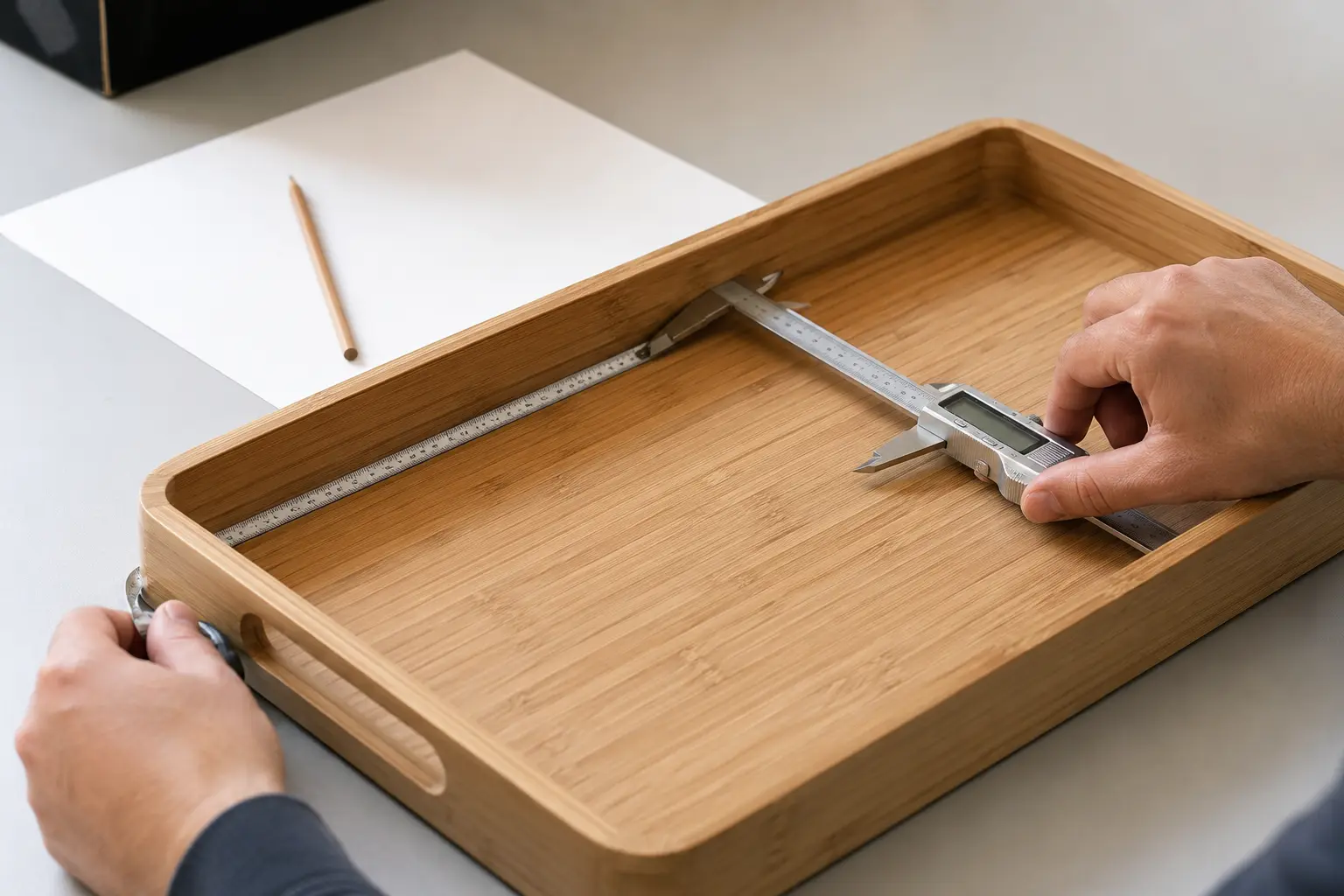
Overall dimensions
Record maximum external length and width, or external diameter for a circle. Include total height, any handles, feet, lid, folded legs or hardware. State the measurement orientation and units. For an oval or irregular profile, include a dimensioned drawing rather than only two numbers.
Usable internal area
Measure the flat area inside the walls, not just the outside footprint. Record internal length and width or usable diameter, wall slope, corner radius and any recesses. A plate may fit across the opening but rest unstably if its base crosses a curved edge, so actual samples or complete dish dimensions are useful.
Thickness and height
Define base thickness, wall or rail thickness, internal wall height and total external height. A higher rim can retain products better, but it may make low items harder to lift and increase nested stack height. Tolerances should reflect the manufacturing method and the dimensions that are critical to function.
Handle dimensions
For cutout handles, specify opening length, height, edge radius and distance from the top and base. Attached handles require their projection, fixing method and fastener details. Handle comfort should be assessed with the intended load rather than with an empty tray only.
Connect Size to Load and Handling
A larger tray does not automatically support a higher load. Performance depends on panel thickness, grain orientation, frame construction, joints, handle design and how the load is distributed. Agree on a representative test: product weight, number and position of items, carry distance, hold time and pass criteria. Point loading from a heavy bottle can behave differently from an evenly distributed load.
For a bamboo serving tray round, side handles can help control a larger diameter, but they may increase the overall width. A square or rectangular tray can have a longer unsupported span. Extra-large designs may need a reinforced structure or a different thickness after engineering review. Avoid publishing an unsupported weight capacity; document the exact model and test conditions instead.
Stacking, Nesting and Storage Requirements
Hospitality and retail programs often need trays to stack securely. Straight-sided trays may stack on top of each other, while slightly tapered walls can allow nesting. Nesting saves storage and carton volume, but excessive friction can scratch the finish or make trays difficult to separate.
Specify maximum stack height, acceptable movement, contact points and whether protective sheets are required. Measure both one-piece height and the incremental height added by each nested tray. Round, oval and rectangular designs can behave differently even at a similar external size. If lids are included, define whether they stack separately or remain fitted.
Packaging and Freight Planning by Shape and Size
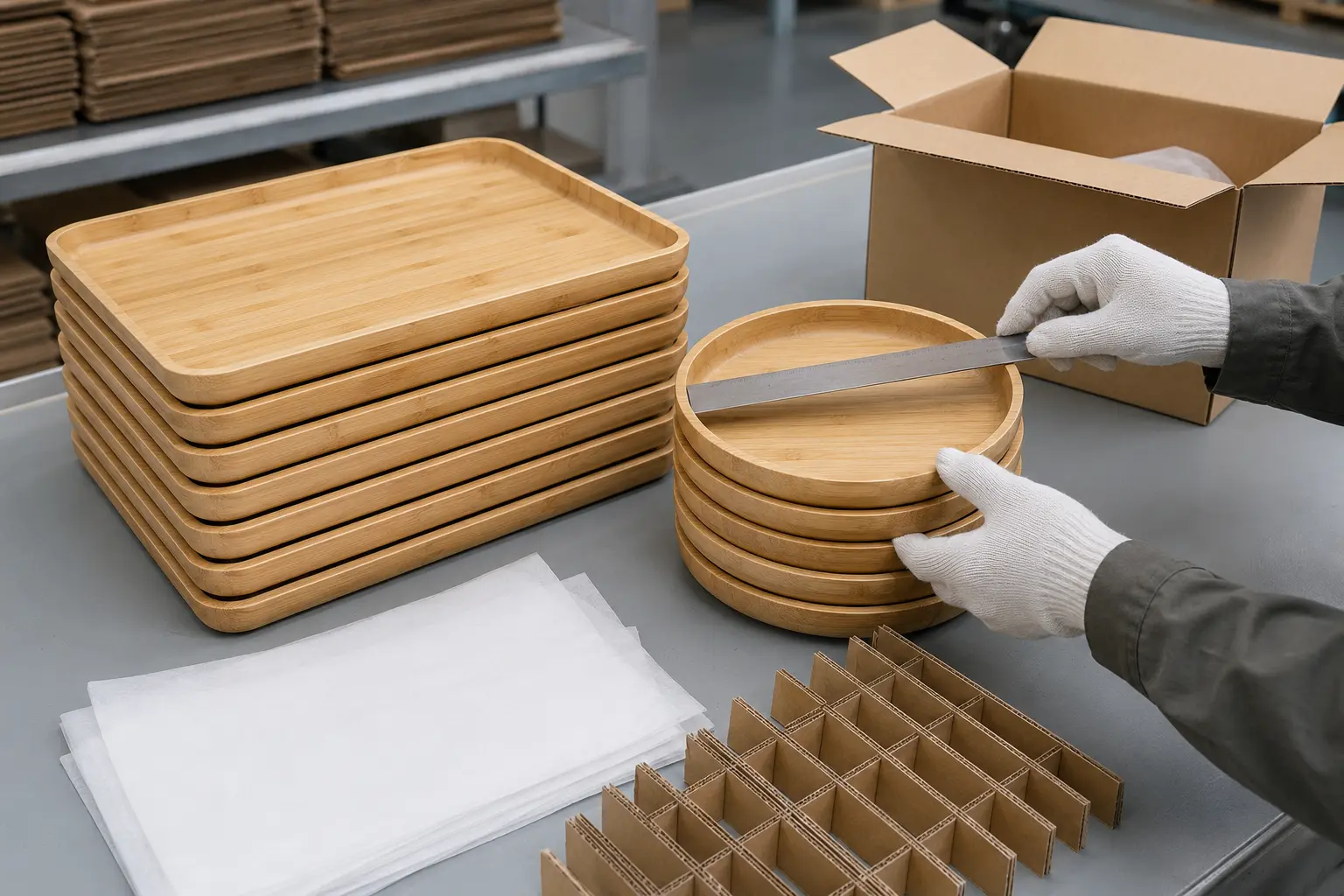
Carton design should be considered before the tray is finalized. A few millimeters added to each side can change units per carton, pallet pattern and container utilization. Round and oval products may leave voids inside rectangular cartons, while long or extra-large trays can exceed convenient carton dimensions and raise damage risk.
Packaging may include tissue, sleeves, interleaving sheets, corner blocks, fitted inserts or individual boxes, depending on finish and sales channel. Define maximum carton weight and confirm who must lift it. Conduct a packing trial with final-size samples, then agree on any transit tests appropriate to product fragility and route. Printed packaging should be developed only after dimensions and protective clearances are stable.
OEM and ODM Size Development
Custom tray dimensions should begin with an intended-use brief and target market, not an arbitrary enlargement of an existing model. Increasing length or diameter may require changes to thickness, handle placement, machining sequence and packing. Reducing a tray can also create problems if handle openings, corner radii or wall joints no longer fit.
An OEM or ODM development file should include a revision-controlled drawing, material and finish specification, target contents, load test, critical tolerances, logo position, packaging and labeling requirements. Buyers can review our bamboo and wooden kitchenware range for collection context and our bamboo tray materials comparison when selecting laminated, framed, woven or blended constructions.
Quality Control for Tray Dimensions and Shape
Dimensional inspection
Identify critical-to-quality dimensions on the approved drawing and specify sampling, measurement points, tools and tolerances. Inspect overall size, usable area, height, handle openings and component fit. Measuring one corner or one diameter may miss twist, taper or out-of-round conditions.
Flatness, rocking and geometry
Place trays on a controlled flat surface to check rocking. For circles, review roundness when it affects fit or rotation. For squares and rectangles, inspect diagonals or squareness where required. Oval templates may help compare curves. The inspection method and pass criteria should be agreed before mass production.
Edges, finish and stacking
Inspect sanding, splinters, sharp edges, dents, cracks, glue residue, coating coverage and unusual odor. Confirm that stacked or nested trays separate without damage and remain stable. Compare color and natural grain variation to an approved range rather than expecting every bamboo surface to be identical.
Conditional FSC, BSCI and Compliance Requirements
If FSC-certified material or an FSC claim is required, verify that the relevant supplier and transaction have valid scope and supporting documentation for the specified product. The official FSC chain-of-custody overview explains how certified material is tracked through the supply chain. Do not assume every bamboo tray or every shipment is automatically FSC certified.
An amfori BSCI audit concerns social-performance assessment at a production site; it is not a product certificate. Confirm the current audit details and the facility that will make the order. Our company overview and Vietnam factory information provide starting context, but buyers should request the documents relevant to their project and production location.
Product testing depends on materials, coatings, intended food contact, cleaning method, destination market and retailer requirements. Define the applicable protocol before sample approval. Size and shape may influence how a product is used, but they do not by themselves demonstrate compliance. Avoid broad claims unless they are accurate, current and supported for the precise model.
Wholesale Specification Checklist
- shape definition and dimensioned drawing;
- overall dimensions and usable internal area;
- base, wall, rim and handle dimensions;
- material construction, finish and color range;
- intended contents, loading and handling test;
- stacking or nesting method and maximum stack;
- critical tolerances and approved sample;
- logo, label and market-specific information;
- unit packaging, carton limits and transit plan;
- order quantity, destination, Incoterm and required date.
Frequently Asked Questions About Bamboo Tray Sizes
What is a standard bamboo serving tray size?
There is no single universal standard. Size ranges vary by supplier, application and market. Use millimeter dimensions, usable area and an approved sample instead of relying on small, medium or large labels.
How do I choose between a round and rectangular bamboo tray?
Choose around the items served, table or shelf space, carrying method and packaging. Round trays offer an all-direction presentation, while rectangles often align more efficiently with dishes, shelves and cartons.
What dimensions should appear on a purchase order?
Include overall length and width or diameter, total height, usable internal area, rim height, base and wall thickness, handle dimensions and any critical fit. Reference the latest drawing revision and tolerance.
Can a small tray use the same construction as an extra-large tray?
Not automatically. A larger span and different load may require revised thickness, joints or reinforcement. The supplier should review structure, handling and packing for each size.
Can round, square and oval trays share one retail collection?
Yes, if material, finish, edge profile and branding are coordinated. Buyers should still approve separate drawings and packaging because each shape has different usable area and carton efficiency.
How should tray size tolerances be set?
Set tolerances according to manufacturing method and functional risk. Tighter limits should be reserved for dimensions that affect fit, stacking, hardware, lids or retail presentation, and the measurement method should be documented.
Does a larger bamboo tray always cost more?
Size affects material use and freight, but total cost also depends on construction, thickness, machining, finish, order volume, packaging, testing and trade terms. Compare quotes against the same complete specification.
Request a Size-Specific Bamboo Tray Proposal
Fujian Xianxu Bamboo & Wood Co., Ltd. supports B2B buyers developing bamboo and wooden homeware for wholesale, retail and hospitality programs. Visit our manufacturing website, then contact our team with the intended use, shape, overall and internal dimensions, load, quantity, finish, branding, packaging, destination market and delivery requirement. With those inputs, we can review feasibility and prepare a project-specific OEM or ODM proposal.