
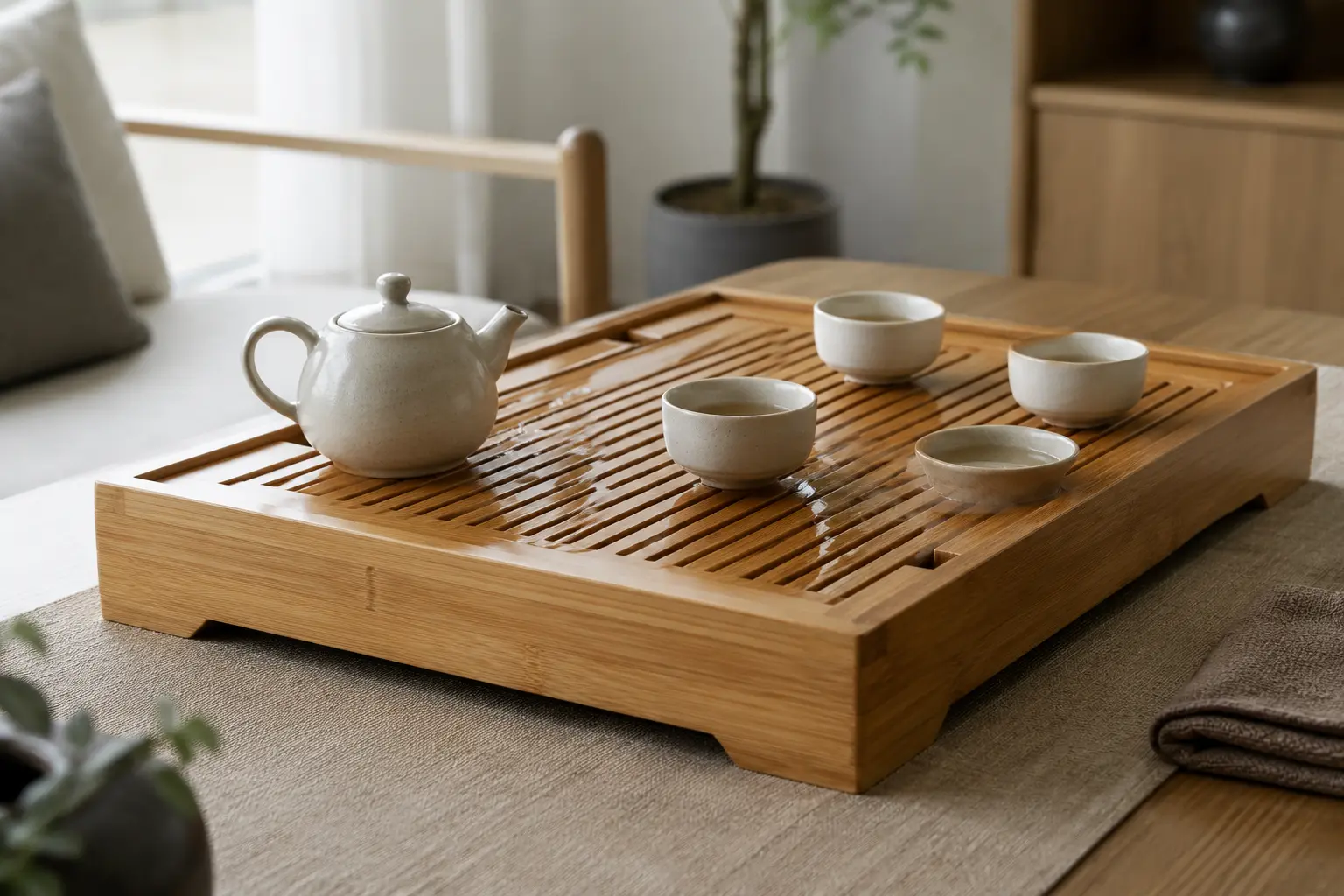
A well-specified bamboo tea tray does more than present a teapot. It defines the serving area, contains drips, supports a repeatable tea ritual, and gives a retail collection a recognizable natural-material story. For tea brands, importers, hospitality groups, wholesalers and retailers, however, visual appeal is only the starting point. The right product also needs a practical water-management system, stable construction, suitable dimensions, efficient packaging and a finish matched to the intended market.
This guide explains the main types of bamboo tea trays, from simple flat serving models to Gongfu-style trays with removable slatted tops, internal catchment pans or drain hoses. It also covers round and rectangular formats, materials, finishes, quality control, care instructions and OEM/ODM decisions. Buyers sometimes enter the search phrase “tea tray bamboo,” but the useful sourcing question is which bamboo construction fits the intended service method. Those looking for a general category overview can also compare our bamboo trays wholesale guide, while this article focuses specifically on tea preparation and presentation.
What Is a Bamboo Tea Tray?
A bamboo tea tray is a dedicated platform for preparing, carrying or presenting tea. A flat bamboo tea serving tray may resemble a compact serving tray with a raised rim and handles. A water-handling tea tray is more specialized: grooves or openings in its top guide spilled water into a reservoir or toward a drain outlet. The best format depends on the brewing method, service frequency and cleaning routine.
Bamboo is selected because it can provide a warm appearance, a relatively favorable strength-to-weight balance and efficient machining for slots, handles and shaped edges. It is still a natural lignocellulosic material, not a waterproof substance. Lamination quality, moisture control, edge sealing and daily care strongly affect performance. A buyer should therefore evaluate the complete construction rather than treating “made of bamboo” as a sufficient specification.
Flat Serving Trays vs Gongfu Water-Management Designs
Flat bamboo tea serving trays
A flat tray is suitable when tea is poured cleanly and only minor drips are expected. It can carry cups from a preparation counter to a table, present packaged teas in a shop, or serve as a compact hospitality tray in a hotel room. Typical features include a solid base, raised perimeter and either cut-out or attached handles. Flat models are usually lighter, simpler to inspect and easier to pack than trays with internal reservoirs.
The product brief should state whether the tray is intended only for presentation or for direct contact with wet teaware. Even a flat tray benefits from rounded internal corners, a wipeable finish and enough rim height to contain incidental spills. For broader food-service applications, see the related guide to bamboo food serving trays.
Removable-top trays with a water catchment pan
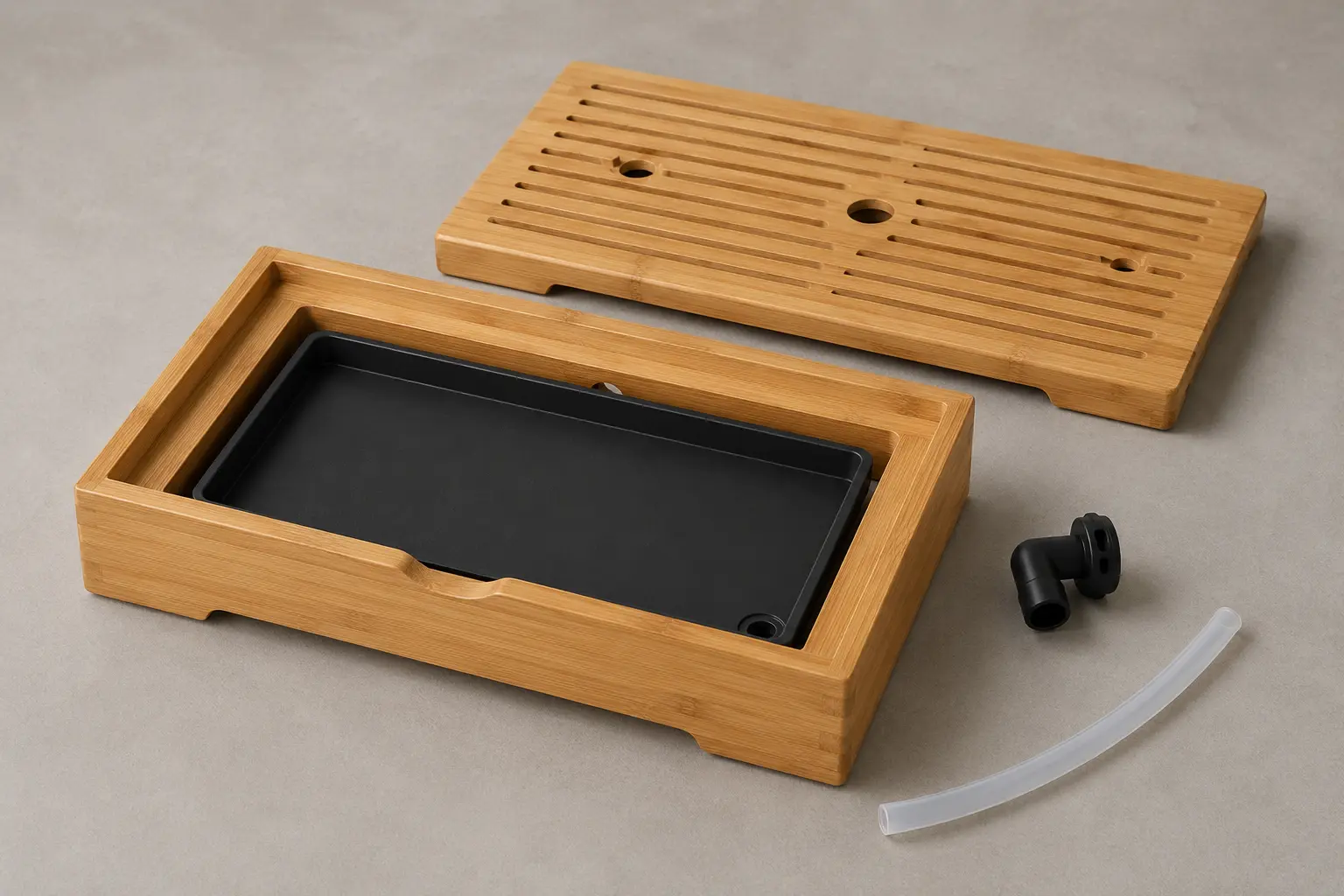
This format uses a slatted, grooved or perforated bamboo top over a removable pan. Rinse water and spills pass through the top and collect below. It is a convenient choice for a home tea table, tasting room or retail demonstration where a nearby drain is unavailable. Reservoir capacity should be proportionate to the tray, but a very deep pan can make the product bulky. Buyers should check how easily the top lifts, whether fingers can reach the pan safely, and whether the reservoir can be removed without scraping the frame.
Direct-drain trays
A direct-drain design guides liquid through an outlet and hose into a separate waste-water container. It supports longer service sessions without repeatedly emptying a shallow pan. The outlet location, hose fit, slope and sealing method require careful prototyping. A detachable hose is useful for cleaning and packing, but the connection should remain secure during normal use. Some programs offer both a catch-pan and a drain version within one visual family; buyers should avoid assuming that every tray supports both systems without a construction change.
Round and Rectangular Bamboo Tea Tray Sizes
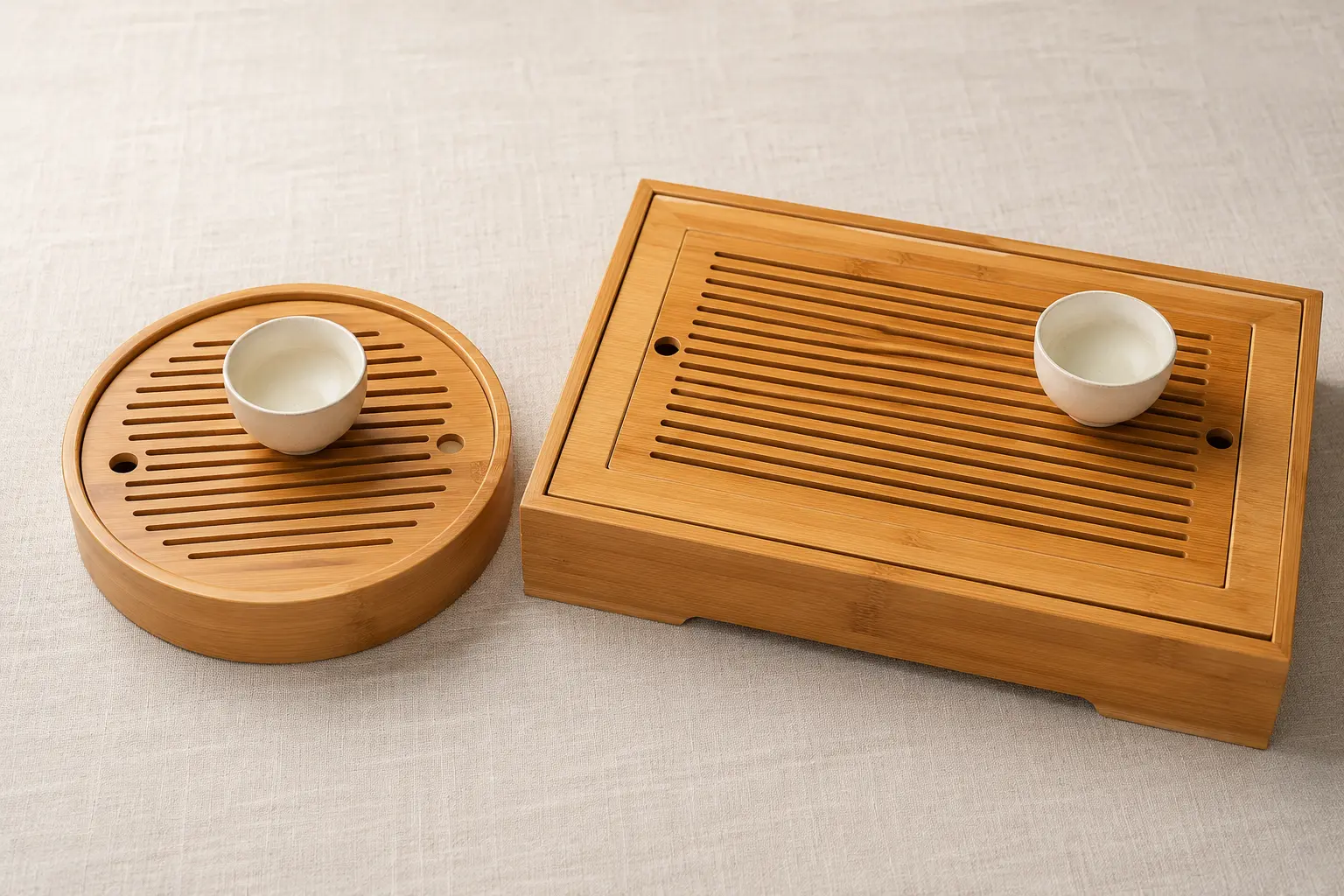
A rectangular tray uses table depth efficiently and accommodates a linear arrangement of teapot, fairness pitcher and cups. It is the most flexible option for collections requiring several sizes. A round bamboo tea tray creates a softer visual presentation and works well with a compact teapot and a few cups, but usable surface area decreases quickly near the curved edge. Square and oval shapes can fill narrower assortment gaps, although custom tooling and packaging should be considered.
| Format | Illustrative size range | Typical setup | Buyer consideration |
|---|---|---|---|
| Compact round | Approximately 20–28 cm diameter | One small pot and 1–3 cups | Confirm stable cup area around the curved perimeter |
| Small rectangular | Approximately 28–35 cm long | Personal or couple service | Balance reservoir capacity with overall height |
| Medium rectangular | Approximately 36–50 cm long | Tea tasting or family service | Check flatness and center support across the span |
| Large rectangular | More than 50 cm long | Hospitality or group presentation | Review carton strength, weight and dimensional freight |
These ranges are planning examples, not universal standards. The final specification should list external dimensions, usable top area, internal pan capacity, overall height, product weight and carton size. Request a physical sample with the intended teaware because product photographs alone can make a tray look larger than it is.
Construction Details That Influence Daily Performance
Bamboo panels, strips and lamination
Most solid-looking trays are assembled from laminated bamboo strips or panels. Specify the visible grain direction, color tolerance and acceptable joint lines. A stable moisture range and balanced construction help reduce cupping and twisting, but performance also depends on storage and climate. Thick material is not automatically better: unnecessary mass increases cost and freight, while poorly balanced thick panels can still move.
Slats, grooves and removable tops
Slots must drain efficiently without weakening narrow ribs or trapping cleaning cloths. Inspect slot width, spacing, machining cleanliness and the support points beneath the top. A removable top should sit without rocking, yet lift without tools. Finger notches can improve access. On direct-drain models, the surface should promote flow toward the outlet instead of leaving persistent puddles.
Edges, feet and hardware
Rounded edges are more comfortable to handle and less vulnerable than sharp corners. Feet should sit level and protect the table from the wet underside. If screws, magnets, fittings or attached handles are used, specify their material and corrosion expectations. Hidden cavities should remain accessible enough for inspection and cleaning. For standard serving ranges, buyers may also browse our bamboo and wooden kitchenware.
Materials, Finishes and Style Direction
Natural-tone bamboo is the most familiar choice, but carbonized-looking darker tones, stains or color finishes can support different retail stories. Color variation must be agreed through an approved sample or boundary samples because bamboo strips naturally vary. The coating brief should define sheen, feel, stain resistance and intended contact conditions. A coating described as “food safe” should be supported by documentation or testing relevant to the precise formula, application and destination market; it should not be assumed from a generic statement.
Searches for Chinese, Japanese or Vietnamese bamboo trays can refer to visual influences, manufacturing origin or a specific cultural use. These terms should be handled accurately. Gongfu-style commonly describes a compact brewing setup that manages rinse water; it does not prove geographic origin. A Japanese-inspired minimalist tray may use restrained lines and a pale natural finish, while a Vietnamese-made product describes manufacturing location only when it is actually produced there. Buyers interested in dual-country sourcing can review our Vietnam factory information. Avoid “authentic” or origin claims unless the design, production and documentation substantiate them.
B2B Specification Checklist
A clear request for quotation reduces revisions and makes supplier comparisons more meaningful. Include the following information:
- Use: dry presentation, routine tea service, retail display or frequent hospitality use.
- Format: flat, catchment-pan or direct-drain construction.
- Dimensions: external size, usable area, height, slat spacing and reservoir capacity.
- Material: bamboo component description plus materials used for pan, hose, feet and fittings.
- Finish: color, sheen, coating performance and approved appearance range.
- Branding: laser engraving, printing, label, sleeve or retail box artwork.
- Packaging: unit protection, carton quantity, drop-test target where required and barcode placement.
- Commercial terms: target quantity, delivery destination, sample plan and requested Incoterm.
Do not compare quotations only by unit price. A lower price may exclude a reservoir, stronger packaging, individual labeling, testing or an upgraded finish. Ask each supplier to quote against the same specification and identify any deviations.
Packaging and Shipping for Wholesale Orders
Tea trays combine wide surfaces, finished corners and sometimes loose internal components, so packaging should prevent abrasion and movement. A soft interleaf or protective bag can reduce rubbing; molded paper, corrugated inserts or corner protection can secure the product. The slatted top, reservoir and hose should not move freely inside the box. Retail packaging also needs clear assembly or care instructions when the drainage system is not self-evident.
For e-commerce programs, review single-unit drop resistance and the appearance of the retail box after parcel handling. For palletized wholesale orders, confirm master-carton strength, carton orientation, pallet pattern and moisture protection. Large trays may have an attractive unit cost but inefficient volumetric freight, so packaging dimensions should be evaluated during design—not after production approval.
Quality Control and Conditional Compliance
A practical inspection plan should cover dimensions, flatness, wobble, surface color, sanding, coating, slat integrity, pan fit, outlet function, leakage, odor and packaging. Function tests can include pouring a defined amount of water across representative areas, confirming flow and emptying the reservoir repeatedly. Samples should also be checked after normal wipe cleaning and drying. Inspection thresholds and test methods need to be agreed before mass production.
Compliance requirements vary by material, intended use and destination. REACH-related screening, food-contact testing or other documentation may be relevant, but the correct protocol must be confirmed for the specific product and market. FSC claims are also scope-dependent: ask for a valid certificate, product scope and transaction documentation where an FSC claim is required. The FSC Chain of Custody overview explains how certified material is tracked through the supply chain. BSCI is generally discussed as a social-audit framework for a production site, not as a product safety certificate. Buyers should verify current audit status and scope rather than placing an unsupported logo on packaging.
How to Clean and Care for a Bamboo Tea Tray
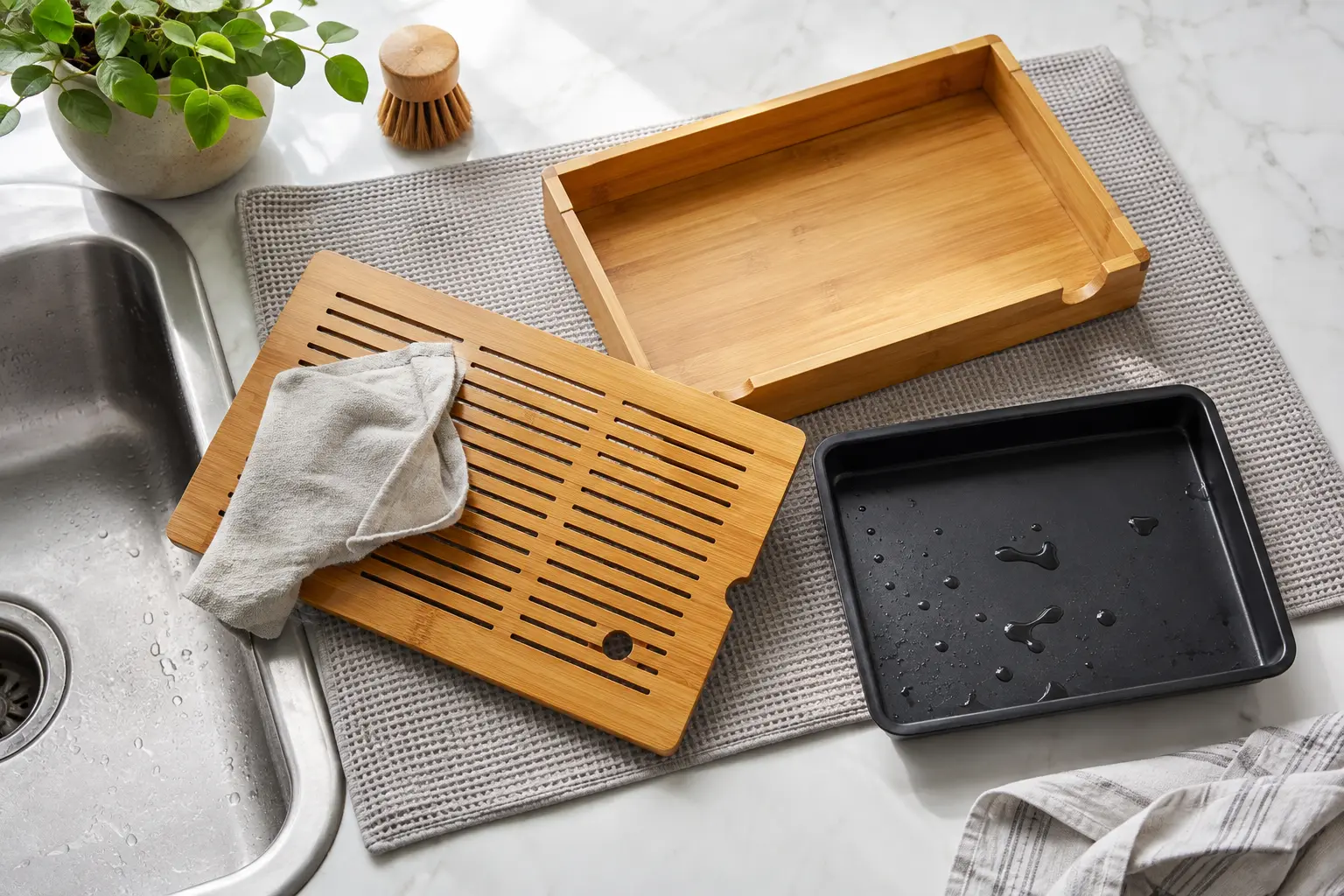
Care instructions should match the approved finish and drainage parts. As a general routine, remove the teaware, empty the catchment pan, wipe the bamboo with a soft damp cloth, and dry all components promptly. Lift the removable top so both sides can air-dry. Clean the hose and outlet according to the supplier’s instructions and do not allow old tea water to remain in the system.
Avoid prolonged soaking, dishwashers, harsh abrasives and storage beside intense heat. Never pack a damp tray back into a closed box. If tea stains appear, use only a mild cleaning method compatible with the coating. Retail care cards should distinguish bamboo components from removable plastic or metal parts because their cleaning requirements can differ.
OEM and ODM Options for Tea Brands and Importers
OEM customization can begin with an existing construction and adjust size, color, laser engraving, packaging or accessories. ODM development goes further, potentially changing the frame, slat pattern, reservoir, outlet or visual language. New structures require more engineering time than a logo change. A sensible process is concept review, dimension drawing, material confirmation, prototype, function testing, packaging sample, pre-production sample and mass-production inspection.
Provide the intended teaware footprint and service method at the beginning. This allows the factory to evaluate load, working area and water volume rather than designing from an exterior silhouette alone. Our manufacturer profile explains the broader custom-development approach, and buyers can use the contact page to submit drawings, target quantity and destination.
Frequently Asked Questions About Bamboo Tea Trays
Do all bamboo tea trays have drainage?
No. Some are flat carrying or presentation trays, some use a removable catchment pan, and others drain through an outlet and hose. The quotation should name the system and list every included component.
Is a round bamboo tea tray suitable for Gongfu brewing?
It can be, provided the tray has sufficient working area and a suitable way to contain or drain water. Round models work best with compact teaware; verify the arrangement with a physical sample.
Can a bamboo tea tray be washed in a dishwasher?
Usually not. Heat, extended moisture and detergent can affect bamboo joints and finishes. Follow product-specific instructions, wipe the bamboo promptly and wash removable non-bamboo components only as permitted.
What information is needed for a wholesale quotation?
Send dimensions, design type, drainage method, finish, branding, packaging, target quantity, destination and compliance needs. Photographs are helpful, but a dimensioned drawing or annotated reference reduces ambiguity.
How should bamboo tea trays be inspected before shipment?
Inspection should combine appearance, dimensions, flatness, stability, component fit, drainage or reservoir testing, odor and packaging checks. The sampling level and pass/fail criteria should be agreed in the purchase specification.
Can tea trays be coordinated with other bamboo organizers?
Yes. A coordinated assortment can share bamboo tone, edge profile and packaging design. Keep the functions distinct: tea trays manage serving and water, while bamboo cutlery trays and drawer organizers require different dimensions and compartment engineering.
Request a Bamboo Tea Tray Quote
Fujian Xianxu Bamboo & Wood Co., Ltd. supports OEM/ODM development for bamboo and wooden homeware programs. To discuss a tea tray collection, send the target shape and size, flat or drainage construction, finish, logo method, packaging, order quantity, destination market and desired timeline. We can then review manufacturability, sample requirements and the information needed for a comparable quotation. Visit our bamboo and wooden products website or contact our team with your brief.