
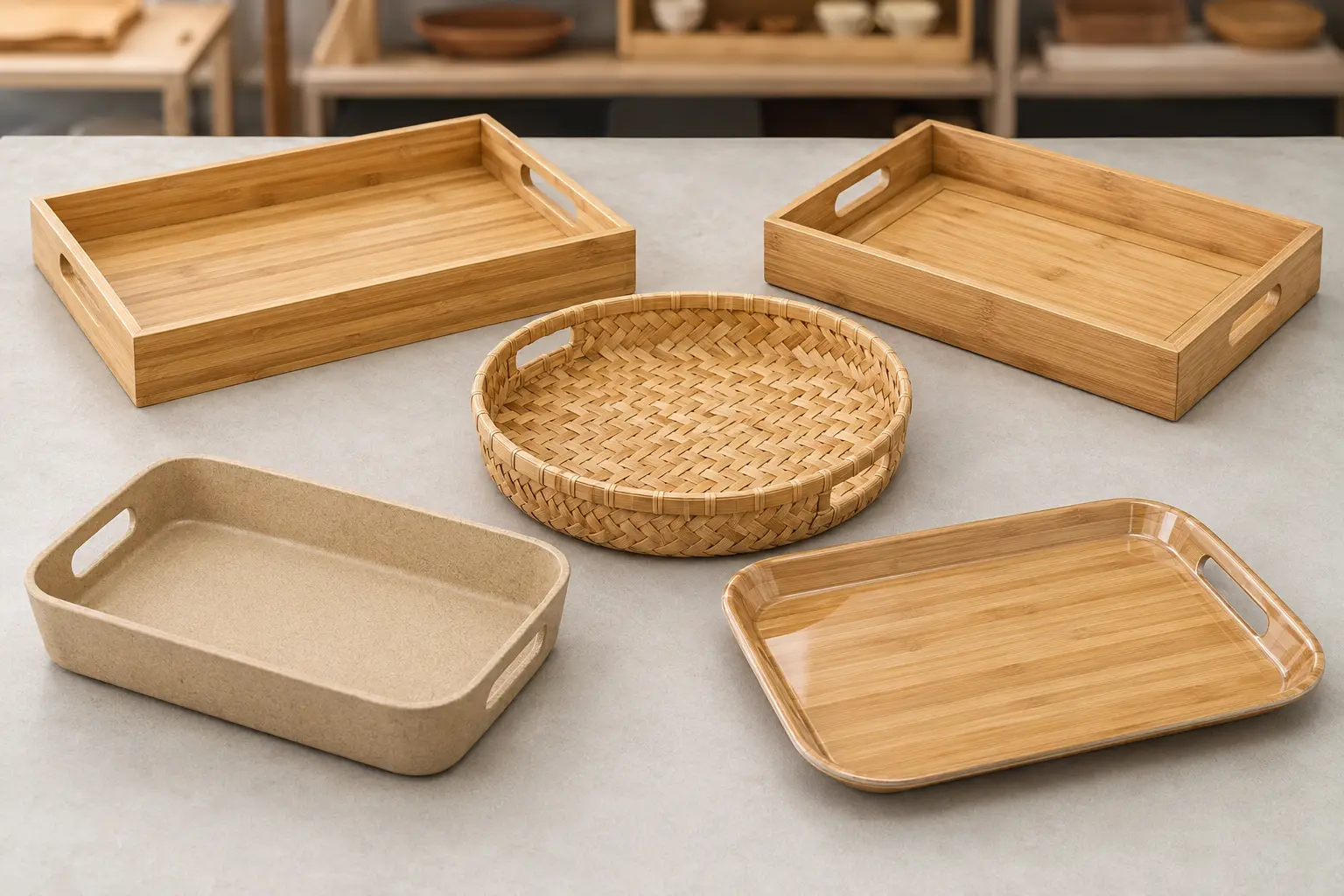
The phrase bamboo tray can describe products with very different structures. A buyer may receive a solid laminated bamboo wooden tray, a framed tray with a thin inset panel, a woven basket, a molded fibre composite or a melamine product with bamboo content or bamboo-look decoration. These options do not share the same weight, moisture response, surface performance, food-contact conditions or documentation.
This guide helps European and North American importers, wholesalers, hospitality suppliers, retailers and brands compare bamboo tray materials on a like-for-like basis. It focuses on what the names usually mean, which questions uncover the actual bill of materials, and how construction should influence testing, packaging, quality control and OEM development.
Why Bamboo Tray Material Names Need Verification
A marketplace title is written for search, not engineering. “Natural,” “wooden,” “woven,” “fibre” and “melamine” can refer to material, appearance, construction or all three. Even the phrase tray made of bamboo does not state whether bamboo forms the entire tray, a veneer, a woven surface, a filler or only a printed visual.
Before comparing quotations, request a component-level description. The base, rim, handles, feet, adhesive, coating, ink and decorative parts should each be identified. Ask suppliers to state approximate material proportions where composites are involved. This prevents a low-cost molded product from being compared directly with a thick laminated panel, and it gives compliance reviewers a usable starting point.
1. Solid and Laminated Bamboo Wooden Trays
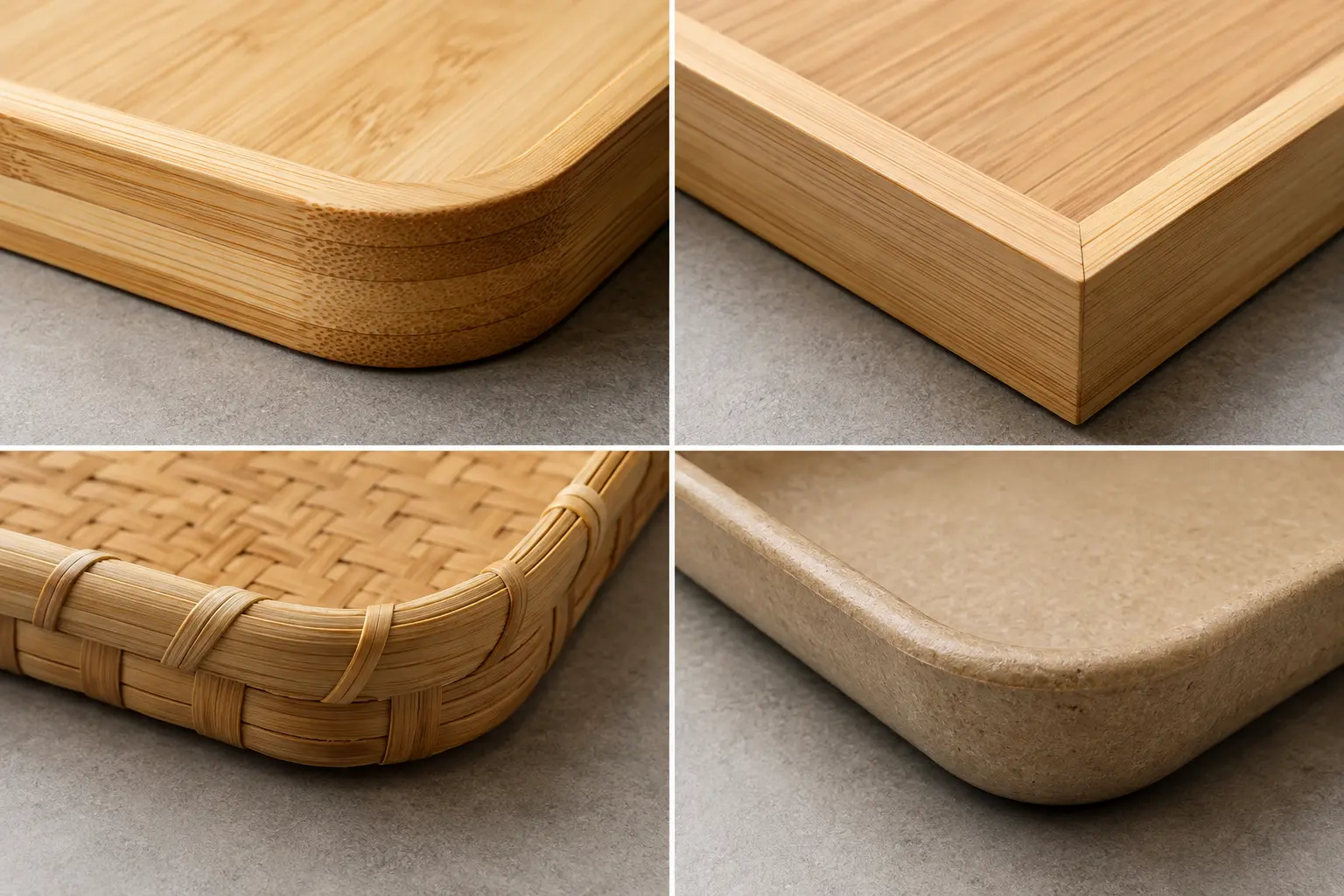
A solid-looking bamboo wooden tray is commonly assembled from laminated bamboo strips or panels. Bamboo is botanically a grass, but “wooden bamboo tray” and “bamboo wood tray” are familiar commercial descriptions for products manufactured with woodworking processes. The critical point is not the wording; it is whether the base and rim are solid laminated bamboo, veneered board or a combination.
Laminated construction can show attractive linear grain and support routed edges, attached rails or integrated handles. Its performance depends on strip preparation, moisture control, adhesive distribution, pressing, conditioning, machining and finishing. More bamboo thickness does not automatically mean a better tray: poor grain selection, unbalanced construction or weak joints can still lead to warping and cracks.
A natural bamboo tray may have a clear coating, oil or wax even though its color looks untreated. Conversely, a genuinely raw bamboo tray may be unfinished and intended for further processing rather than retail use. Ask whether “raw” describes the surface, the color or the production stage.
2. Frame-and-Panel Bamboo Tray Construction
Frame-and-panel trays use separate side rails around an inset base. The panel may be laminated bamboo, bamboo plywood, veneer over another core or a composite sheet. This approach can reduce weight and create deeper walls, but the rim-to-base joint becomes a key inspection point.
Request a cross-section drawing that identifies the core and surface layers. Check panel thickness, insertion depth, adhesive line, corner joint, handle reinforcement and the finish applied to concealed edges. A frame can appear substantial while holding a very thin base, so load testing should reflect the intended dishes or merchandise.
3. Woven, Wicker, Rattan, Cane and Basket Trays
Woven bamboo serving trays are made from strips or splints arranged around a rim or supporting frame. They can create a lighter, handcrafted presentation and may suit decorative display, dry packaged goods, guest amenities or a lined serving concept. Weave density, strip width, edge binding and frame stiffness determine how the tray handles and how easily it collects dust or crumbs.
“Wicker” describes a weaving technique, not a single plant. Bamboo wicker serving trays may be bamboo, another cane material or a mixture. Rattan is also not the same material as bamboo, so listings for bamboo rattan serving trays require a species and component breakdown. A bamboo cane tray or bamboo basket tray can likewise use a bamboo frame with non-bamboo woven elements.
A spun bamboo tray may refer to thin bamboo strips that are coiled, formed or laminated around a mold, often with a coating system. Because regional terminology varies, confirm the production method with a section sample or factory video. Do not infer composition from a visual “rattan style.”
4. Molded Bamboo Fiber and Bamboo Fibre Trays
Bamboo fiber tray is the US spelling, while bamboo fibre tray is common in UK and European searches. Both often describe a molded material containing processed bamboo fibre or powder plus a binder or polymer. The result may have consistent color, rounded forms and efficient molding, but it is not equivalent to a solid bamboo panel.
Ask for the full formulation or the disclosure level required by your compliance process: bamboo fraction, binder or resin type, pigments, coatings and any recycled content claim. Heat response, odor, staining, dishwasher suitability and migration behavior depend on the final formulation and manufacturing conditions. A high bamboo percentage alone does not establish food-contact suitability or environmental performance.
5. What Does “Bamboo Melamine Tray” Mean?
A bamboo melamine tray can mean several things: melamine tableware with a bamboo-grain print, melamine resin containing bamboo fibre filler, or a product marketed beside bamboo items despite using a different substrate. These are materially different products. The supplier should state the resin system, filler, decorative film, coating and intended temperature and contact conditions.
Melamine products can provide repeatable shapes and decorative surfaces, but buyers must assess the exact formulation against current destination-market rules and the intended use. Do not treat “bamboo” in the name as evidence that the product is plastic-free, compostable, automatically suitable for food contact or covered by a bamboo sourcing certificate.
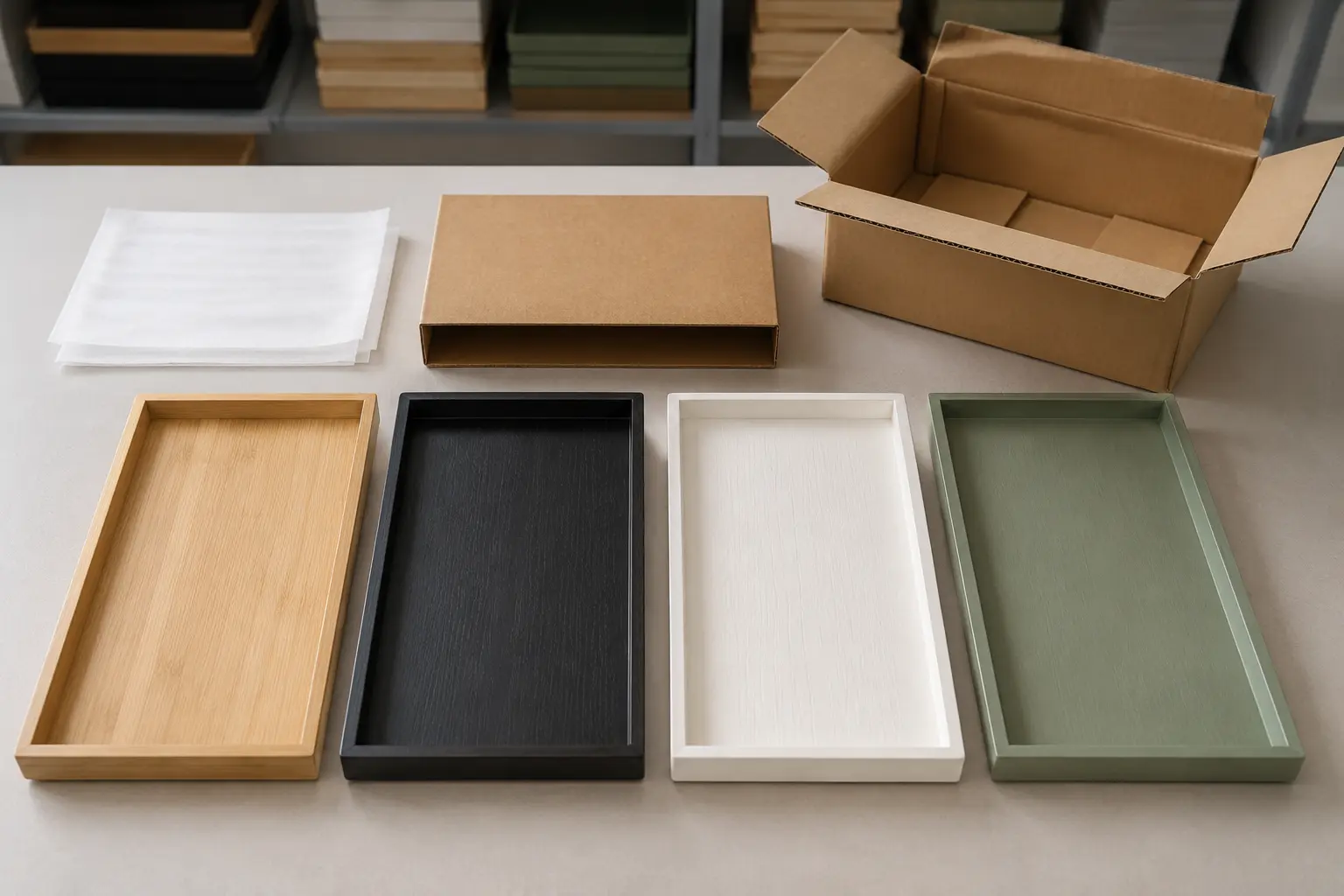
Raw, Natural and Colored Bamboo Are Finish Descriptions
Color names should not be confused with substrate. A clear-coated natural tray, a black bamboo tray, a white bamboo tray and a green bamboo tray may all use the same laminated base beneath different coatings. Alternatively, the color may be introduced through stain, pigment, decorative film or a molded compound. Each route changes the inspection and testing questions.
The phrases bamboo raw tray and raw bamboo tray are sometimes used for a pale natural look even when a clear finish is present. For an accurate quotation, state “unfinished,” “clear matte coated,” “stained,” or “opaque painted” instead. Provide a physical color standard and acceptable variation range. Natural bamboo will show grain and tone variation; an opaque finish may hide grain but make scratches or edge chipping more visible.
Adhesives, Coatings and the Final Bill of Materials
Adhesive holds laminated strips, frame joints, veneers and some woven reinforcements together. Coatings control appearance and help manage routine surface exposure. Neither should be evaluated only by a trade name. Request supplier declarations or technical information that identifies the exact production system, including catalyst, thinner, pigment and printing ink where applicable.
Any compliance conclusion must relate to the final bill of materials, production process, intended use and destination market. A test on clear-coated laminated bamboo does not automatically cover a colored tray, a different adhesive, a printed logo or a molded fibre formula. Changes after sample approval should be controlled and documented.
If an FSC claim is commercially required, review the supplier's certificate scope, product eligibility and transaction documents through the FSC Chain of Custody framework. FSC status concerns sourcing and claim control; it does not establish food-contact suitability, chemical compliance, moisture resistance or overall product sustainability.
Moisture Resistance and Food Contact Must Be Validated
No material in this guide should be assumed waterproof or automatically food-safe. Laminated bamboo may swell or warp after prolonged exposure; woven structures can retain moisture; molded fibre and melamine systems respond according to their binders and processing. The appropriate evaluation depends on whether the tray holds sealed packages, carries ceramic dishes or contacts food directly.
Define food type, temperature, duration, repeated-use cycle, cleaning method and contact area. Oil, acid, alcohol, salt, heat and abrasion may affect results differently. Select declarations and laboratory tests for the actual construction and current EU, US or other destination requirements. Importers should confirm the plan with qualified compliance advisers rather than relying on a generic “eco” or “food grade” statement.
For application-specific examples, review our guide to bamboo food serving trays and the separate bamboo tea tray guide.
Bamboo Tray Material Selection Matrix
| Construction | Potential design advantages | Questions for the supplier | Key validation |
|---|---|---|---|
| Laminated solid bamboo | Visible grain, machined profiles, substantial feel | Strip orientation, adhesive, thickness, moisture control | Flatness, joints, load, wet-cycle response |
| Frame and inset panel | Lower weight, deeper rim, mixed thicknesses | Panel core, insertion depth, concealed-edge finish | Base deflection, joint strength, dimensional tolerance |
| Woven bamboo or cane | Light, tactile, handcrafted appearance | Species, weave, frame, binding and coating | Loose ends, snagging, cleaning, load and shape |
| Molded bamboo fibre composite | Repeatable form, rounded geometry, color options | Fibre percentage, binder, pigment and process | Heat, odor, staining, migration and impact |
| Melamine or decorated composite | Consistent surface, printed design, scalable molding | Resin, filler, decorative layer and use limits | Applicable migration, heat and surface-wear tests |
This matrix is a starting point, not a ranking. The best option depends on positioning, duty cycle, target price, shape, care instructions, packaging and regulatory plan. Buyers can compare broader tray programs in our bamboo trays wholesale guide and dimensions in the bamboo tray sizes and shapes guide.
How to Compare Supplier Quotations Fairly
Send one RFQ template to every supplier. Include a drawing, outer and usable dimensions, component materials, target weight, load, finish, food-contact condition, logo, packaging and required documentation. Ask each supplier to list deviations rather than silently substituting a panel, coating or resin.
Compare unit price together with net weight, packing density, tooling, sample charges, testing, carton specification and expected defect risk. A lower quote may reflect a thinner base, different core, lower bamboo proportion, simplified sanding or retail packaging exclusion. Obtain section samples when the finished appearance hides the construction.
Quality Control for Material, Bonding and Finish
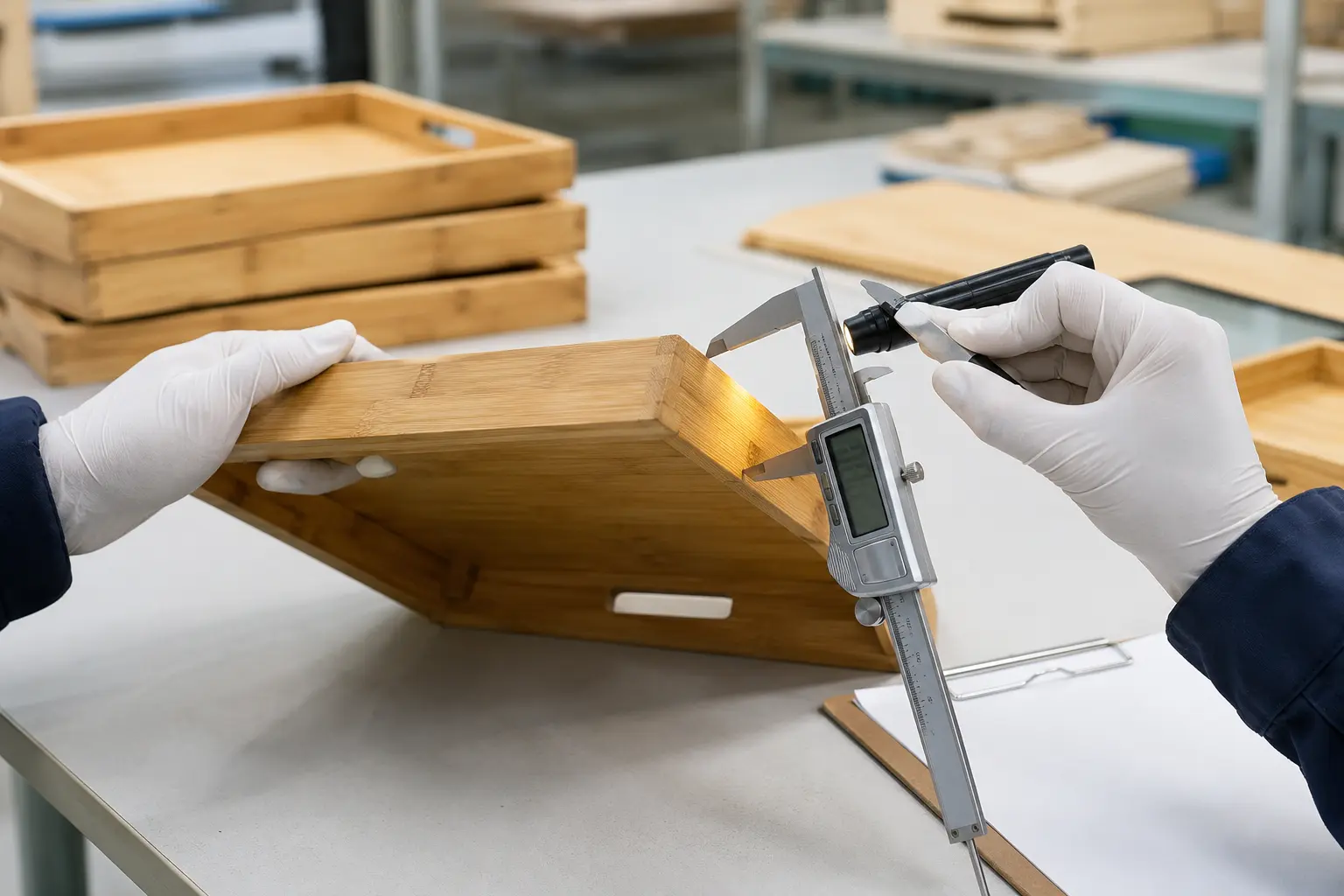
Approve a signed sample, component list and color standard before production. Incoming checks may cover bamboo strip quality, panel moisture, veneer condition, woven material, resin batch or coating identity, depending on construction. First-article inspection should confirm dimensions, assembly sequence, joint fit and finish before volume increases.
In-process and final checks can include thickness, usable area, flatness, corner geometry, handle strength, surface smoothness, coating coverage, weave security, molded defects, color range and stack fit. Functional tests should replicate the agreed load, cleaning and exposure conditions. Packaging checks must use the final unit pack and carton, not a temporary sample box.
Define critical, major and minor defects with photographs. Sampling and acceptance limits should reflect the order's risk and sales channel; there is no universal AQL setting for every material. Any approved material change should trigger a documented review of performance and compliance impact.
Packaging and OEM/ODM Development
Solid and framed trays need edge, corner and surface protection; woven trays need support against crushing and snagging; molded products may need separators to prevent rubbing. Specify interleaving, sleeve, inner carton, master carton, quantity, barcode location and pallet pattern. Moisture-control packaging should be selected for the route and local rules, not added by habit.
OEM/ODM options can include size, shape, handle, weave, frame, finish color, laser or printed logo and retail packaging. Confirm how customization changes the bill of materials. A colored coating, new ink or decorative film may require additional review. Our company overview and Vietnam factory page provide background for sourcing discussions, and our kitchenware range shows related category context.
Frequently Asked Questions
Is a bamboo wooden tray made from one solid piece?
Usually not. Many are laminated from bamboo strips or assembled from a panel and separate rim. Ask for a cross-section drawing, material breakdown and thickness specification rather than assuming “solid” means one piece.
Are woven bamboo serving trays the same as rattan trays?
No. Wicker is a technique, while bamboo and rattan are different materials. A woven tray may contain bamboo, rattan, another cane or a mixture. Request species and component identification.
Does a bamboo fiber tray contain plastic or resin?
Many molded fibre trays use a binder or polymer, but formulas vary. Request the bamboo content, binder type, pigments and other additives. Do not infer “plastic-free” from the bamboo-fibre name.
Is a bamboo melamine tray food-safe?
The name is insufficient to answer. Suitability depends on the exact resin, filler, decoration, manufacturing process, food conditions and destination requirements. Validate the final product and intended use with appropriate documentation or testing.
Is an unfinished raw bamboo tray more natural?
“Raw” may mean unfinished or may only describe a pale color. An unfinished surface is not automatically better for moisture, cleaning or food contact. Confirm the surface treatment and intended next production step.
Can black, white and green bamboo trays use the same base material?
Yes. Different colors can be coatings over the same bamboo construction, although molded compounds or decorative films are also possible. Treat color as a separate specification and verify the exact finish system.
Specify the Material Before You Compare the Price
A reliable tray quotation begins with material clarity. Define the substrate, joints, adhesive, finish, intended contact and validation plan before evaluating price or environmental claims. Visit our bamboo and wooden products website, then contact our team with your target construction, dimensions, quantity, market and packaging. We can review open specification questions and discuss a sample and OEM/ODM route.