
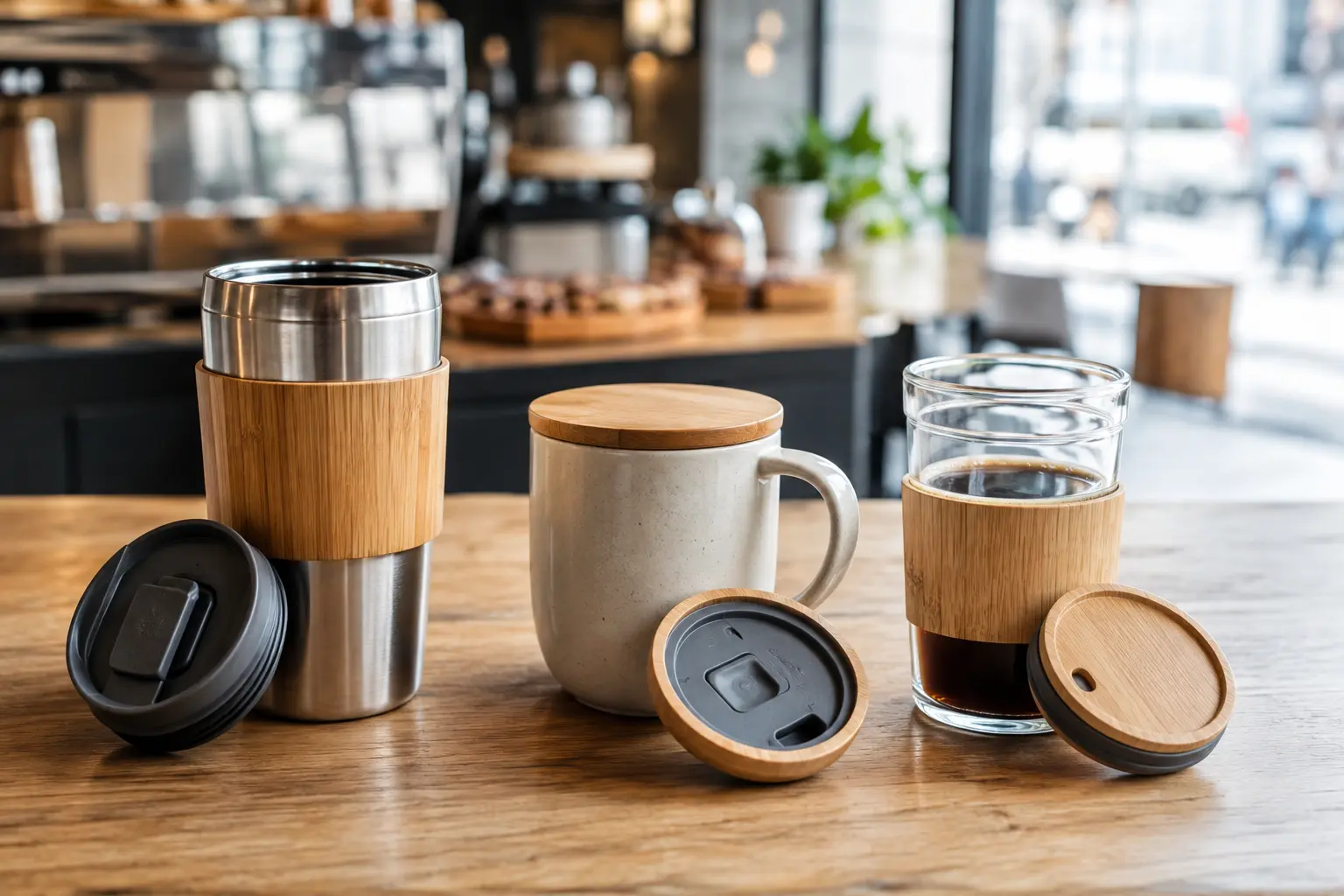
A bamboo coffee cup can be a compact mug for the desk, a lidded cup for the café queue, or an insulated travel vessel for a long commute. Those products may look similar in a search result, yet their construction, lid behavior, heat retention, cleaning requirements, and customization options can be very different. Choosing well starts by looking beyond the word “bamboo.”
This guide explains how to compare a bamboo travel mug or bamboo travel cup by its actual materials and intended use. It covers reusable designs, common lid systems, insulation, handles, decoration, and the questions a buyer should resolve before ordering. It does not treat “bamboo” as a performance claim: microwave, dishwasher, food-contact, hot-drink, and leak-resistance statements must always be supported for the exact product.
What Does “Bamboo Coffee Cup” Actually Mean?
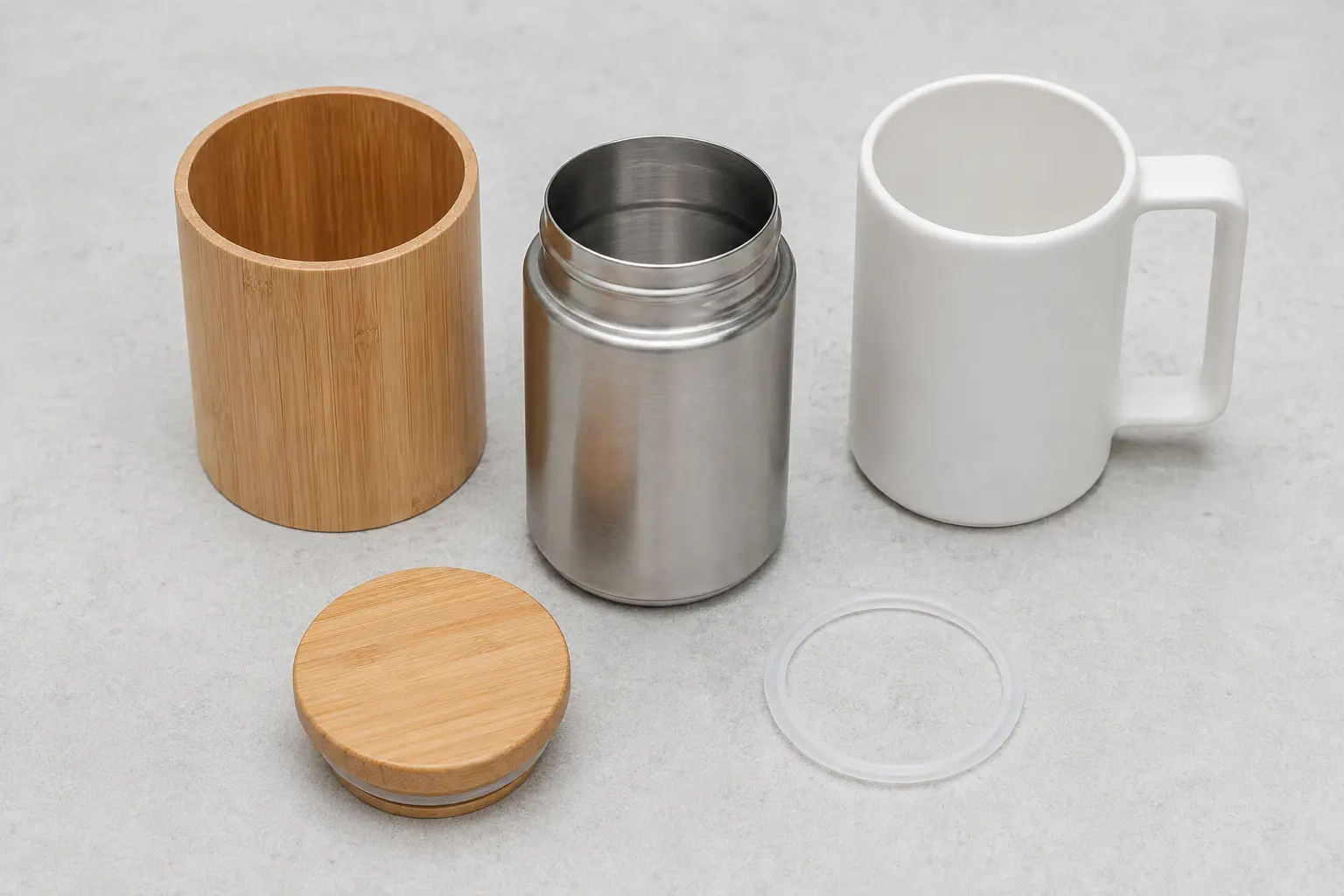
The name describes an appearance or a material connection, not one universal construction. A bamboo coffee cup may use bamboo as the main cup body, as an outer sleeve, as a decorative veneer, or only as the lid. It may also be a molded composite sold as a bamboo-fiber cup. Before comparing prices or features, identify every layer that contacts the drink.
- Natural bamboo body: bamboo is shaped, laminated, or assembled to form much of the vessel. The coating, adhesive, joints, and intended beverage temperature all matter.
- Stainless-steel interior with bamboo exterior: the metal liner holds the drink while bamboo provides the visible finish, grip, or sleeve. This format can be single-wall, double-wall, or vacuum insulated.
- Ceramic or glass mug with bamboo lid: the cup’s food-contact body is ceramic or glass, while a fitted bamboo lid changes the look and may help cover the opening. The gasket and closure determine how the lid behaves.
- Molded bamboo-fiber composite: plant fiber is combined with a binder or polymer. The complete formulation and the target market’s food-contact rules must be reviewed; “bamboo fiber” alone does not describe the product sufficiently.
This distinction prevents an easy sourcing mistake. A coffee mug with bamboo lid is not the same as a cup made of bamboo, and a stainless bamboo coffee thermos is not the same as a lightweight molded cup. Product descriptions, specifications, test scope, and care instructions should reflect the real construction.
For the glass-body subcategory, our separate glass tumbler with bamboo lid wholesale guide covers glass thickness, lid fit, straw dimensions and protective packaging. This article stays focused on coffee and travel-mug selection rather than repeating that sourcing guide.
Start With the Drinking Situation
There is no single best bamboo coffee cup for every user. The right design depends on where the cup will be filled, how it will be carried, how long the drink should remain warm, and how the user prefers to sip. Build a short use-case brief before selecting a catalog shape.
| Use case | Useful design priorities | Questions to verify |
|---|---|---|
| Desk or home | Comfortable rim, stable base, optional handle, simple cleaning | Will it be used with a lid, and is the lid only a cover or a travel closure? |
| Café takeaway | Fast opening, manageable sip flow, easy hand grip | Does the lid fit consistently after repeated removal and cleaning? |
| Short commute | Cup-holder fit, one-hand operation, splash control | Must the cup remain upright, or is bag transport expected? |
| Long journey | Documented insulation, secure closure, replaceable seals | Has the finished design been tested for heat retention and leakage? |
| Corporate gift | Visible branding area, attractive finish, presentation packaging | Can the decoration survive normal use and cleaning? |
A bamboo reusable coffee cup intended for an office program may prioritize a comfortable drinking edge and quick cleaning. A reusable bamboo travel mug intended for field staff may need a more secure closure and an insulated metal liner. Defining the route from fill point to final sip is more useful than selecting by appearance alone.
Choose the Lid as a Complete System
The lid often determines whether a bamboo to-go cup feels convenient or frustrating. Buyers should assess the lid, gasket, drinking port, vent, and cup rim together. A lid that fits one nominal diameter may not fit another cup with the same listed capacity, because rim dimensions and tolerances can differ.
| Lid format | Typical advantage | Important limitation to check |
|---|---|---|
| Press-fit silicone lid | Quick to remove and convenient for upright café use | Fit depends on rim geometry; it should not be assumed suitable for loose bag transport |
| Threaded screw lid | Positive engagement is easy to feel when correctly aligned | Cross-threading, gasket position, and an open sip port can still allow leakage |
| Slider or flip closure | Covers the drinking opening between sips | Small channels and moving parts can be harder to clean |
| Locking or stopper system | Can provide added closure control for travel | Performance must be tested after repeated opening, washing, and gasket removal |
| Bamboo lid with gasket | Natural visual finish for ceramic, glass, or metal mugs | It may function as a dust cover rather than a spill-resistant travel lid |
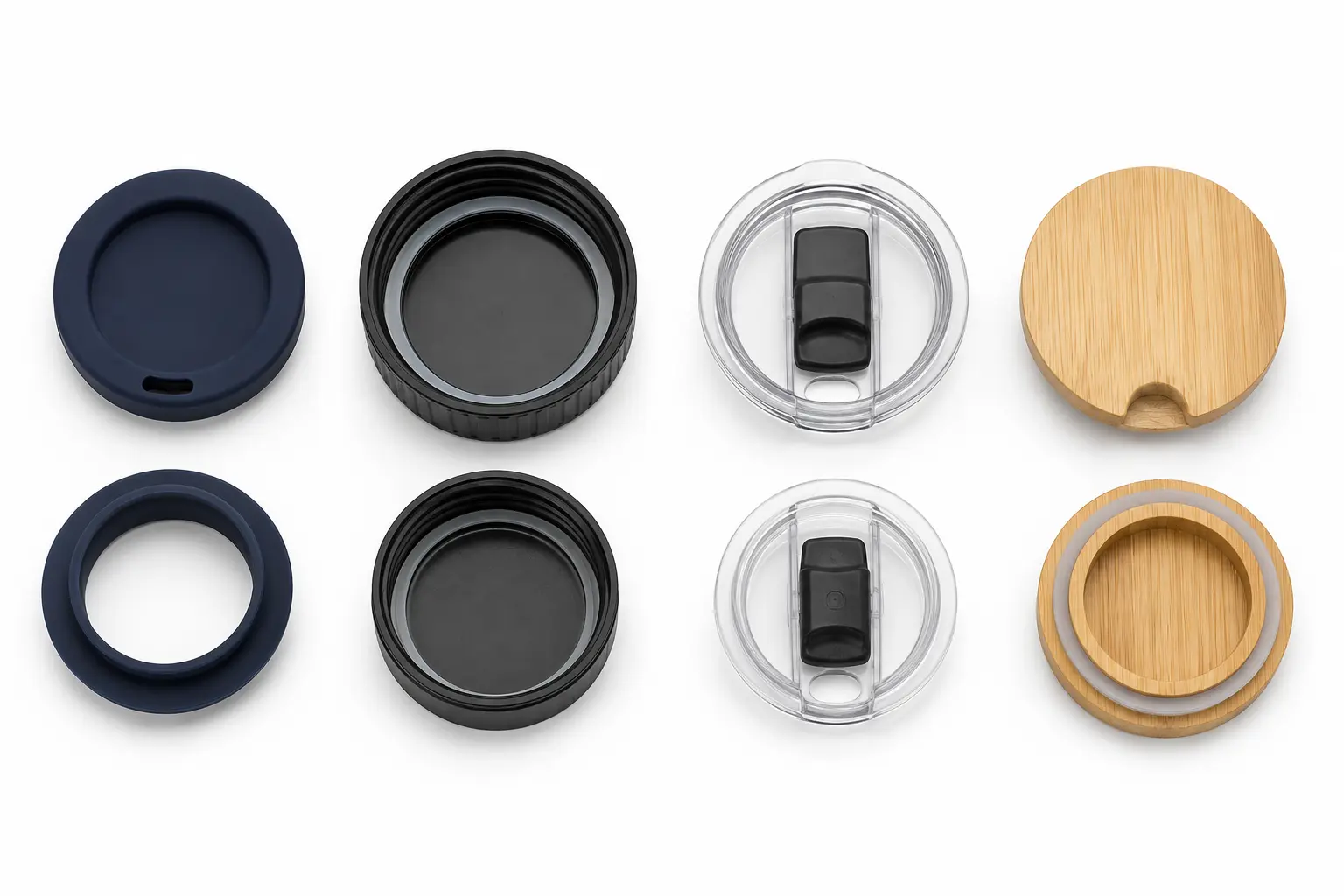
A bamboo travel mug with screw lid is not automatically leakproof. “Threaded,” “splash-resistant,” and “leak-resistant” describe different things. If a product will be placed in a backpack, request a defined test method, fill level, liquid temperature, orientation, duration, and pass criterion. Also test the cup after realistic use cycles, because a new gasket can behave differently from one that has been removed and refitted many times.
A bamboo travel mug with silicone lid can be a practical upright-use format, particularly when fast refilling matters. Evaluate the force required to fit and remove it, the sip-opening geometry, the vent, and whether the user’s nose contacts the lid while drinking. For either lid type, replacement gaskets or closures can extend the usable life of the complete cup.
Insulation: Separate Structure From Appearance
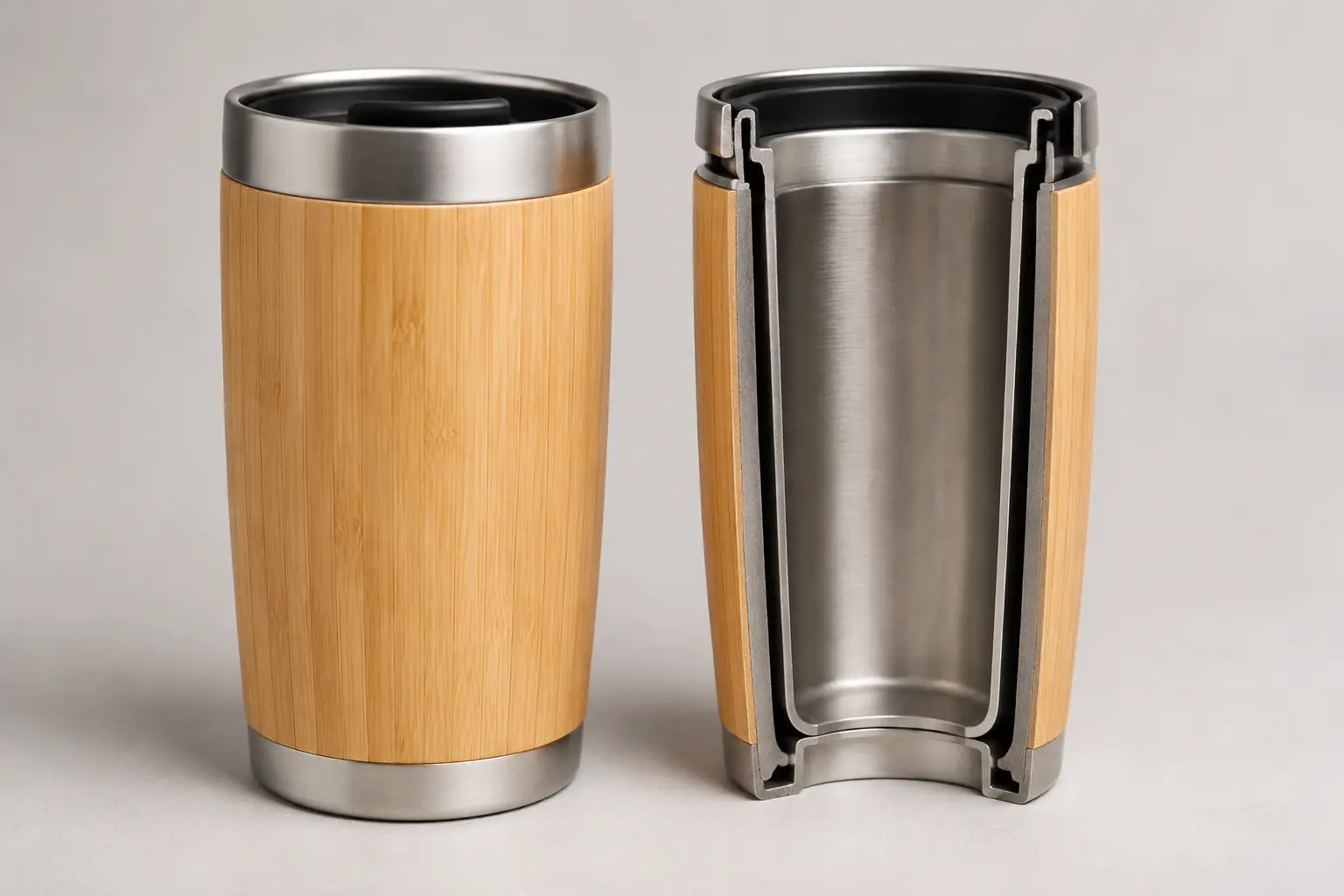
A bamboo-style surface does not tell you how well a cup retains heat. Insulation comes mainly from the vessel structure beneath that surface. A single-wall cup offers little thermal separation. An air-gap double wall can slow heat transfer, while a properly manufactured vacuum-insulated metal vessel is designed to reduce conduction and convection between its inner and outer walls.
- Single-wall designs are often lighter and simpler but may become hot to hold, depending on the material and beverage temperature.
- Double-wall, non-vacuum designs add a separation layer and can improve hand comfort, but their performance should not be equated with vacuum insulation.
- Vacuum-insulated stainless-steel designs use a sealed space between metal walls; bamboo may be added outside as a sleeve or finish.
- External bamboo sleeves can change grip and appearance, but they do not by themselves establish a measurable heat-retention time.
If a listing calls a product a bamboo thermos cup or bamboo coffee thermos, ask for the liner material, wall construction, vacuum process, lid design, and finished-product test data. Avoid adopting “keeps drinks hot for hours” language from a different model. Capacity, starting temperature, lid position, ambient conditions, and test method can all change the result.
Handle, Grip, Shape, and Capacity
The choice between a bamboo mug with handle and a straight tumbler affects packing, branding, and daily use. A handle can feel familiar at a desk and may help users keep their fingers away from a warm body. It also adds width, complicates nesting, and may prevent a mug from fitting some vehicle cup holders. A handle-free bamboo coffee travel mug can be more compact, but its diameter, surface texture, and weight distribution need attention.
Confirm usable fill volume rather than only brimful capacity. Leave room for the lid and beverage movement. Check height with the lid open, base and widest diameters, handle projection, empty weight, and filled weight. For a bamboo travel coffee cup used at vending machines or barista counters, verify dispenser clearance and cup-holder fit.
Natural bamboo color and grain can vary. A smooth coating may be easy to wipe but slippery when wet; a textured sleeve can improve grip but collect residue around its edges. Testing a prototype with dry and damp hands reveals issues that drawings may miss.
Hot Drinks and Care Instructions Need Product-Specific Evidence
Search phrases such as “bamboo cups for hot drinks” can create the impression that all products bearing the name have the same use conditions. They do not. The drink contacts the liner, coating, gasket, adhesives, and closure—not the marketing title. Confirm the intended food type, temperature, contact duration, and repeated-use conditions for the finished configuration.
Cleaning instructions also depend on the construction. Removable gaskets and simple channels are easier to inspect than concealed mechanisms. Bamboo surfaces, coatings, printed graphics, glued sleeves, metal liners, and composite bodies may all require different care. Never infer dishwasher or microwave suitability from another bamboo cup. Metal vessels must not be microwaved, and any care claim should follow the exact supplier instructions and supporting documentation. For a material-by-material answer, see our bamboo cup microwave, dishwasher, and hot-drink safety guide.
Designing a Reusable Cup for a Longer Service Life
“Reusable” is most meaningful when the product remains convenient. A lid that traps residue, an unstable finish, or an unavailable replacement seal can shorten service life while the cup body remains intact. Review the vessel and lid as one system.
- Can the user disassemble the lid without tools and reassemble it correctly?
- Are seals, sliders, and threads visible enough to inspect?
- Can high-wear components be supplied as replacements?
- Does the decoration remain legible after the specified cleaning cycles?
- Are care instructions clear for every component?
- Is end-of-life language accurate for the complete mixed-material product?
Terms such as bamboo eco mug, eco bamboo travel mug, and eco-friendly bamboo travel mug are common search language, but they are not evidence by themselves. Environmental claims should identify the feature being discussed—reusability, verified material content, packaging reduction, repairability, or another measurable attribute—and should match the rules in the sales market.
Personalized Bamboo Coffee Cups: Match Decoration to the Surface
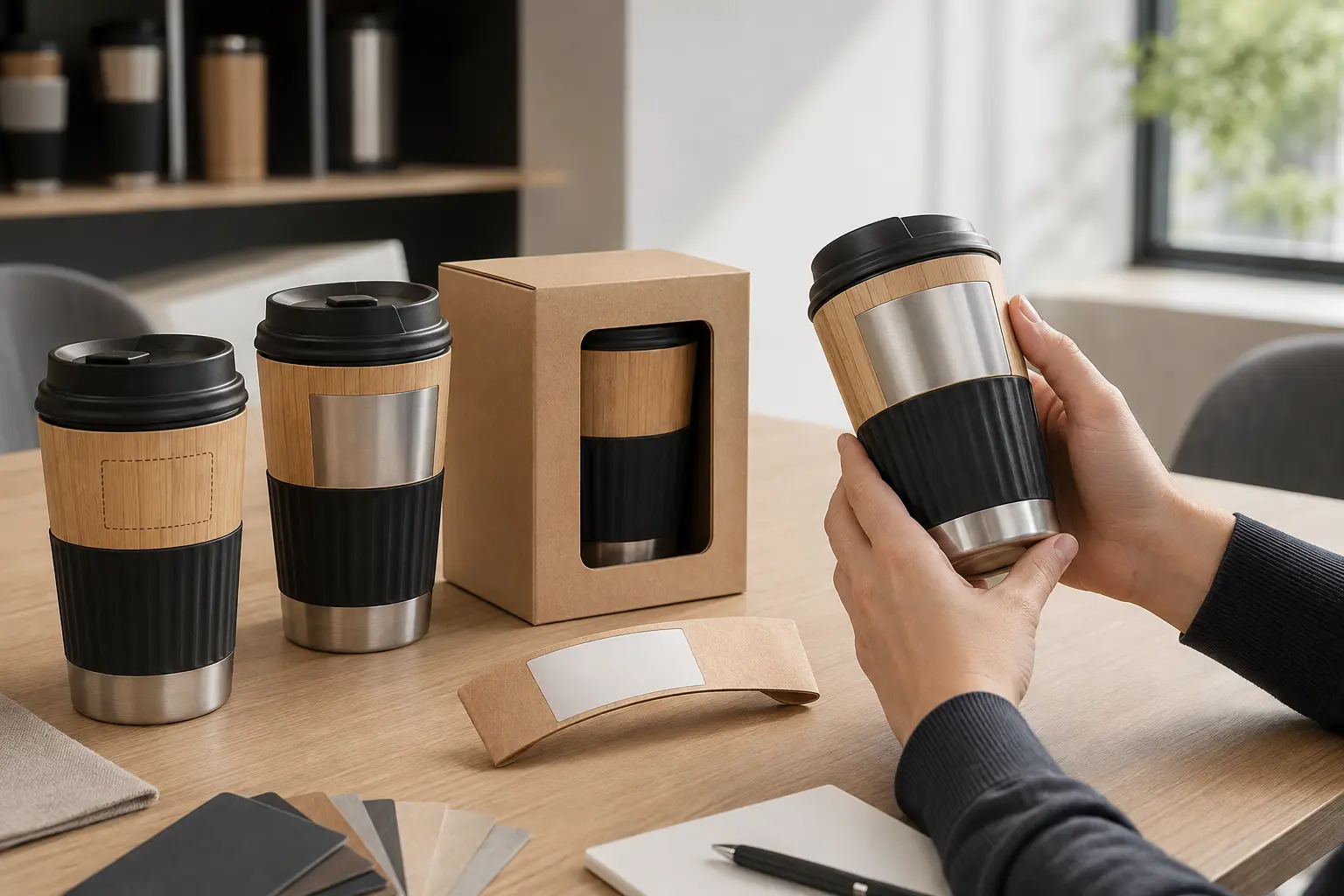
A personalised bamboo coffee cup can work as employee drinkware, a retail item, or a branded gift, but the artwork method depends on the surface. Laser marking can create a restrained mark on suitable bamboo components. Printing may provide more color on coated bodies, metal, or selected sleeves. A separate engraved tag, paper band, or gift box can carry information without crowding the cup.
For a personalised bamboo travel mug, specify logo size, position, orientation relative to the lid or handle, color reference, and acceptable variation. Bamboo grain and tone can change how a mark appears, so a physical pre-production sample is more informative than a screen mockup. Check the sample under normal handling and the stated cleaning method, then retain an approved reference for production inspection.
A Practical Buyer Checklist
Use this checklist when comparing bamboo travel mugs from different suppliers. It turns a broad product name into specifications that can be quoted, sampled, and inspected.
- Define the user, beverage, fill temperature, and typical journey.
- List the material and finish of every food-contact and non-contact component.
- Confirm usable capacity, dimensions, empty weight, and cup-holder requirements.
- Select the lid type and define whether the goal is dust covering, splash control, or tested travel closure.
- Specify single-wall, double-wall, or vacuum-insulated construction.
- Request the exact heat-retention or leakage test method behind any performance claim.
- Review gasket removal, cleaning access, care labels, and replacement parts.
- Confirm food-contact documentation for the exact materials, market, and use conditions.
- Approve decoration on a physical sample, including placement and color.
- Test packaging for abrasion, moisture exposure, and transit movement.
- Define inspection points and acceptable cosmetic variation for bamboo grain.
- Use only substantiated safety, environmental, and performance statements.
Frequently Asked Questions
Is a bamboo coffee cup made entirely from bamboo?
Not necessarily. It may be natural bamboo, a bamboo component around a metal liner, a ceramic or glass mug with bamboo lid, or a molded fiber composite. Check a component-by-component material list.
Is every bamboo travel mug insulated?
No. Insulation depends on wall construction. A bamboo finish or sleeve does not prove that a cup is double-wall or vacuum insulated.
Does a screw lid make a travel mug leakproof?
No. Threads can improve engagement, but gasket fit, sip openings, assembly, wear, and test conditions all affect leakage. Request finished-product test evidence for the promised use.
What is the difference between a silicone lid and a bamboo lid?
A press-fit silicone lid is flexible and commonly used for upright takeaway cups. A bamboo lid is rigid and often paired with a gasket; depending on its design, it may be a simple cover rather than a travel closure.
Can a bamboo travel mug hold hot coffee?
Only when the exact liner, coating, lid, seals, and assembly are specified and supported for the intended temperature and contact time. Do not generalize from the word “bamboo.”
What should “best bamboo coffee cup” mean in a specification?
Replace “best” with measurable priorities: capacity, fit, lid behavior, insulation target, cleanability, weight, decoration, documentation, and budget. The best choice is the one verified for its intended use.
Turn the Product Name Into a Buildable Brief
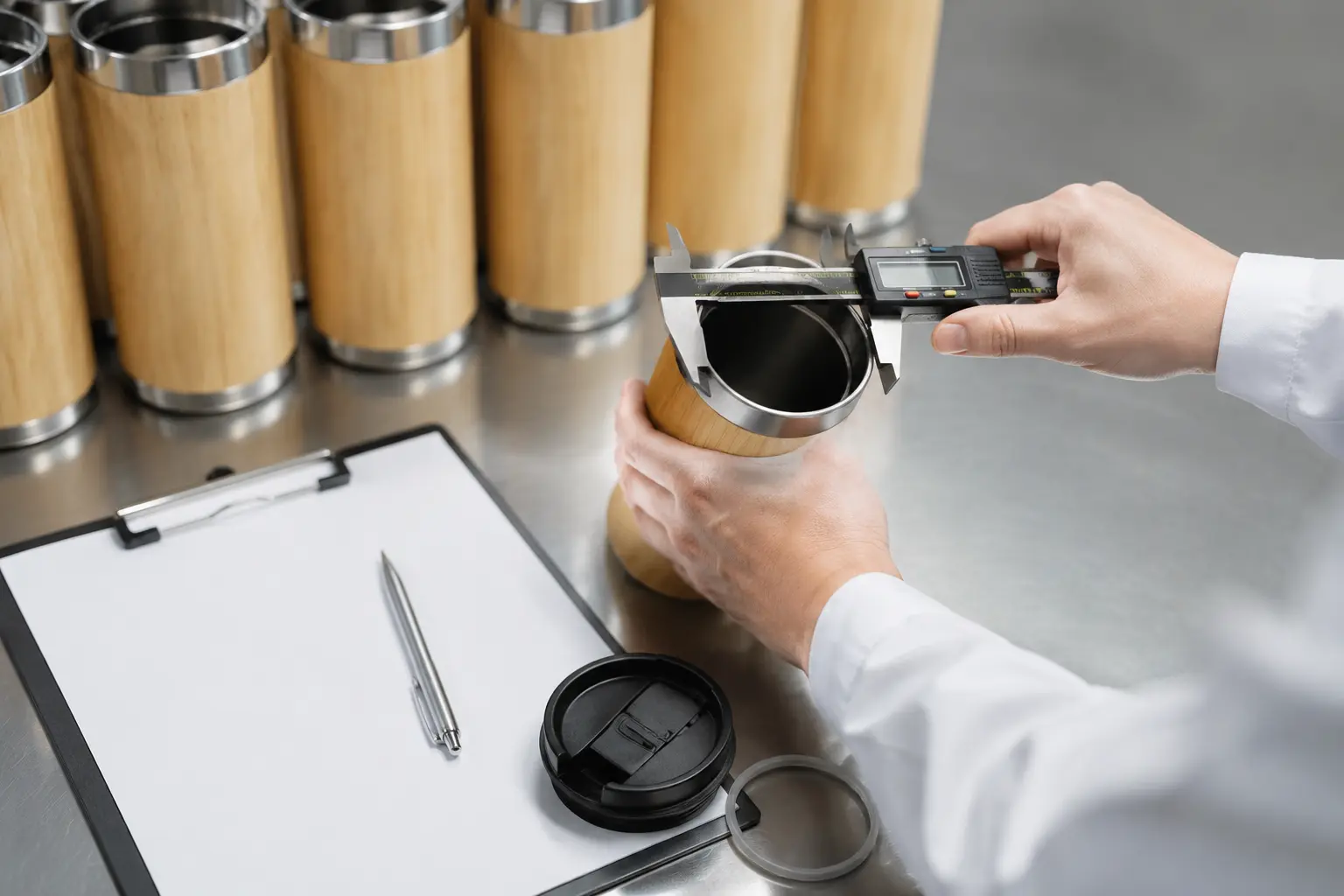
A successful bamboo reusable cup project begins with construction, not a trend label. Define the beverage path, choose a lid for real carrying behavior, identify the insulation structure, and verify care or performance claims on the finished sample.
To review material options, lid concepts, branding positions, packaging, and project feasibility for custom bamboo drinkware, contact Fujian Xianxu Bamboo & Wood Co., Ltd. with your target market, quantity range, intended use, and reference design. A clear brief makes supplier comparisons more accurate and reduces revisions during sampling.