
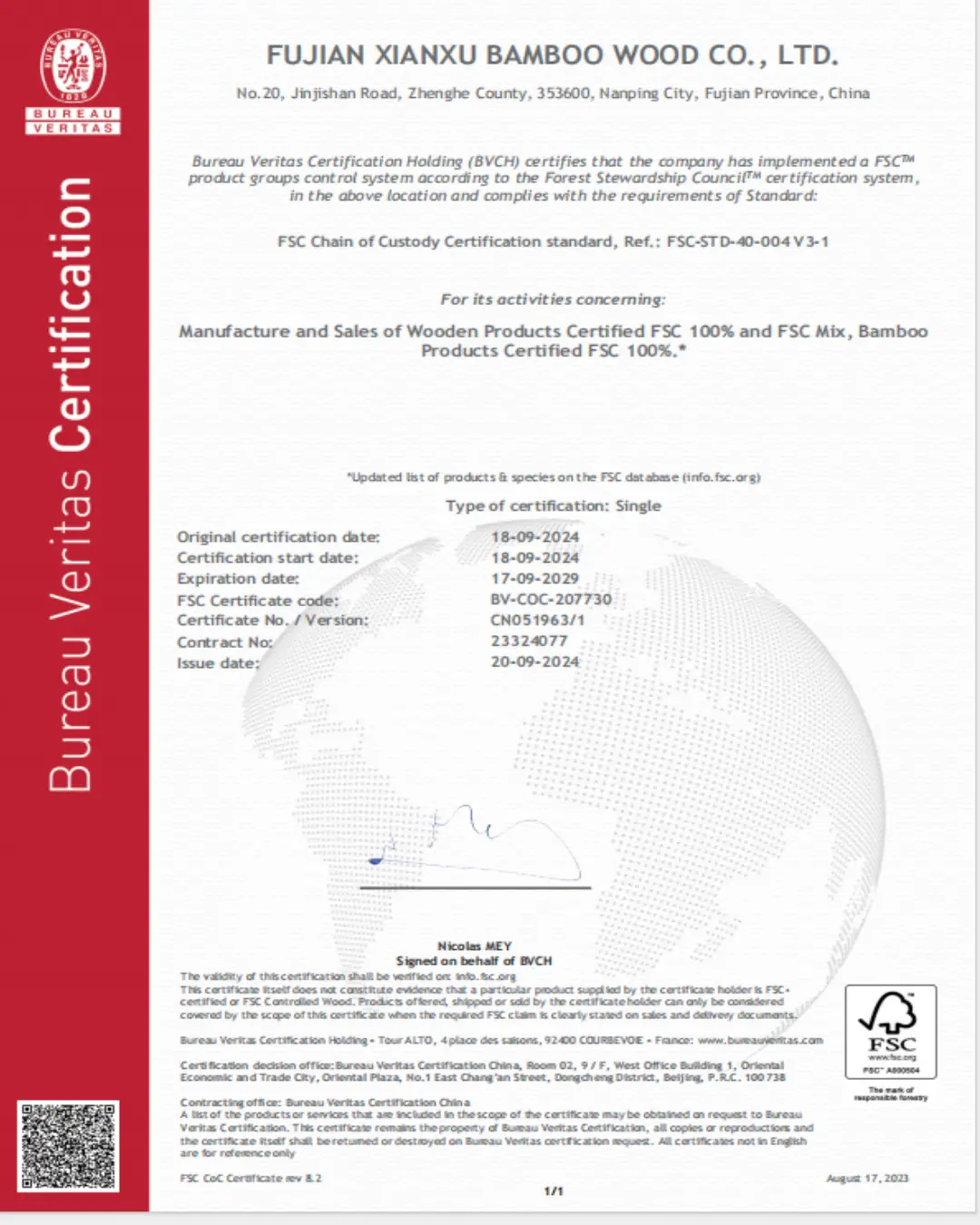
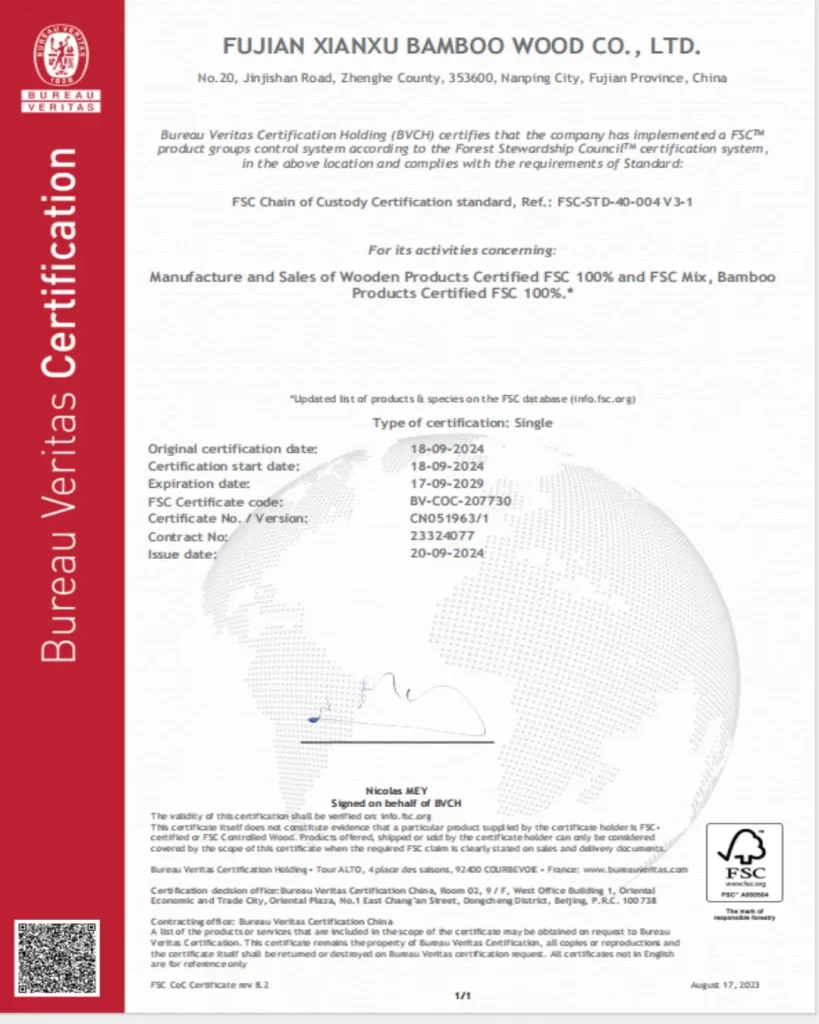
Sustainability is no longer simply a marketing message for bamboo products. For many international retailers, importers, wholesalers and brand owners, responsible sourcing, supply-chain transparency and credible certification have become important parts of supplier selection.
This is where FSC bamboo certification becomes relevant.
When buyers source bamboo kitchenware, bathroom accessories, furniture, storage products or other bamboo goods, they may see terms such as FSC-certified bamboo, FSC 100%, FSC Mix or FSC Chain of Custody. However, these terms do not all mean the same thing.
What exactly does FSC certification mean for bamboo? Can bamboo really be FSC certified even though it is technically a grass? Does an FSC-certified raw-material supplier automatically make the finished product FSC certified? And how can an importer verify whether a bamboo manufacturer is making a valid FSC claim?
This guide explains FSC certification for bamboo products from a practical B2B sourcing perspective and provides a checklist for buyers evaluating bamboo manufacturers and suppliers.
What Is FSC Certification?
FSC stands for the Forest Stewardship Council, an international organization that establishes standards for responsible management of forests and forest-based supply chains.
FSC certification is designed to provide a credible system for identifying materials that come from recognized responsible sources and for maintaining their traceability through the supply chain.
For buyers, FSC certification can provide greater transparency regarding where the material comes from and how certified material is controlled as it moves through processing, manufacturing and distribution.
FSC certification is therefore not simply a logo printed on a product.
It involves a certification and traceability system covering different stages of the supply chain.
Can Bamboo Be FSC Certified?
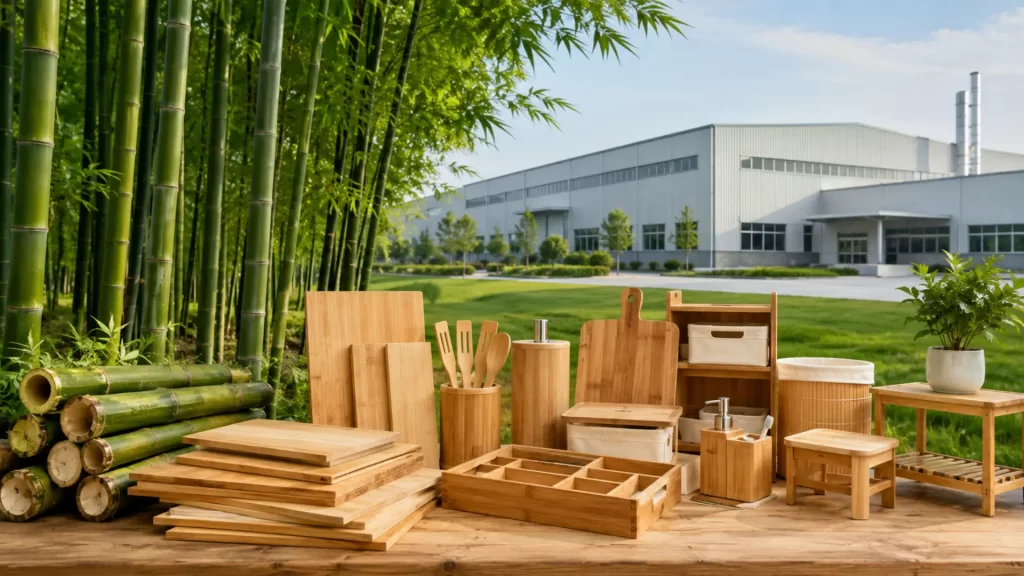
Yes.
Although bamboo is botanically a grass rather than a tree, bamboo can be included within the FSC certification system.
Bamboo is generally treated as a non-timber forest product (NTFP) within relevant FSC frameworks. Bamboo growing in natural forests or cultivated plantations may be eligible for certification when the applicable management and certification requirements are met.
This is important because bamboo is now widely used to manufacture products such as:
- Bamboo cutting boards
- Bamboo kitchen utensils
- Bamboo serving trays
- Bamboo organizers
- Bamboo bathroom accessories
- Bamboo soap dishes
- Bamboo furniture
- Bamboo shelving
- Bamboo storage products
- Bamboo tableware
- Bamboo flooring
- Bamboo panels
- Bamboo household products
Therefore, FSC-certified bamboo products can play an important role in sustainable product programs for international retailers and brands.
What Does FSC-Certified Bamboo Mean?
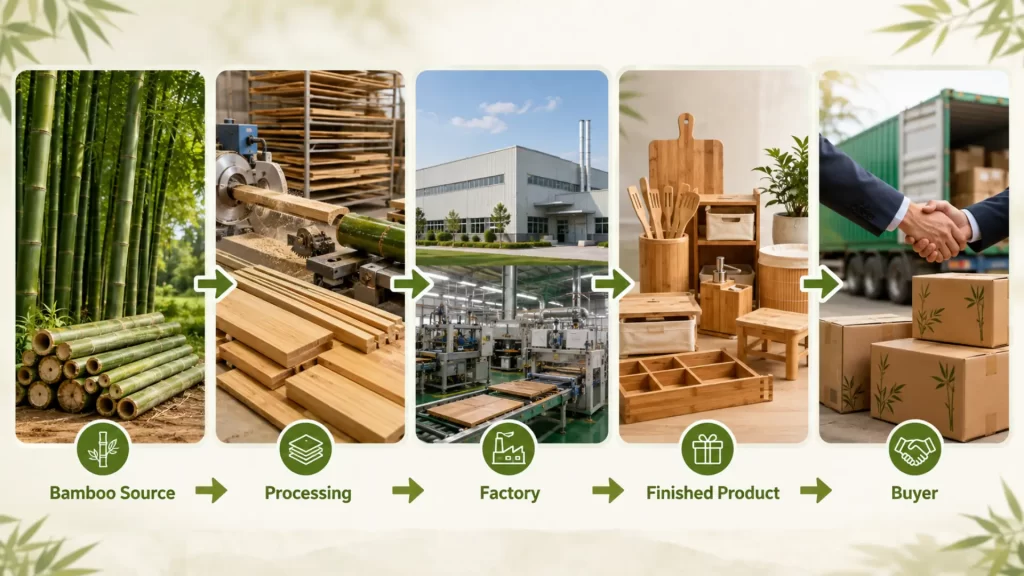
The phrase FSC-certified bamboo should not simply mean that a supplier purchases some bamboo from an FSC-certified source.
For a valid FSC-certified supply chain, the certified material must be properly controlled and documented throughout the relevant stages between its source and the finished product.
This is where the difference between Forest Management certification and Chain of Custody certification becomes important.
FSC Forest Management vs FSC Chain of Custody
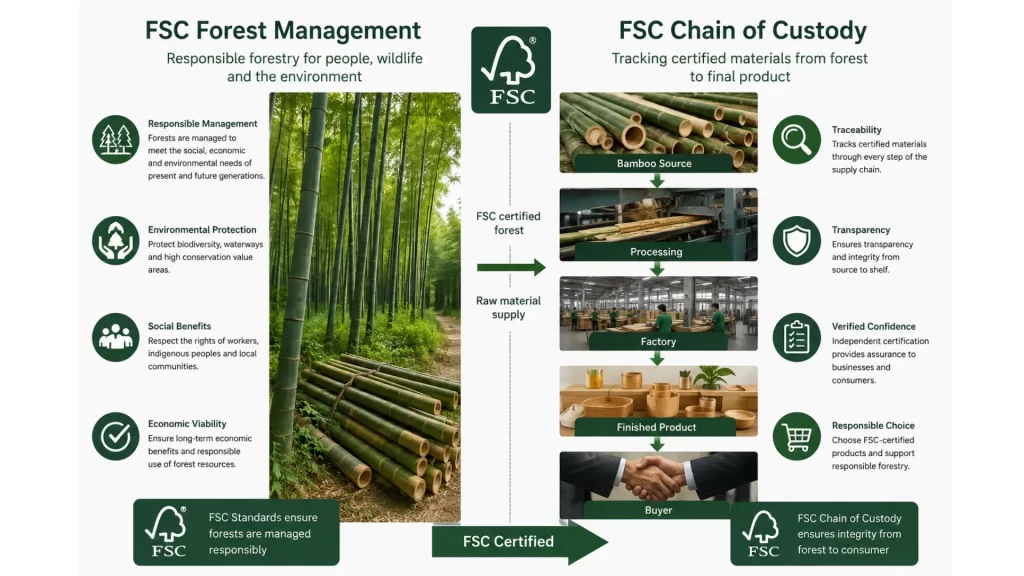
Understanding these two parts of FSC certification is essential for bamboo buyers.
FSC Forest Management Certification
Forest Management certification concerns the origin and management of the forest or bamboo resource.
It evaluates responsible management practices according to applicable FSC requirements.
Depending on the applicable certification system, areas assessed may include:
- Responsible harvesting
- Environmental protection
- Biodiversity
- Workers' rights
- Community interests
- Management planning
- Monitoring
This certification is essentially about where the bamboo originates.
FSC Chain of Custody Certification
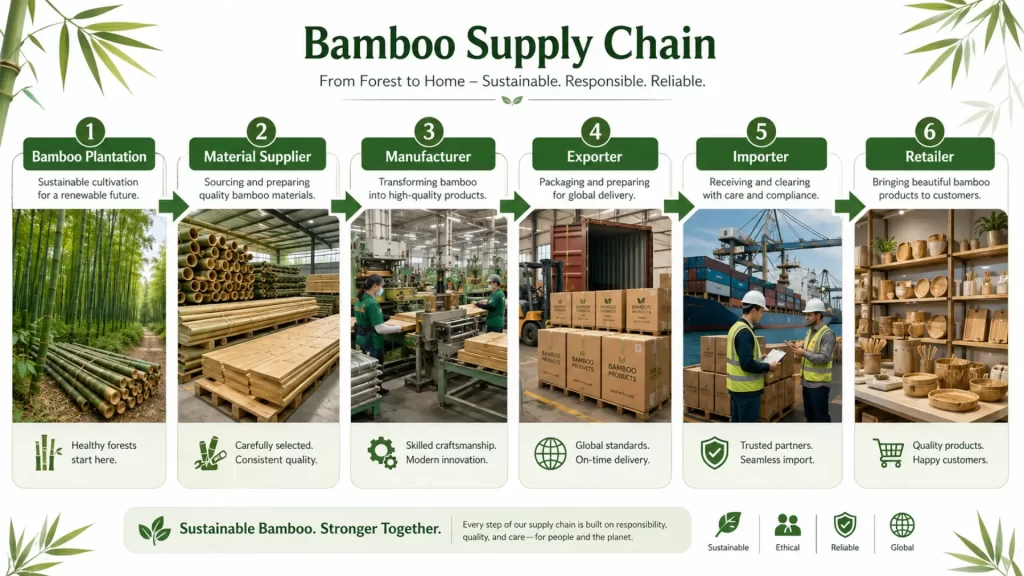
FSC Chain of Custody (CoC) focuses on what happens to certified material after it enters the commercial supply chain.
This can involve:
Certified bamboo source
↓
Raw material supplier
↓
Bamboo processor
↓
Component manufacturer
↓
Finished-product factory
↓
Exporter or trader
↓
Importer / retailer
The purpose of Chain of Custody control is to ensure that eligible FSC materials and claims are properly identified and managed throughout the supply chain.
For a bamboo products manufacturer, this may involve systems for:
- Purchasing certified material
- Supplier verification
- Material identification
- Inventory control
- Production records
- Product-group control
- Sales documentation
- FSC claims
- Trademark use
This distinction is extremely important for international buyers.
Buying bamboo that originated from a certified source does not by itself mean that every finished product can automatically be sold or promoted as FSC certified.
The relevant supply chain and product claims must meet FSC requirements.
Understanding FSC 100%, FSC Mix and FSC Recycled
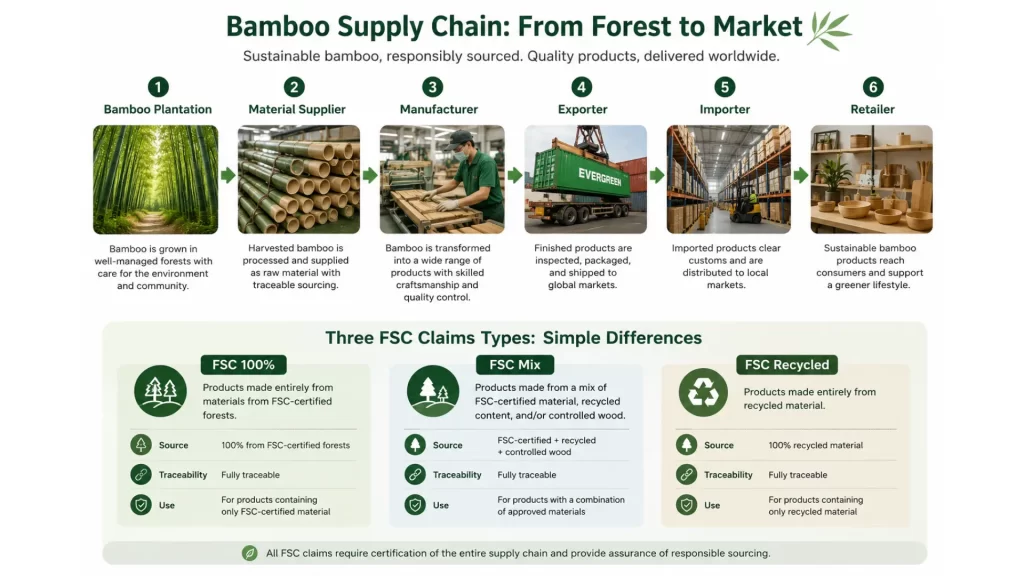
International buyers will usually encounter three main FSC labels.
FSC 100%
An FSC 100% label identifies products made from virgin material originating from FSC-certified forests or eligible certified sources.
For a bamboo product carrying an applicable FSC 100% claim, the certified material requirements and Chain of Custody controls must be properly maintained.
This may be attractive for brands that want a particularly clear certified-material sourcing proposition.
FSC Mix
FSC Mix products can contain a combination of eligible FSC-certified material, recycled material and/or controlled virgin material according to the applicable FSC system and requirements.
The exact composition should not be guessed from the words "FSC Mix."
Professional buyers should check the actual FSC claim and documentation associated with the product.
FSC Recycled
FSC Recycled identifies products made from recycled material in accordance with FSC requirements.
Whether this label is relevant to a particular bamboo household product depends on its material composition and certified supply chain.
Why FSC Bamboo Certification Matters to International Buyers

For B2B buyers, FSC certification is not simply an environmental badge.
It can support several important procurement objectives.
1. Responsible Sourcing
FSC certification provides a recognized framework for buyers seeking materials from responsibly managed sources.
For retailers with sustainability policies, this can be an important part of product sourcing.
2. Supply-Chain Traceability
Large retailers and established brands increasingly want suppliers to provide more than a verbal statement such as:
"Our bamboo is sustainable."
They may want documentation showing the origin and supply-chain status of the material.
An FSC Chain of Custody system provides a structured method for maintaining relevant material and transaction information.
3. Buyer and Retailer Requirements
Some retailers, distributors, public procurement programs and private-label brands include FSC certification in their sourcing specifications.
Therefore, working with an experienced FSC-certified bamboo manufacturer can make the sourcing process easier when an FSC claim is required.
4. Brand Credibility
Sustainability claims should be based on evidence.
Using recognized certification can help a brand communicate responsible sourcing more credibly than relying only on generic environmental claims such as:
- Eco-friendly
- Green
- Sustainable
- Natural
These terms can be useful, but responsible buyers increasingly expect evidence behind sustainability claims.
5. Supply-Chain Risk Management
Certification also encourages buyers and suppliers to maintain better documentation.
For importers managing multiple factories and product categories, better documentation can reduce sourcing uncertainty and improve supplier evaluation.
Is FSC Certification Required for Every Bamboo Product?
Not necessarily.
Whether you need FSC-certified bamboo depends on several factors:
- Your customer's purchasing policy
- Retailer requirements
- Product category
- Tender requirements
- Brand sustainability commitments
- Target market
- Packaging and labeling strategy
For some projects, FSC certification may be a mandatory purchasing specification.
For others, buyers may simply prefer a supplier capable of providing FSC-certified material when required.
Therefore, importers should define FSC requirements during the RFQ stage rather than after mass production begins.
How to Verify an FSC-Certified Bamboo Supplier
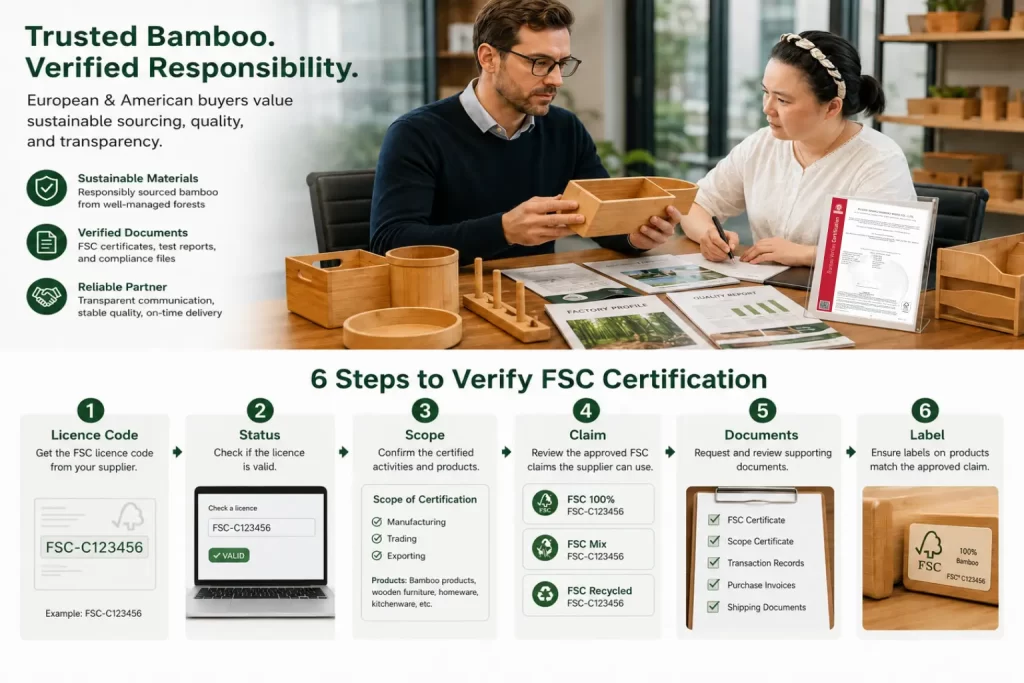
This is one of the most important steps when sourcing bamboo products.
Do not rely only on a supplier's website or a picture of an FSC logo.
Step 1: Ask for the FSC Licence Code
Request the supplier's current FSC licence or certificate information.
The company name on the certification record should correspond to the actual company involved in your transaction.
Step 2: Verify the Certificate Status
Check the supplier through the official FSC certificate database.
Confirm that the certificate is:
- Valid
- Not suspended
- Not terminated
Do this before confirming a major FSC-certified order.
Step 3: Check the Certification Scope
A company holding an FSC certificate does not automatically mean every product it manufactures is covered.
Check whether the relevant product group is included within the supplier's certification scope.
For example, if you are sourcing:
Bamboo cutting boards
you should make sure the supplier's certified scope supports the relevant bamboo product category rather than assuming that any FSC certificate is sufficient.
Step 4: Confirm the FSC Claim
Ask your supplier which FSC claim will apply to your order.
Do not simply write:
"FSC bamboo"
on the purchase order.
Specify the required claim and product requirements clearly.
Step 5: Check Commercial Documentation
For FSC-certified transactions, buyers should ensure that relevant documentation is consistent with the certified claim.
Depending on the transaction and Chain of Custody requirements, this may include:
- Supplier information
- Product identification
- Invoice
- Delivery documentation
- FSC claim
- Certification details
Step 6: Confirm FSC Logo and Trademark Use
Do not independently download an FSC logo from the internet and place it on retail packaging.
FSC trademarks are controlled.
If your product requires an on-product FSC label, discuss the requirement with the certified supplier during artwork development so that the appropriate approval process can be followed.
A Practical FSC Bamboo Sourcing Workflow for Importers
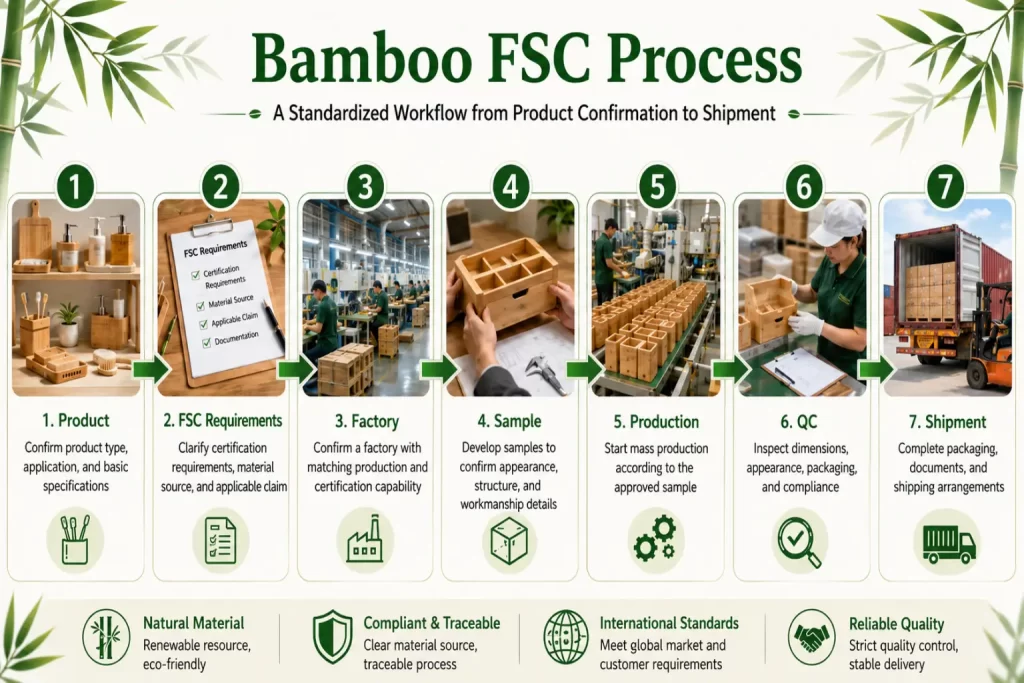
A professional purchasing process can look like this:
Step 1 — Define the Product
Determine:
- Product type
- Bamboo percentage
- Other wood components
- Packaging materials
- Target market
Step 2 — Define the FSC Requirement
Specify whether your project requires an FSC-certified product and which claim or labeling requirement is needed.
Step 3 — Verify the Manufacturer
Review:
- FSC certificate status
- Product scope
- Manufacturing capability
- Quality systems
- Export experience
Step 4 — Confirm Materials
Confirm the bamboo and any additional wooden components used in the finished product.
Step 5 — Develop the Sample
Check:
- Material
- Dimensions
- Finish
- Construction
- Logo
- Packaging
- Label location
Step 6 — Approve Documentation
Confirm FSC-related product and transaction requirements before mass production.
Step 7 — Mass Production and Quality Control
Monitor:
- Raw materials
- Production consistency
- Surface finish
- Assembly
- Packaging
- Product labeling
Step 8 — Final Shipment Documentation
Before shipment, confirm that commercial documentation matches the approved product and certification requirements.
FSC Bamboo Certification for Different Product Categories
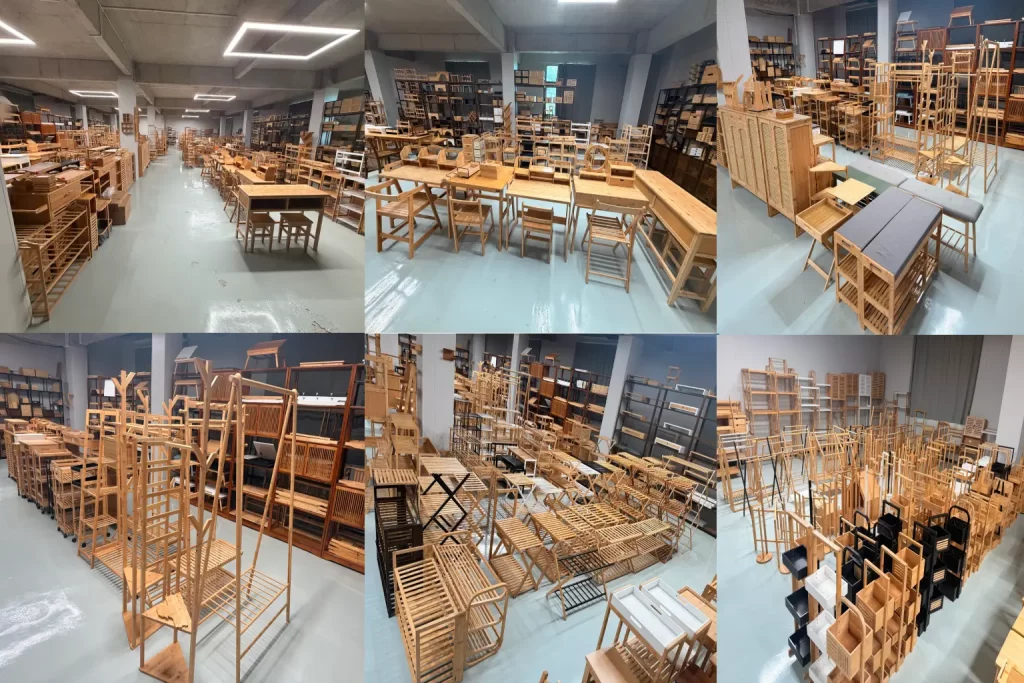
Bamboo Kitchenware
Common products include:
- Bamboo cutting boards
- Bamboo serving trays
- Bamboo utensil holders
- Bamboo drawer organizers
- Bamboo dish racks
- Bamboo steamers
- Bamboo kitchen storage
For food-contact products, buyers should remember that FSC certification concerns responsible sourcing and supply-chain certification.
It should not be confused with food-contact testing or other product safety requirements.
Bamboo Bathroom Accessories
Products can include:
- Bamboo soap dishes
- Bamboo toothbrush holders
- Bamboo bath caddies
- Bamboo toilet paper storage
- Bamboo bathroom shelves
- Bamboo laundry products
For bathroom products, buyers should also evaluate moisture resistance, coating, adhesive selection and product construction separately from FSC certification.
Bamboo Furniture
Examples include:
- Bamboo shelving
- Bamboo stools
- Bamboo tables
- Bamboo benches
- Bamboo racks
- Bamboo storage cabinets
Furniture buyers should evaluate structural performance, load requirements, packaging and relevant market standards in addition to material certification.
Bamboo Storage and Organization Products
This category includes:
- Drawer organizers
- Storage boxes
- Desktop organizers
- Kitchen organizers
- Bathroom organizers
- Laundry storage
These products are particularly suitable for OEM and private-label retail programs because sizes, configurations and packaging can be customized for different markets.
Common FSC Bamboo Certification Mistakes Buyers Should Avoid
Mistake 1: "Bamboo Is Sustainable, So FSC Is Unnecessary"
Bamboo has several attractive material characteristics, but being bamboo does not automatically provide independent verification of responsible sourcing.
If your customer requires FSC certification, the required certified supply chain still needs to be followed.
Mistake 2: "The Raw Bamboo Is FSC, So the Finished Product Is Automatically FSC"
This is an important misconception.
The certified status of raw material alone is not enough to assume that the finished product can carry an FSC claim.
Chain of Custody requirements also matter.
Mistake 3: "An FSC Certificate Means Every Product From the Factory Is FSC Certified"
Not necessarily.
The certificate scope and the specific product transaction need to be checked.
Mistake 4: "FSC Certification Replaces Product Testing"
No.
FSC certification and product testing serve different purposes.
Depending on the product and destination market, buyers may still need to consider:
- Food-contact requirements
- Chemical requirements
- Coating requirements
- Adhesive requirements
- Mechanical testing
- Packaging requirements
- Retailer-specific standards
Mistake 5: "The FSC Logo Can Be Added to Any Packaging"
FSC trademarks are controlled.
Logo and label use must follow applicable FSC trademark requirements.
Brands should coordinate packaging artwork with qualified FSC-certified supply-chain partners before printing.
FSC Certification vs BSCI — What Is the Difference?
International buyers sometimes see both FSC and BSCI during factory sourcing, but they evaluate different aspects of the supply chain.
| Item | FSC | BSCI |
|---|---|---|
| Main focus | Responsible material sourcing and supply-chain certification | Social compliance in manufacturing |
| Raw material | Important | Not the primary purpose |
| Chain of custody | Yes, where applicable | No |
| Working conditions | Included within relevant FSC requirements, but different scope | Major audit focus |
| Supplier evaluation | Responsible sourcing | Social compliance |
| Common B2B use | Sustainability and material sourcing programs | Retailer/vendor social compliance programs |
For many international buyers, the two systems are complementary rather than interchangeable.
A bamboo products manufacturer capable of supporting both responsible material sourcing and social-compliance expectations may therefore be more suitable for established retailers and private-label programs.
Questions Buyers Should Ask an FSC Bamboo Manufacturer
Before confirming a supplier, consider asking:
- Do you hold a valid FSC Chain of Custody certificate?
- What is your FSC licence code?
- Are bamboo products included in your certificate scope?
- Which FSC claims can you supply?
- Can you provide FSC documentation with the shipment?
- Can you support FSC labeling on retail packaging?
- How do you separate or control certified materials?
- How do you verify FSC raw-material suppliers?
- Can you manufacture custom FSC bamboo products?
- Do you support private-label packaging?
- What quality-control procedures do you use?
- What other factory certifications or audits do you maintain?
These questions help distinguish a factory that simply uses "FSC" as a marketing term from a manufacturer that understands certified supply-chain management.
Choosing an FSC-Certified Bamboo Products Manufacturer
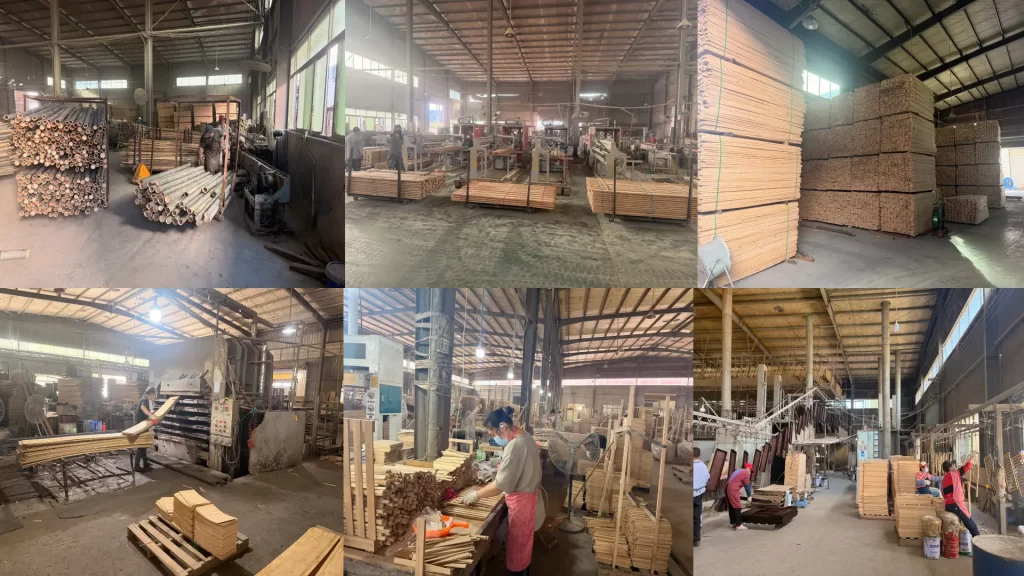
Certification is important, but it should be only one part of supplier evaluation.
A reliable FSC bamboo products manufacturer should also provide:
Manufacturing Capability
The supplier should have adequate equipment, production capacity and technical experience for your product category.
Product Development
For OEM and ODM projects, look for capabilities such as:
- Custom dimensions
- New structures
- Logo development
- Custom finishes
- Packaging development
- Prototype sampling
Quality Control
The factory should maintain controls for:
- Raw materials
- Moisture
- Dimensions
- Sanding
- Surface finish
- Assembly
- Packaging
- Final inspection
Export Experience
Experienced exporters are generally more familiar with:
- Buyer specifications
- Commercial documentation
- Retail packaging
- Shipment requirements
- Quality inspection
- International communication
Certification Management
Most importantly, the supplier should understand the difference between:
having an FSC certificate
and
supplying a correctly documented FSC-certified order.
Fujian XianXu — FSC-Certified Bamboo & Wooden Products Manufacturer
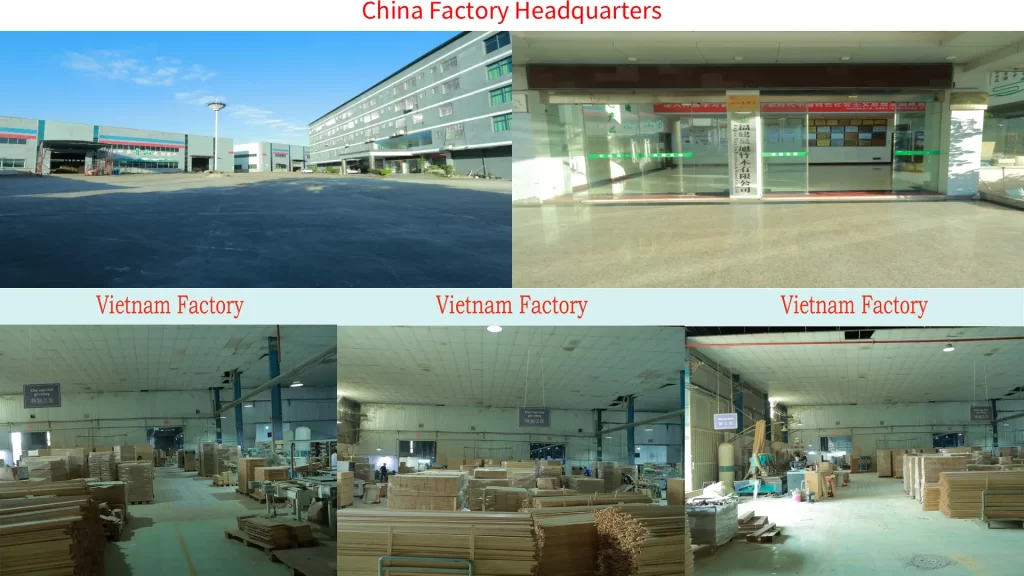
Fujian XianXu Bamboo Wood Co., Ltd. is a professional bamboo and wooden products manufacturer serving global importers, wholesalers, retailers and private-label brands.
Our product portfolio includes:
- Bamboo kitchenware
- Bamboo bathroom accessories
- Bamboo furniture
- Bamboo storage products
- Wooden household products
- Custom OEM and ODM products
With manufacturing operations in China and Vietnam, we support international customers from product development and sampling through mass production, quality inspection, packaging and export.
Our manufacturing and sourcing capabilities include FSC-certified material options, and our factory compliance system includes BSCI.
OEM & ODM Services
We support:
- Custom bamboo products
- Custom dimensions
- Private-label branding
- Laser engraving
- Surface-finish development
- Custom packaging
- Retail packaging
- Product-set development
- New-product development from drawings or concepts
Support for FSC Bamboo Projects
For customers requiring FSC-certified bamboo products, our team can coordinate applicable requirements during product development and order confirmation, including material sourcing, product specifications, documentation and packaging requirements.
This is particularly useful for:
- Importers
- Wholesalers
- Retail chains
- Supermarkets
- E-commerce brands
- Private-label brands
- Home and kitchenware companies
FSC Bamboo Certification FAQ
Is Bamboo FSC Certified?
Bamboo itself is not automatically FSC certified simply because it is bamboo. Bamboo can be included within FSC-certified systems when the applicable source and supply-chain requirements are met.
Can Bamboo Products Carry an FSC Label?
Eligible bamboo products can carry an appropriate FSC label when the product and supply chain meet applicable FSC certification and trademark requirements.
What Is FSC Chain of Custody for Bamboo?
Chain of Custody is the system used to maintain the identity and eligible claims of FSC materials as they move through processing, manufacturing and distribution.
Does My Bamboo Manufacturer Need FSC Certification?
If the manufacturer takes ownership of certified materials and produces or sells goods with FSC claims, applicable Chain of Custody requirements need to be considered. Buyers should verify the specific supply-chain situation and certificate scope.
How Can I Check Whether an FSC Bamboo Supplier Is Genuine?
Ask for the FSC licence code and verify the supplier using FSC's official certificate database. Also check certificate status, company identity and product scope.
Does FSC Certification Mean a Bamboo Product Meets All EU or US Regulations?
No. FSC certification focuses on responsible sourcing and related certification requirements. Product safety, chemical, food-contact, labeling and other regulatory requirements must be evaluated separately.
Can I Customize FSC-Certified Bamboo Products?
Yes, provided the manufacturer can support the required product, certified supply chain and FSC claim. Product dimensions, structure, logo and packaging can usually be developed according to the project's manufacturing requirements.
What Products Can Be Made From FSC-Certified Bamboo?
Depending on the manufacturer's certified scope and capability, possibilities can include kitchenware, bathroom accessories, furniture, organizers, tableware, storage products and other bamboo household products.
Final Thoughts: FSC Certification Is About More Than a Logo
For international buyers, FSC bamboo certification should be viewed as a supply-chain system rather than simply a green logo placed on packaging.
A strong FSC bamboo sourcing program requires buyers and manufacturers to understand:
- Where bamboo comes from
- Whether suppliers are certified
- Whether the relevant product is within certificate scope
- Which FSC claim applies
- How material is controlled during manufacturing
- Whether commercial documents are correct
- Whether trademark and labeling requirements are followed
For importers, wholesalers and private-label brands, selecting an experienced FSC-certified bamboo manufacturer can simplify these steps while supporting more transparent and responsible sourcing.
If you are developing a new bamboo kitchenware, bathroom, furniture or home-storage collection, Fujian XianXu Bamboo Wood Co., Ltd. can support OEM and ODM production, FSC-certified material options, custom packaging and international export requirements.
Contact us to request an FSC bamboo product catalog, wholesale quotation, samples or a custom product development proposal.