
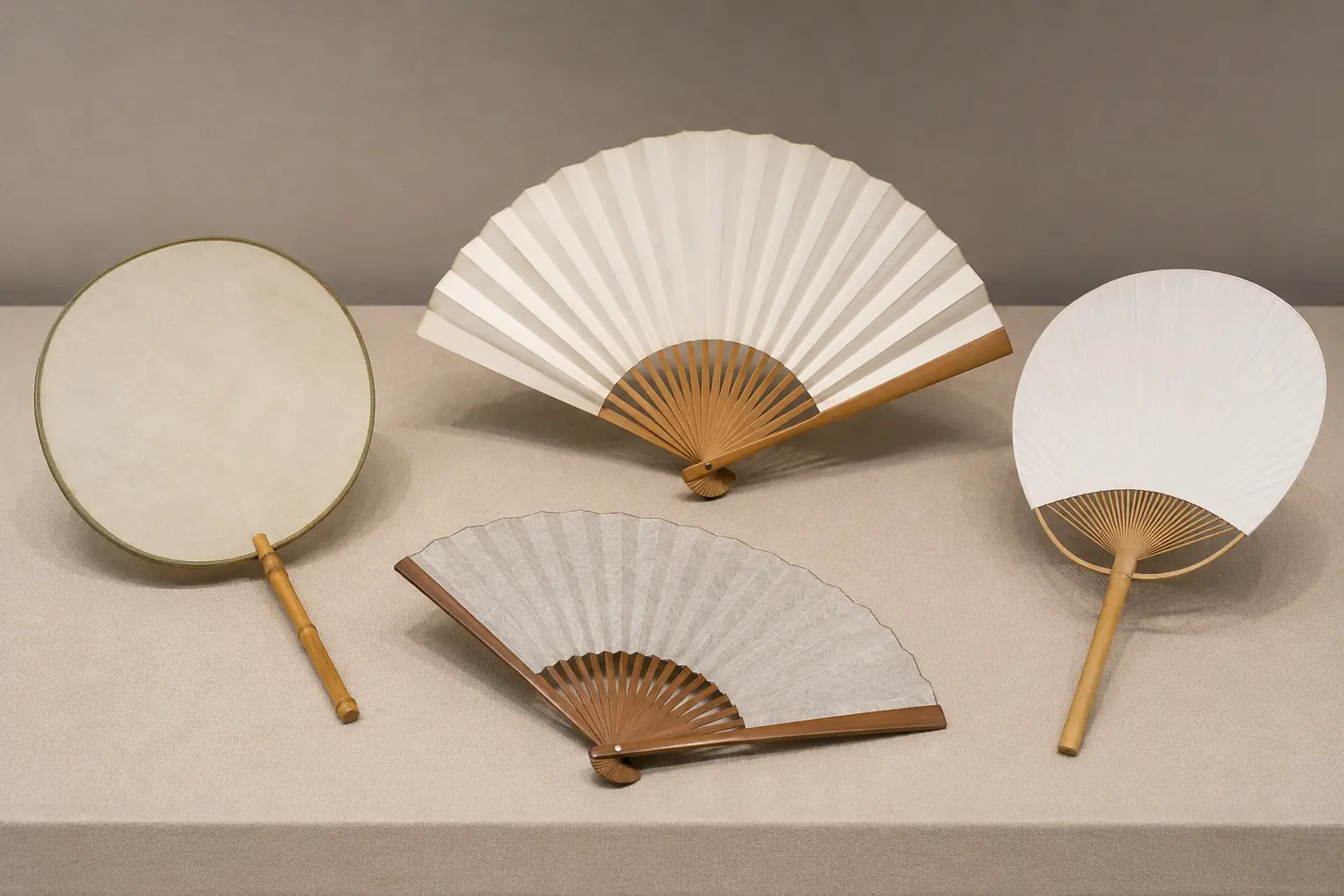
A bamboo hand fan can be a cooling tool, painting surface, accessory, gift or object used in a specific performance or ceremony. Broad labels such as “Asian fan” obscure that variety. Chinese and Japanese traditions have exchanged ideas over centuries, but each contains distinct forms, terms and histories.
This guide introduces the main formats without treating them as interchangeable. It also explains paper and silk options, rigid and folding construction, winnowing tools and the checks required before using a cultural description in product marketing.
A Chinese bamboo hand fan and a Japanese bamboo hand fan should each be identified by its form, construction and intended cultural context; the national label alone is not a complete specification.
Start with Structure: Rigid or Folding
Most handheld fans can first be understood as rigid or folding. A rigid fan has a fixed leaf and handle, with outlines that may be round, oval or asymmetrical. A folding fan uses pivoted sticks and a pleated leaf to open into an arc and close into a narrow bundle.
Bamboo may form the handle, inner ribs, outer guards or a split frame. The leaf may be paper, silk, another textile, feathers or a modern sheet material. Consequently, “bamboo fan” describes the presence or visual prominence of bamboo, not necessarily the whole object. Product specifications should name each principal component.
| Form or term | Working description | Important caution |
|---|---|---|
| Chinese tuánshàn (团扇) | A rigid fan, commonly translated as round fan; surviving examples also show varied rounded outlines and painted or embroidered leaves. | “Round” is a useful category name, not a guarantee of a perfect circle or one fixed material. |
| Chinese zhéshàn (折扇) | A folding fan; bamboo sticks and a paper leaf are one historically documented combination. | Not every Chinese folding fan has bamboo ribs, and not every design represents literati practice. |
| Japanese sensu (扇子) | A common term for a folding fan, usually built from narrow sticks and a pleated leaf. | Construction and etiquette differ among everyday, dance, tea, court and ceremonial fans. |
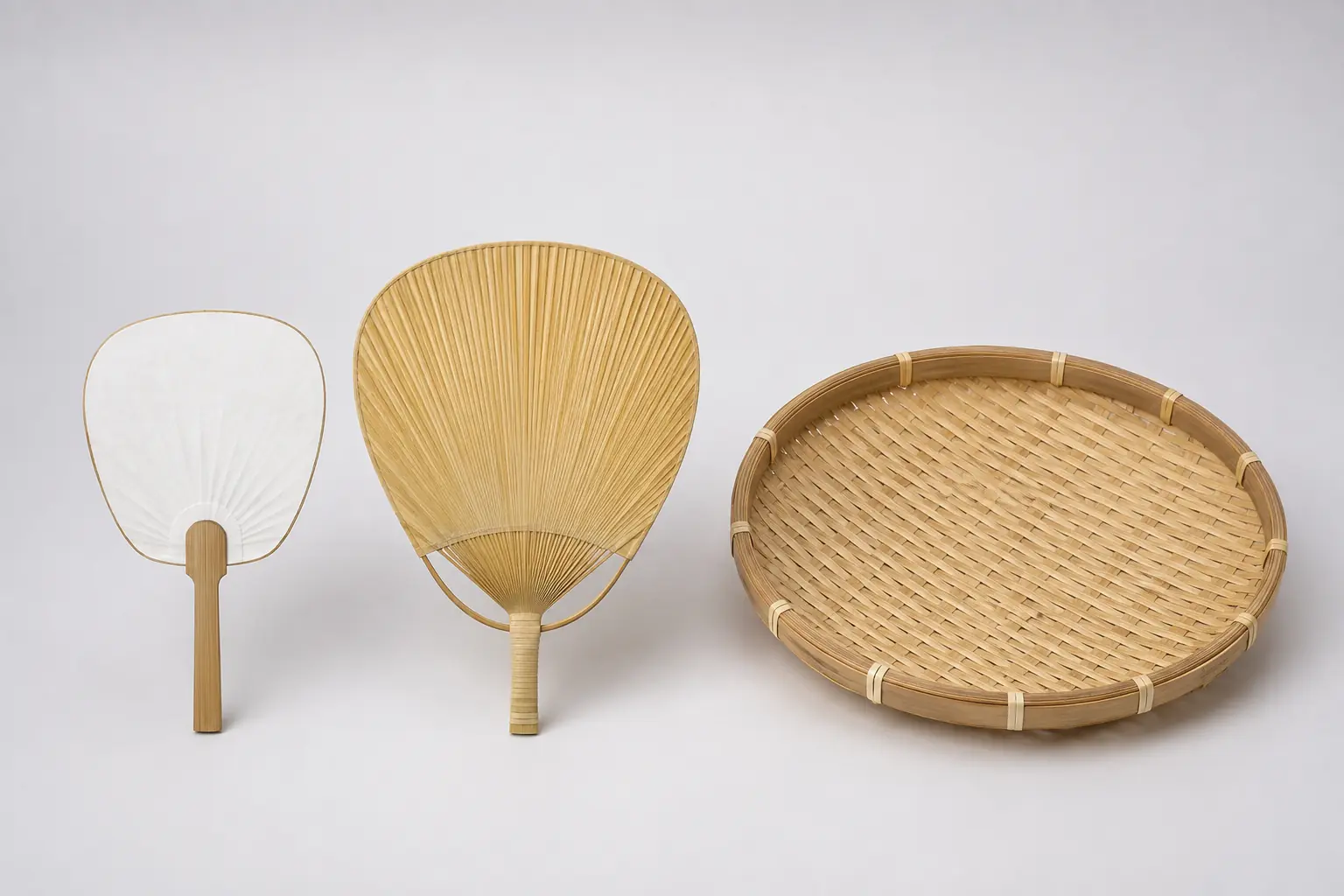
| Japanese uchiwa (団扇) | A flat, non-folding fan with a fixed handle; traditional production may use a split-bamboo framework and paper. | Uchiwa shapes and regional making methods vary; “paddle fan” is only a loose visual comparison. |
| Ōgi (扇) | A broader Japanese word for fan and, in many contexts, a folding fan. | Translate according to the object and context rather than treating it as one product specification. |
A Short History Without a One-Line Origin Story
Rigid fans have deep histories in China and elsewhere; folding-fan histories reflect travel, trade, court culture and craft exchange across East Asia. Japanese accounts commonly place early folding fans in the Heian period, around the ninth century. Folding forms were later adopted and reinterpreted in China and Korea. Dates, pathways and single-inventor claims vary, so product content should avoid reducing a complex history to a slogan.
The Metropolitan Museum of Art records an early seventeenth-century Chinese folding fan painting in ink on gold-flecked paper. Its collection also includes Chinese folding fans with carved bamboo frames, showing how frame carving, painting and calligraphy could come together.
The British Museum documents an 1841 Japanese folding fan made with paper and bamboo, painted by Yamamoto Baiitsu, plus an uchiwa on its original bamboo frame dating to about 1910. Such records support material and format descriptions; cultural use still needs specific evidence.
Chinese Bamboo Fans: Round Forms, Folding Forms and Art
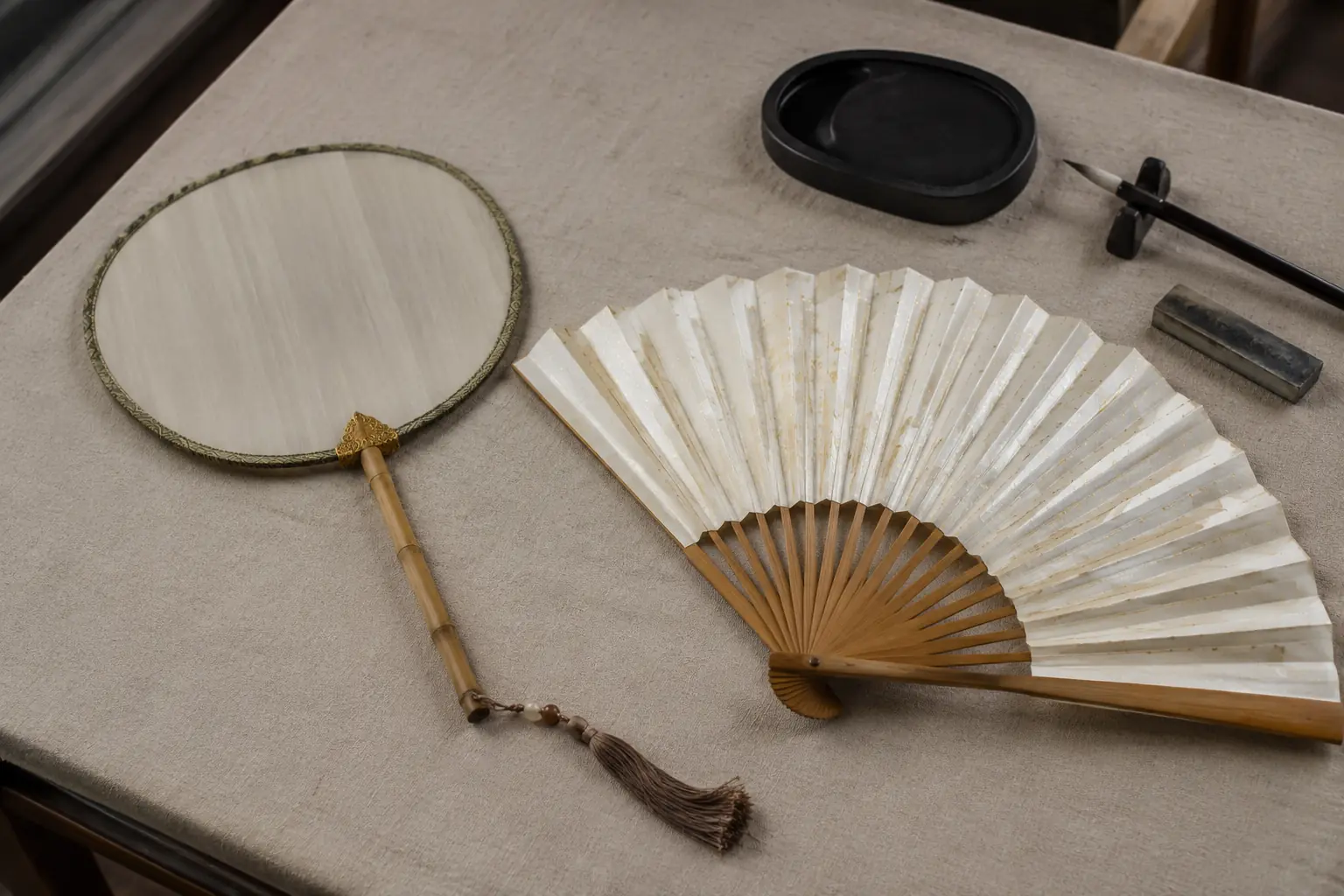
The rigid round fan is strongly associated with Chinese visual culture. Silk or paper leaves might carry painting, calligraphy or embroidery. Shape and social use changed across periods, so describe a specific object rather than assigning every round fan one universal meaning.
The Chinese bamboo folding fan became an important format for painting and calligraphy, particularly within literati and elite social networks in certain periods. The fan’s arc gives an artist a demanding composition: a narrow center expanding toward the outside edge, crossed by folds and ribs. Bamboo guards and ribs could remain plain, be polished or become surfaces for fine carving.
What “Chinese bamboo fan” should mean in a listing
If a product is made in a contemporary Chinese style, say what that style consists of: perhaps a rounded silk leaf, a bamboo handle, an ink-inspired botanical print or carved guards. Do not label an unrelated floral fan “traditional” simply because it is made from bamboo. When using historical artwork or calligraphy, confirm rights, orientation, translation and cultural context.
Handheld use versus display
A Chinese bamboo hand fan intended for cooling needs smooth edges, a comfortable grip and reliable structural movement. A display fan may prioritize a larger painted surface and mounting provision. A large wall piece should not be sold as a functional hand fan unless its pivot, leaf and guards are engineered for repeated handling at that scale.
Japanese Bamboo Fans: Sensu and Uchiwa
Sensu is the familiar folding format. Everyday versions are portable, while specialized fans appear in dance, theater, tea practice, court dress and other settings. Those objects may follow conventions of size, color and handling. Do not market a generic folding fan as an authentic ceremonial or performance fan without relevant expertise.
Uchiwa are non-folding fans. Many traditional examples use a bamboo handle that divides into fine ribs supporting a paper leaf, although regional methods and silhouettes differ. They are associated with summer cooling, print design, festivals and promotion, among other uses. Modern uchiwa can also use plastic or synthetic materials; the Japanese name identifies the form, not a guaranteed bamboo specification.
Art, poetry and social life
Japanese folding fans have served as portable painting and poetry surfaces as well as functional objects. The British Museum’s early nineteenth-century group includes fan paintings and inscriptions by artists and poets, showing how collecting and social exchange could be part of a fan’s life. That does not make every modern printed sensu a reproduction of this practice, but it offers useful context for restrained artwork and well-made paper surfaces.
Paper, Silk and Bamboo: Read the Bill of Materials
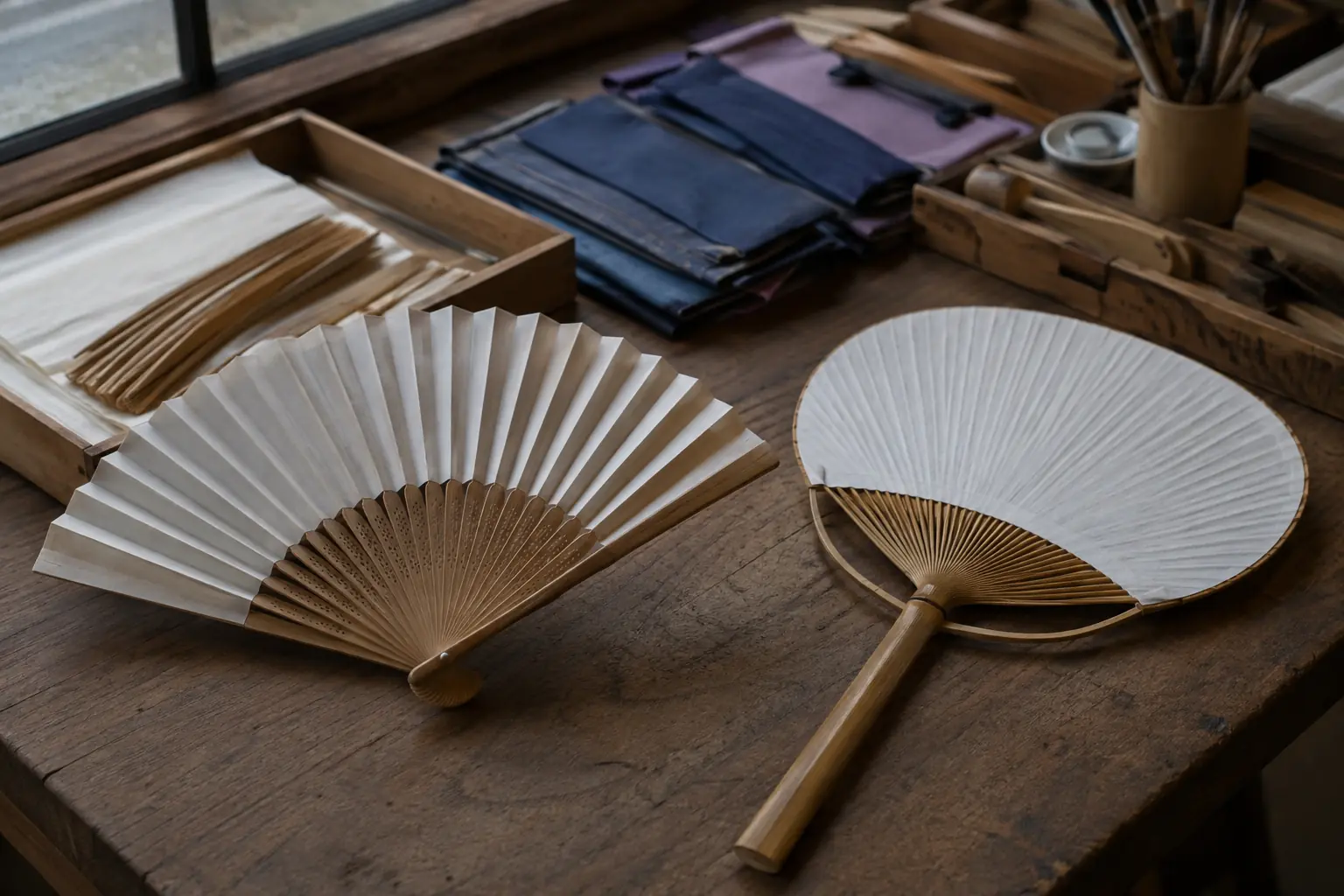
A bamboo paper fan usually combines bamboo sticks with a paper leaf. Paper varies in fiber, weight, sizing, opacity and print response. “Rice paper” is often used loosely and should not replace a verified specification. Confirm any named paper such as washi.
A bamboo silk fan may use silk, but “silk fan” also describes satin-like synthetic fabric. Request fiber content and relevant documentation. Natural silk and synthetic textile differ in printing, fraying, moisture response and cost.
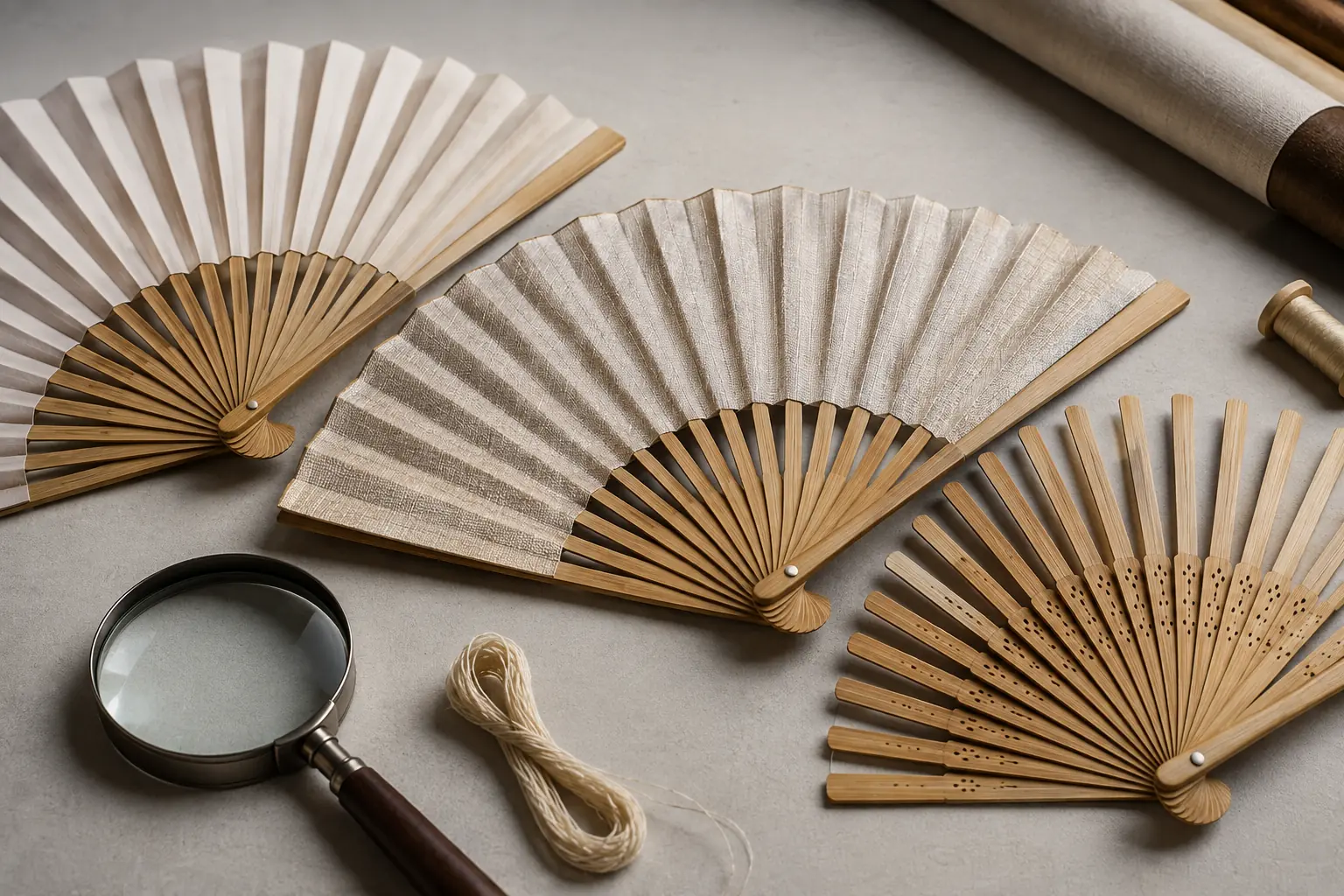
The bamboo components deserve the same attention. Buyers should review rib thickness, edge smoothness, straightness, pivot fit, guard alignment, finish and acceptable grain variation. A dark stain can change appearance but does not identify bamboo species or prove a protective performance claim.
| Component | Variables to specify | Sample checks |
|---|---|---|
| Bamboo sticks or frame | Count, dimensions, profile, edge finish, color range and surface treatment | Splinters, warping, alignment, spacing and grip comfort |
| Paper leaf | Paper type, weight, layers, shade, printing, pleating and edge treatment | Tears at folds, ink rub, show-through, adhesive marks and opening behavior |
| Textile or silk leaf | Verified fiber, weave, coating, print method, hem or bonded edge | Fraying, wrinkles, color consistency, attachment and light transmission |
| Pivot and fittings | Material, head shape, tension, decoration and any hanging loop | Smooth movement, looseness, sharp points and repeat opening |
Handheld Fans, Paddle Fans and Winnowing Fans Are Not the Same
Online searches often place a bamboo paddle fan beside Chinese or Japanese hand fans. “Paddle fan” is a descriptive retail term for a rigid fan with an extended handle and broad leaf; it does not identify one historical tradition. If the object is modeled on an uchiwa, round fan or another regional form, use the specific term only when construction and context support it.
A bamboo winnowing fan is different. In English, the phrase commonly refers to a shallow woven tray or basket used in agricultural processing to help separate grain from chaff. It may be circular, oval or fan-shaped, and in some interiors it is repurposed as wall decor. It is not simply an oversized personal cooling fan. Food-contact status, weaving structure, finish and intended use should be stated separately.
Likewise, modern “clack fans,” rave fans, wedding fans and promotional hand fans are contemporary product categories. They can borrow folding geometry, but their performance, sound, size and branding goals should not be presented as evidence of traditional Chinese or Japanese practice.
Choosing a Fan for Use, Gifts or Events
For everyday cooling, begin with weight, grip, opening action and airflow rather than decoration. Edges should feel smooth in the hand. A folding model should open without binding and remain controlled rather than dangerously loose. A rigid model should not flex excessively at the handle-to-leaf connection.
For weddings, gifts or visitor programs, define how the fan will be carried and distributed. A sleeve can protect the leaf and carry information. If guests will use it outdoors, test the actual construction under realistic handling and moderate breeze.
Custom artwork needs a controlled orientation. A design that appears correct on an open fan may be fragmented when folded. Provide vector artwork where possible, approve a physical decorated sample and check both sides. For Chinese characters or Japanese text, use a competent language reviewer; confirm reading, line direction, type style and whether the phrase is appropriate for the event.
B2B Sourcing and Quality-Control Checklist
An RFQ should state the form, open and closed dimensions, bamboo components, leaf, rib count, pivot, finish, artwork, packaging, quantity, destination and required date. Ask the supplier to confirm feasibility, minimums and schedule for that configuration.
Review more than one sample
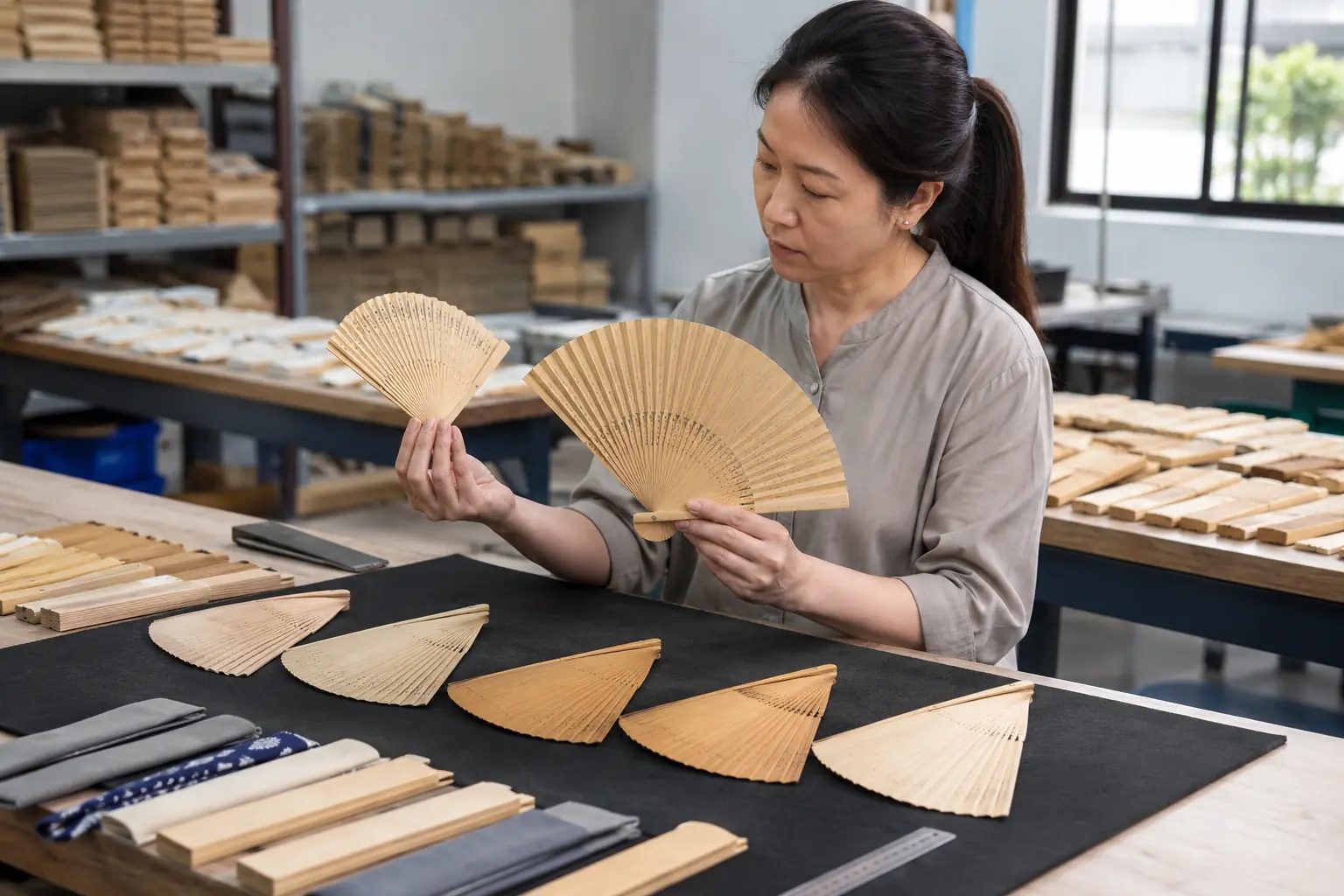
Bamboo grain and shade vary. Evaluate a representative group for acceptable color range, straightness, surface quality and opening tension. Check whether printed registration remains consistent across folds and whether adhesive is visible. For rigid fans, inspect the handle joint and leaf tension. For folding fans, inspect guards, rib tips and pivot security.
Separate cultural description from compliance
A product may be described accurately as sensu-shaped or inspired by a Chinese round fan, yet still require separate review for materials, labeling, chemical restrictions, packaging and intended users. Cultural terminology does not confirm compliance. Match any test reports or declarations to the finished product, target market and current specification.
Care, Opening and Storage
Open a folding fan with two hands until you know its tension and intended motion. Forcing the guards apart, snapping a decorative fan or pulling the leaf can loosen the pivot and stress the folds. “Clacking” is a performance feature of some modern fans, not a safe technique for every bamboo folding fan.
Keep leaves dry and away from prolonged sun. Dust gently and avoid strong cleaners unless approved. Let a damp fan dry open and supported, away from direct heat. Store it fully dry in a sleeve that protects the tips without crushing pleats.
Frequently Asked Questions
Are Chinese and Japanese bamboo hand fans the same?
No. They share materials and a long history of regional exchange, but their terminology, construction, visual traditions and context differ. Identify the specific form and avoid using the labels interchangeably.
What is the difference between sensu and uchiwa?
Sensu are folding fans. Uchiwa are rigid, non-folding fans. Both categories contain regional and purpose-specific variations, so the name alone is not a complete specification.
Do Chinese folding fans always have bamboo frames?
No. Bamboo is a documented and common frame material, but other materials have also been used. Confirm the actual sticks, guards, leaf and fittings for the product in question.
Is a bamboo silk fan made from real silk?
Not necessarily. Some sellers use “silk” for the look of a synthetic fabric. Request confirmed fiber content and supporting documentation when genuine silk is required.
Is a bamboo winnowing fan a hand fan?
Usually not. It is generally a woven agricultural tray or basket used in grain processing, although it may be repurposed as decor. Its construction and intended use should be described separately.
Can a promotional fan use Chinese or Japanese calligraphy?
Yes, but the wording, orientation, font or calligraphic style, rights and cultural suitability should be reviewed by a qualified language and cultural expert before production.
Selected Museum References
- The Metropolitan Museum of Art: Bamboo and poem, early seventeenth century
- The Metropolitan Museum of Art: folding fan with carved bamboo frame, 1960
- The British Museum: Japanese folding fan in paper and bamboo, 1841
- The British Museum: Japanese uchiwa on its original bamboo frame, circa 1910
- Nippon.com: an introduction to uchiwa and sensu