
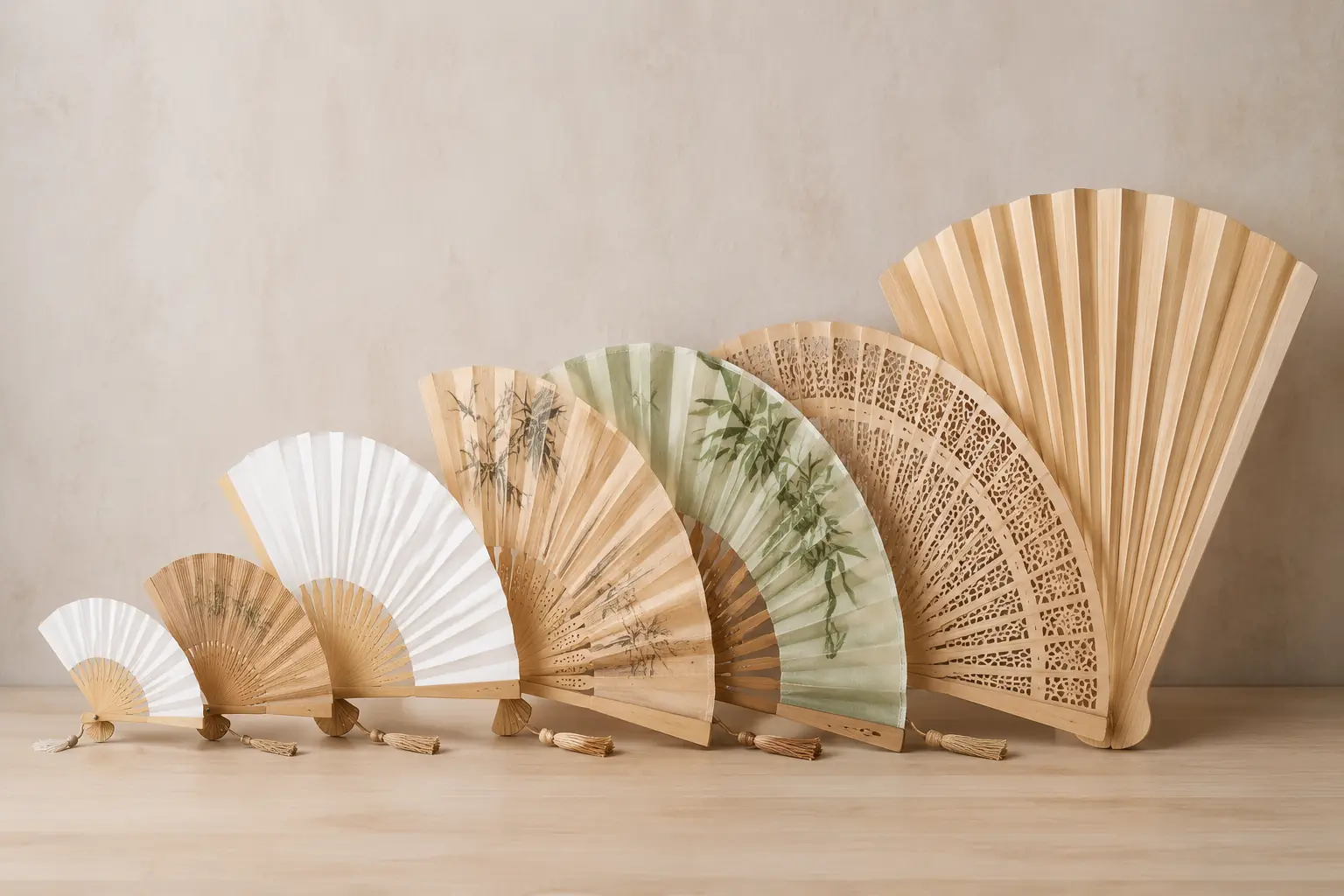
A bamboo folding fan looks simple when open, yet its performance depends on a coordinated set of parts. Bamboo sticks support the leaf, outer guards protect the closed fan, a pivot controls movement, and the paper or fabric surface must fold repeatedly without separating from the frame. Small construction choices affect feel, print quality, durability and packing.
This guide explains the anatomy of a bamboo folding fan, compares paper and silk-related material options, and gives designers and B2B buyers a practical framework for specifications, sampling and quality control. It concerns handheld folding fans—not bamboo ceiling fans, wall-mounted electric fans, folding fan-shaped wall décor, hats or winnowing fans.
What Is a Bamboo Folding Fan?
A folding bamboo fan is a handheld fan whose frame contains multiple narrow sticks joined at a pivot. When the sticks spread, they support a pleated leaf in an arc; when they close, the leaf folds between them. “Bamboo” generally describes the frame or principal sticks. The leaf may be paper, fabric or another specified material, while the pivot and decorative hardware may use metal or other materials.
These products are commonly described as folding bamboo fans or bamboo folding hand fans. Whatever term appears in a listing, a purchase specification needs more precision. State the open and closed dimensions, number and form of sticks, leaf material, pivot construction, surface finish, artwork and packing.
A fan should also be named according to its real use. A handheld product sold as a large wall hanging may require different hanging points, display instructions and structural expectations. A standard personal fan should not be promoted as bamboo fan wall decor simply because it can be opened on a wall.
Anatomy: Bamboo Fan Staves, Sticks, Ribs and Guards
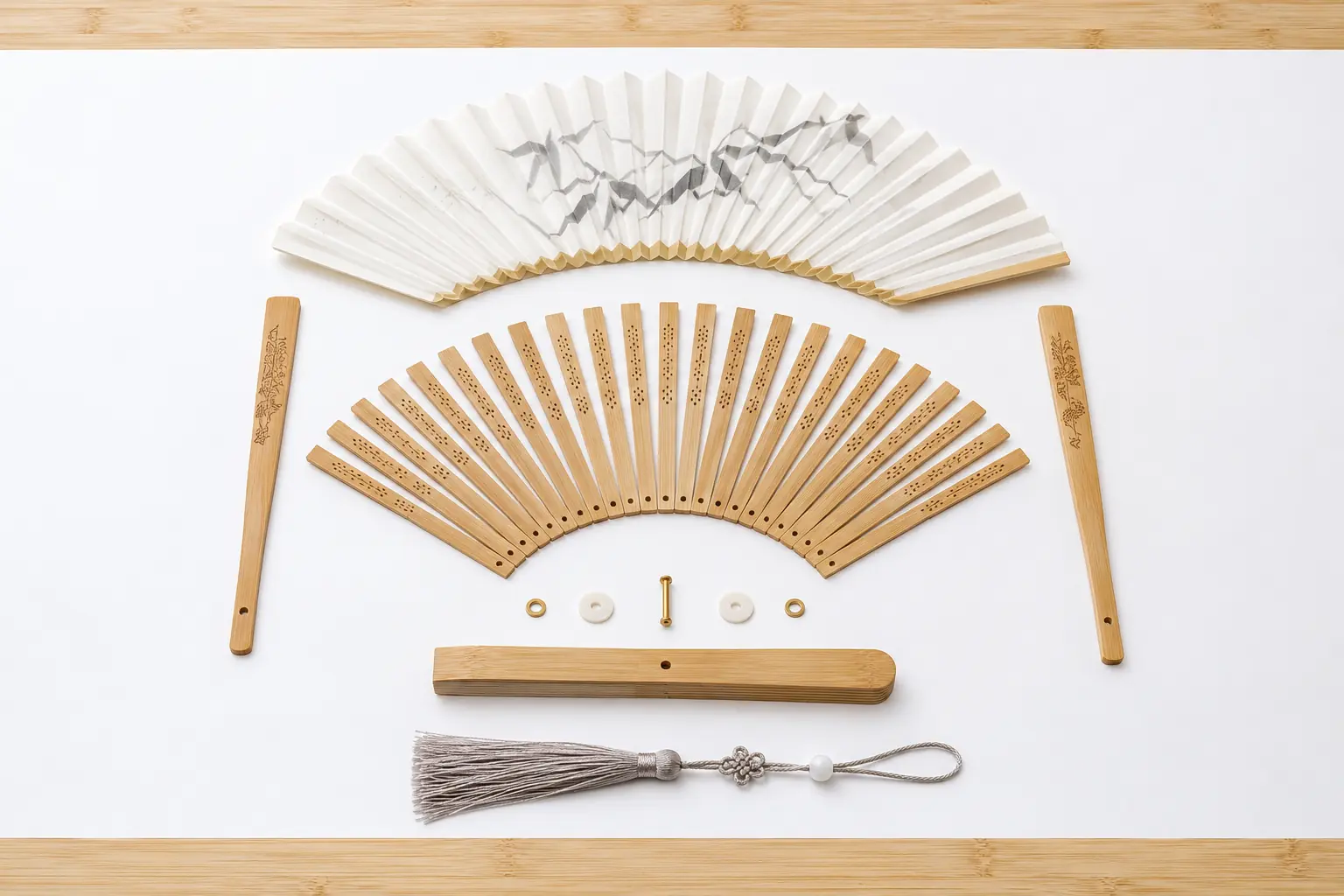
Fan terminology varies between makers and markets. “Bamboo fan sticks” is the broadest practical term for the narrow frame members. “Ribs” often refers to the inner sticks that support the leaf. “Guard sticks” are the two stronger outer members visible when the fan is closed. “Bamboo fan staves” may be used for the full set of structural sticks or, by some sellers, for individual members. A technical drawing should accompany the words so everyone is discussing the same part.
Inner sticks or ribs
The inner sticks determine spacing and support across the open leaf. Their thickness, taper, hole position and surface finish influence alignment and opening feel. Decorative cutouts can reduce weight and add visual interest, but the pattern should not leave weak sections near the pivot or narrow joints without evaluation.
Outer guard sticks
The two guards frame the folded fan and protect the leaf edges. They also provide a practical location for small engraving or a decorative finish. Because users grip these outer pieces, smooth edges and consistent thickness matter. A heavier guard may create a more substantial feel, but weight and balance should be assessed on a physical sample.
Pivot, washer and tension
The pivot holds the sticks together while allowing controlled rotation. If it is too tight, the fan can be difficult to open; if too loose, the fan may not hold a stable arc. Pivot material, pin finish and any washer or end cap should be listed in the bill of materials rather than described as bamboo. Opening feel should be judged on multiple samples because one especially smooth fan is not evidence of production consistency.
Bamboo Paper Fans Versus Bamboo Silk Fans
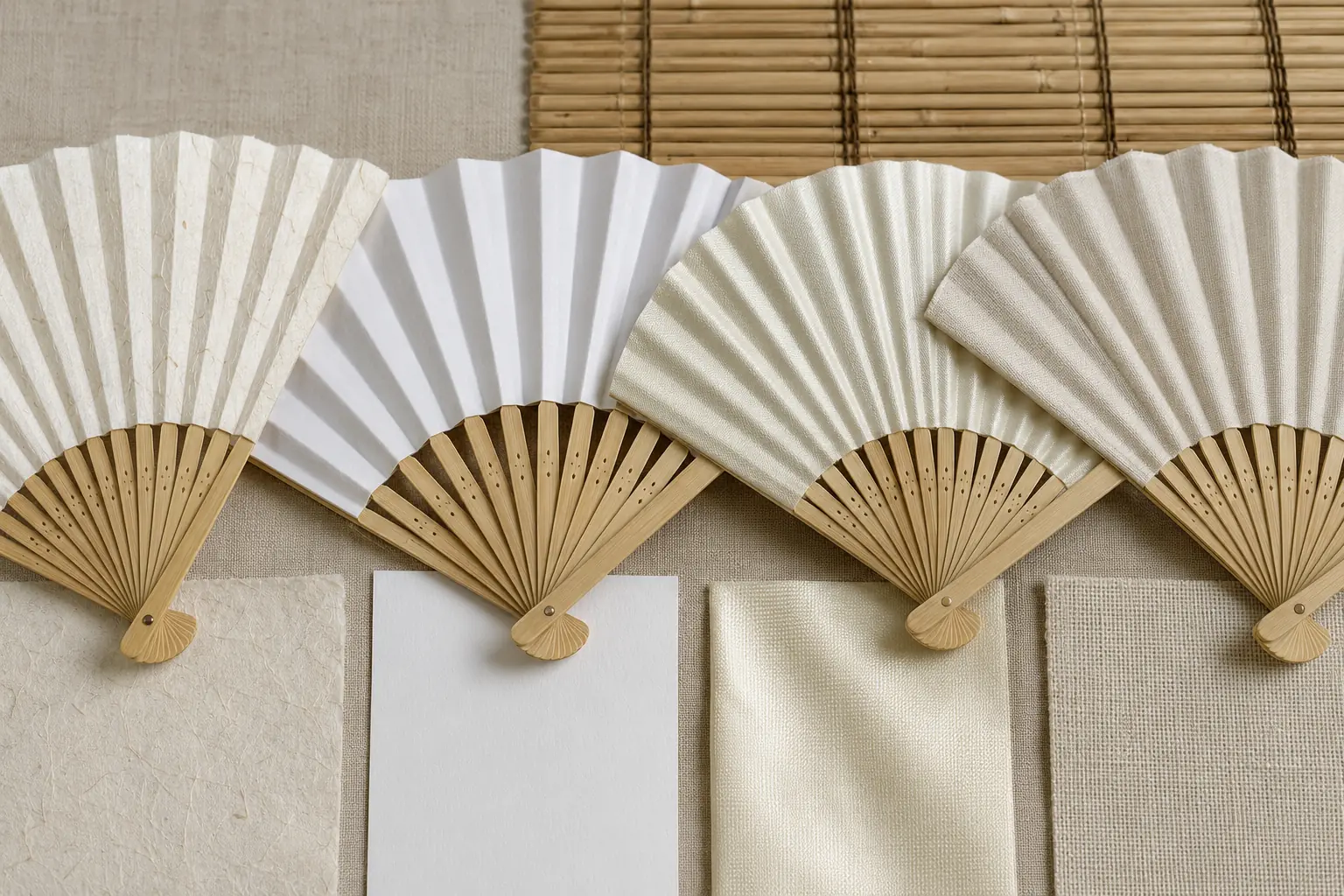
The leaf material shapes the visual result, folding behavior and product claim. A bamboo paper fan uses a paper leaf attached to a bamboo frame. A bamboo silk fan may use natural silk, a silk blend or a synthetic fabric marketed for a silk-like appearance. Buyers should not assume fiber content from the word “silk”; request the actual composition and supporting documentation when the claim is commercially important.
| Leaf option | Typical visual character | Design advantages | Points to verify |
|---|---|---|---|
| Paper | Crisp, matte or lightly coated surface | Detailed printing, broad color choice and clean folds | Paper weight, coating, tear behavior, fold cracking and moisture sensitivity |
| Natural silk | Fine fabric texture and subtle sheen | Premium presentation when fiber content is verified | Composition evidence, print behavior, edge finishing and care |
| Silk-look synthetic fabric | Smooth fabric appearance with controlled sheen | Consistent surface and a range of printed effects | Exact fiber, coating, fraying, opacity and accurate naming |
| Cotton or blended fabric | Softer, more textured and less reflective | Suitable for selected craft, gift or decorative concepts | Fiber composition, thickness, print sharpness and folding bulk |
When to choose bamboo paper fans
Bamboo paper fans suit projects that need detailed printed artwork, a matte appearance or a defined event color. Paper grade and coating should be tested with the intended ink and folding process. Dark solid areas can reveal scuffing or fold stress more readily than light patterns, so inspect a decorated sample in both open and closed positions.
When to choose bamboo silk fans
Bamboo silk fans can provide a soft textile appearance for gifts, performances or coordinated décor. Ask whether “silk” means natural silk or a silk-look material. Fabric thickness must work with the spacing and depth of the frame; a beautiful flat swatch can behave poorly when pleated and folded.
How Frame Construction Changes the Fan
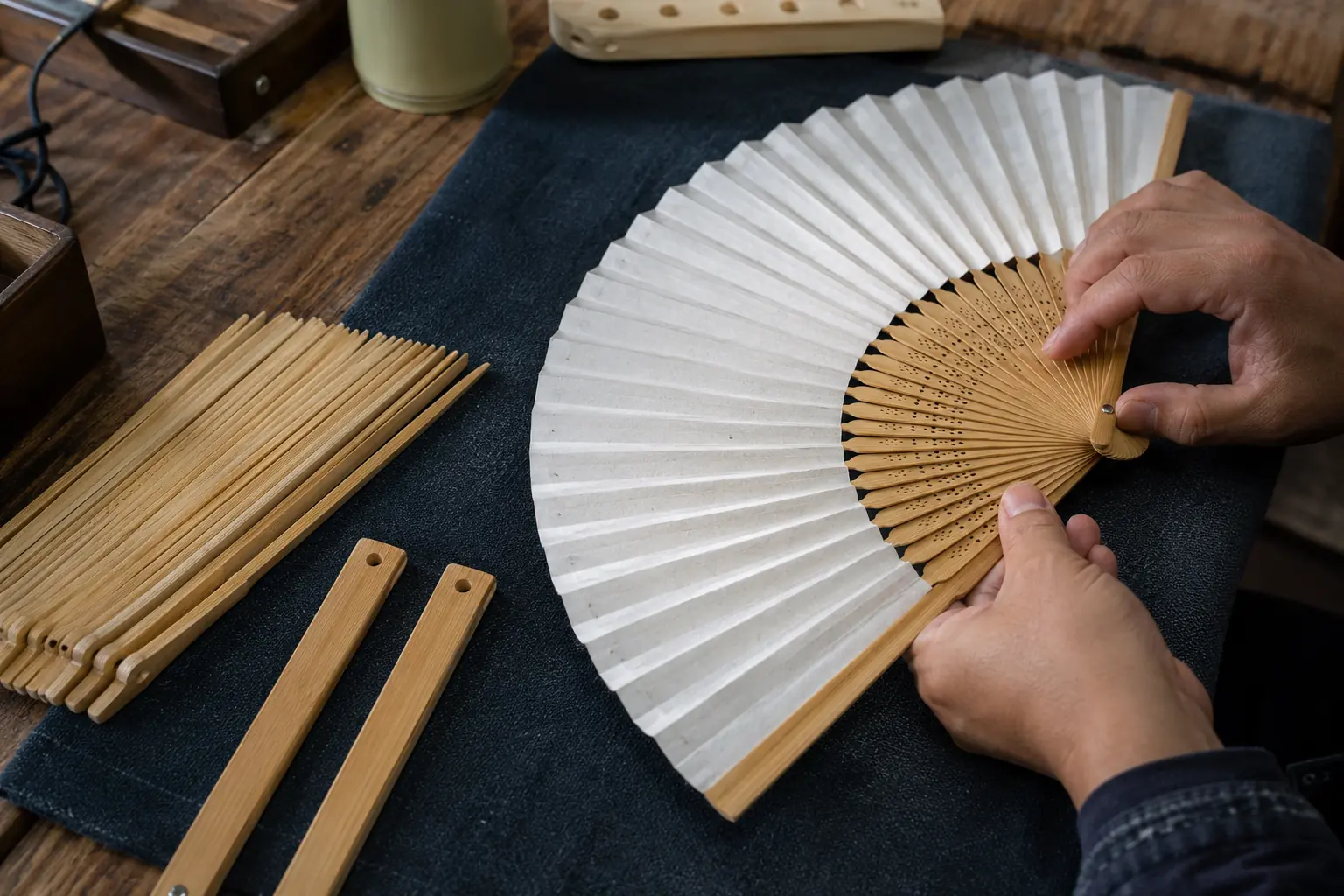
The frame is more than a visual border. It sets the arc, supports the leaf and determines how the folded fan sits in the hand. Buyers should compare complete assemblies, not isolated bamboo samples.
Stick count and spacing
A different stick count changes the number of folds, the visible artwork segments and the support beneath the leaf. More sticks do not automatically mean better quality; geometry, material thickness and workmanship matter together. The supplier should use the same construction for the approval sample and quotation.
Natural, stained and painted finishes
Natural bamboo shows grain and shade variation. Stains can deepen or coordinate the tone while still revealing material texture. Painted finishes can support a strong color concept, but edge coverage, adhesion and transfer onto the leaf should be checked. If a listing uses the phrase “white bamboo fan,” clarify whether the leaf, the frame or both are white.
Cutouts and decorative carving
Perforated patterns in the sticks can create an ornamental closed fan. A white perforated bamboo fan, for example, may use painted or light-finished guards with decorative cutouts. Review edge smoothness and structural continuity. Intricate shapes should be assessed for handling safety, cleaning and breakage risk rather than approved only from a rendering.
Bamboo Fan Design for Print, Engraving and Color
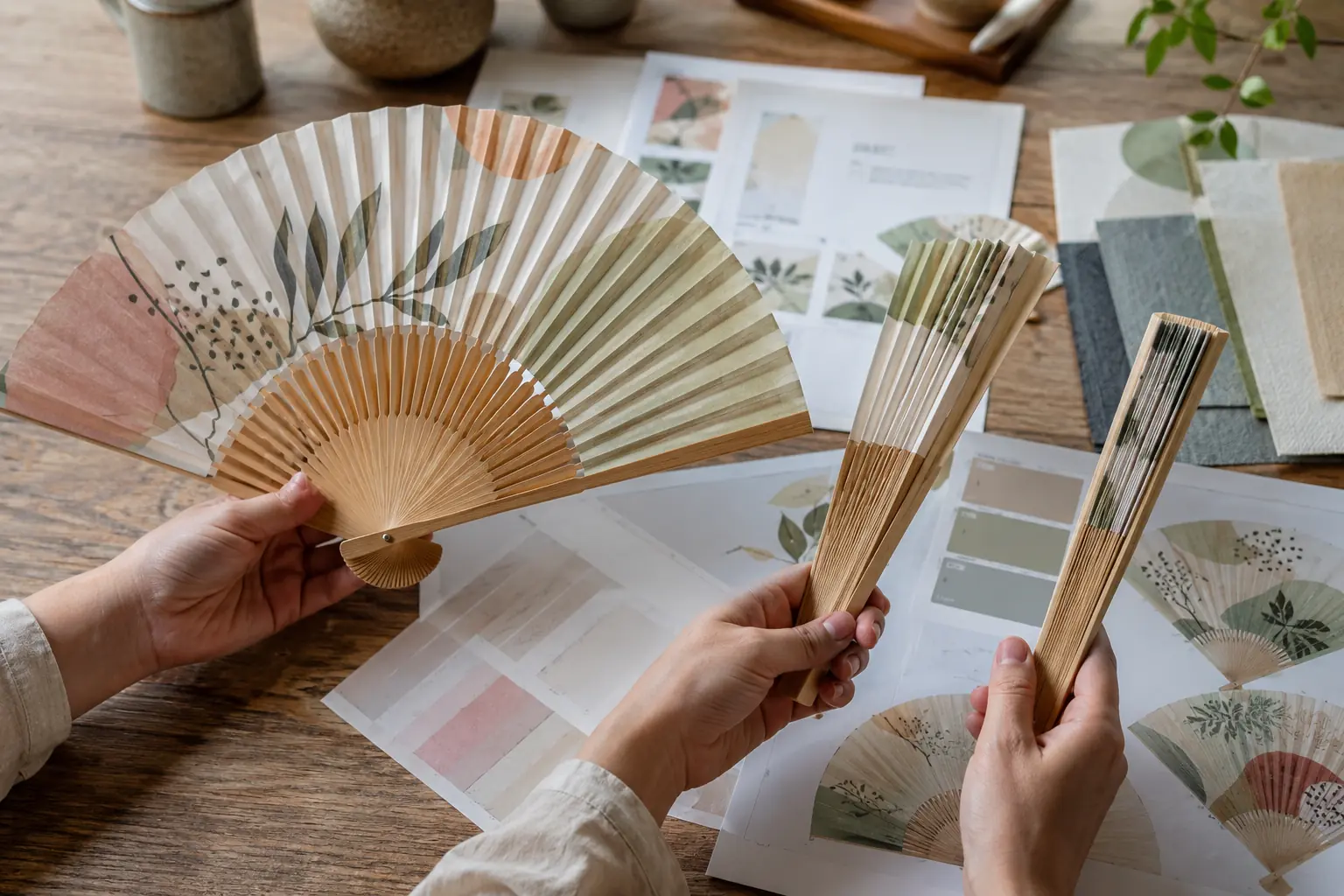
A strong bamboo fan design respects the folds. Ask for the production template, including the open arc, trim edge, guard overlap, pivot zone and recommended safe area. Keep the most important graphic elements away from deep folds and hidden edges. For repeating patterns, check whether the repeat appears intentional when the fan is half open as well as fully spread.
Preparing artwork for the folding leaf
Vector files are useful for logos and line art, while high-resolution raster artwork may be needed for photography or painted effects. Confirm color mode, bleed and resolution with the printing process. A screen preview cannot prove final color because paper, fabric, coating and ink change the result. Approve a decorated physical sample for projects where exact appearance matters.
Engraving the bamboo guard
A name or simple mark can be placed on an outer guard if the surface and available area support it. Fine lines and small lettering may lose clarity on curved grain. Natural variation can also change engraved contrast. Use simplified artwork and define position from a fixed reference point.
Designing product collections
For retail assortments, limit uncontrolled variation. Give each pattern a code, state the unit ratio and define whether colors are packed individually, assorted in inner boxes or mixed in every carton. For mini bamboo fans and large bamboo fans in the same collection, adapt the artwork rather than scaling every element blindly.
Cultural Style Names Require Accurate Sourcing
Cultural labels belong to a separate sourcing decision. If a design is described as Chinese or Japanese, define the specific fan form, construction, motif, production origin and review process instead of using a national label as decoration shorthand. See our dedicated Chinese and Japanese bamboo hand fan guide for historical terminology.
If cultural accuracy matters, define the intended fan tradition, shape, materials, motif, calligraphy, production origin and expert review. Obtain rights for all artwork and fonts. Avoid copying museum objects, contemporary artists or branded designs. For general commercial collections, a neutral description such as “bamboo folding hand fan with printed botanical leaf” is often clearer and less likely to mislead.
B2B Specification Checklist
| Specification area | Details to confirm |
|---|---|
| Use and market | Retail, wedding, event, gift, performance or display; destination country and channel |
| Dimensions | Closed length, open width or arc, height, weight target and tolerances |
| Frame | Bamboo construction, stick count, guard profile, finish, cutouts and pivot |
| Leaf | Material composition, weight or thickness, coating, color and attachment method |
| Decoration | Print process, artwork version, color reference, engraving and approval standard |
| Packaging | Sleeve or box, insert, barcode, warnings, assortment and carton marks |
| Quality and compliance | Inspection criteria, buyer protocol, documentation and market-specific testing |
Include quantity, destination, requested Incoterm and target timing with the specification. MOQ, price and lead time depend on the final construction, artwork, number of variants, packaging and current capacity, so they should be confirmed for each project.
Quality Inspection for Bamboo Folding Fans
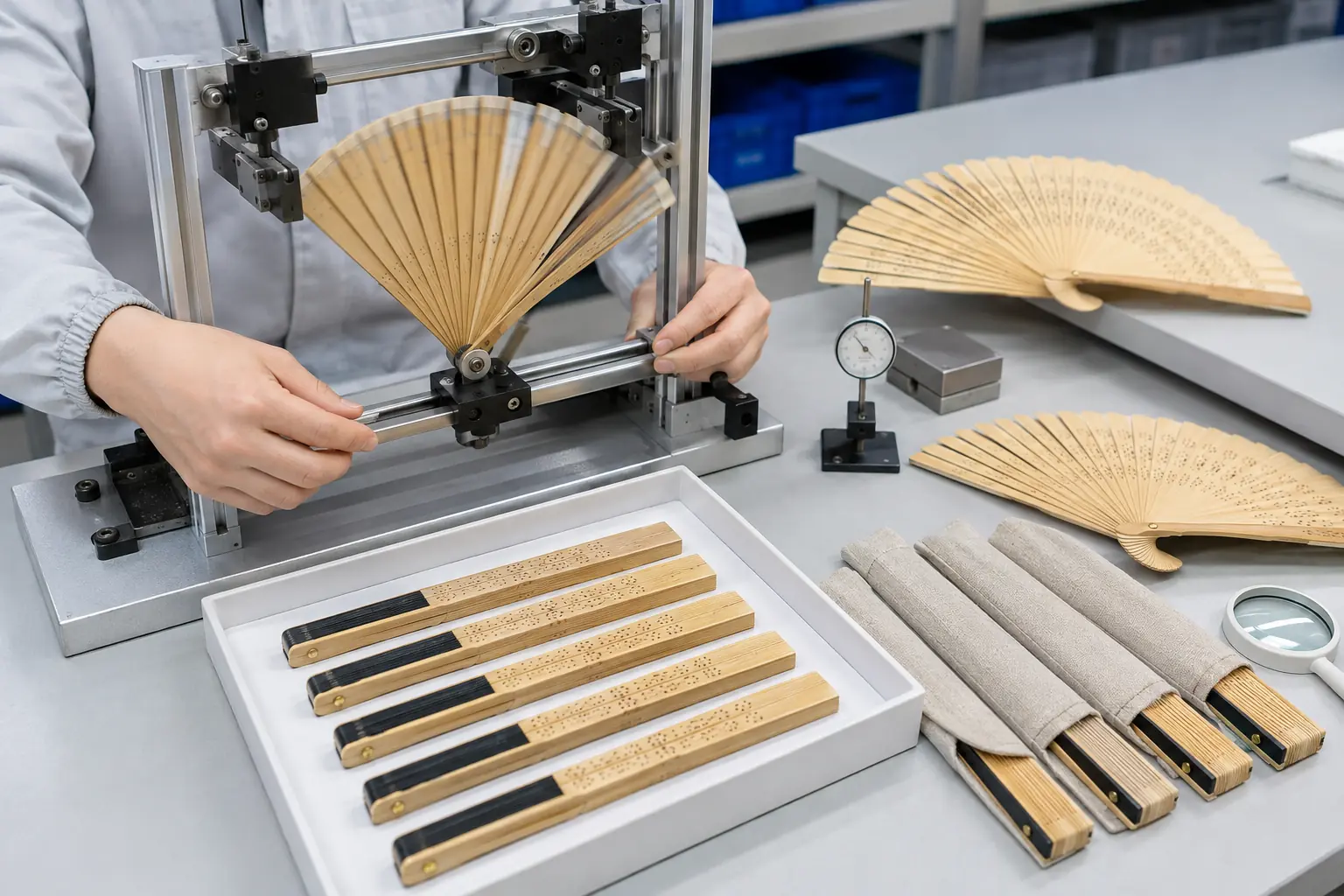
Functional inspection should open and close sampled fans several times using normal handling. Check that sticks spread in sequence, the fan reaches the intended arc, the pivot remains secure and the leaf does not detach or bunch abnormally. Inspect closed alignment, guards, edge smoothness, bamboo cracks, unintended sharp points and surface transfer.
Decoration checks should compare the correct artwork version, orientation, registration and major color appearance with the approved sample. Look for missing print, smudges, visible glue and staining. For fabric leaves, inspect fraying and tension; for paper leaves, inspect tears, fold cracking and unwanted creases.
Packing checks should confirm unit count, design assortment, protective sleeve or box, barcode, labels and carton marks. The inspection standard should recognize reasonable natural bamboo variation while defining defects objectively.
Use, Care and Storage Guidance
Open a folding fan with controlled hand movement rather than forcing individual sticks. Keep paper leaves away from water and prolonged high humidity. Follow the specified cleaning guidance for fabric leaves; do not soak untreated bamboo or the pivot assembly. Allow any lightly damp surface to dry open in a ventilated area, away from excessive heat.
Store the fan closed in a protective sleeve or box where the guards will not be crushed. For long-term retail inventory, use suitable warehouse conditions and inspect representative cartons periodically. Large decorative fans need supports designed for their weight and geometry; do not assume the leaf or outer guard alone is a safe hanging point.
Frequently Asked Questions About Bamboo Folding Fans
Is the entire folding fan made from bamboo?
Usually not. The frame sticks or guards may be bamboo, while the leaf can be paper or fabric and the pivot can be metal or another material. Request a component list for accurate labeling.
What is the difference between fan sticks and staves?
Usage varies. “Sticks” is a broad term; inner sticks are often called ribs, and the two outer pieces are guard sticks. Some suppliers use “staves” collectively. A drawing and parts list remove ambiguity.
Is every bamboo silk fan made with natural silk?
No. Some products use synthetic silk-look fabric or blends. Confirm fiber composition and evidence before describing the material as natural silk.
Which is better, a bamboo paper fan or fabric fan?
Neither is universally better. Paper can support crisp detailed printing, while fabric offers a textile appearance. The artwork, budget, folding behavior, intended use and verified material should guide the choice.
Can artwork be printed across all the folds?
Yes, but folds interrupt the image and some areas may be hidden by sticks or guards. Use the production template and approve a decorated physical sample.
Can the bamboo sticks be engraved?
A simple mark may be engraved on a suitable outer guard. Available space, curvature and natural grain limit very small detail and perfectly uniform contrast.
Are Chinese and Japanese bamboo fans the same?
No single design represents either culture, and the terms should not be used interchangeably. If authenticity matters, define the specific tradition, origin, construction and artwork review requirements.
How should a sample be approved?
Approve the written specification, construction, physical product, open and closed appearance, artwork, color reference and packaging together. Record the approved version and any later changes.
Develop a Custom Bamboo Folding Fan
Begin with the intended use, dimensions, bamboo frame, leaf composition, artwork, quantity, packaging, destination and quality requirements. Contact Fujian Xianxu Bamboo & Wood Co., Ltd. to discuss an OEM/ODM bamboo folding fan concept and confirm sampling, documentation, commercial terms and production timing for the defined order.