
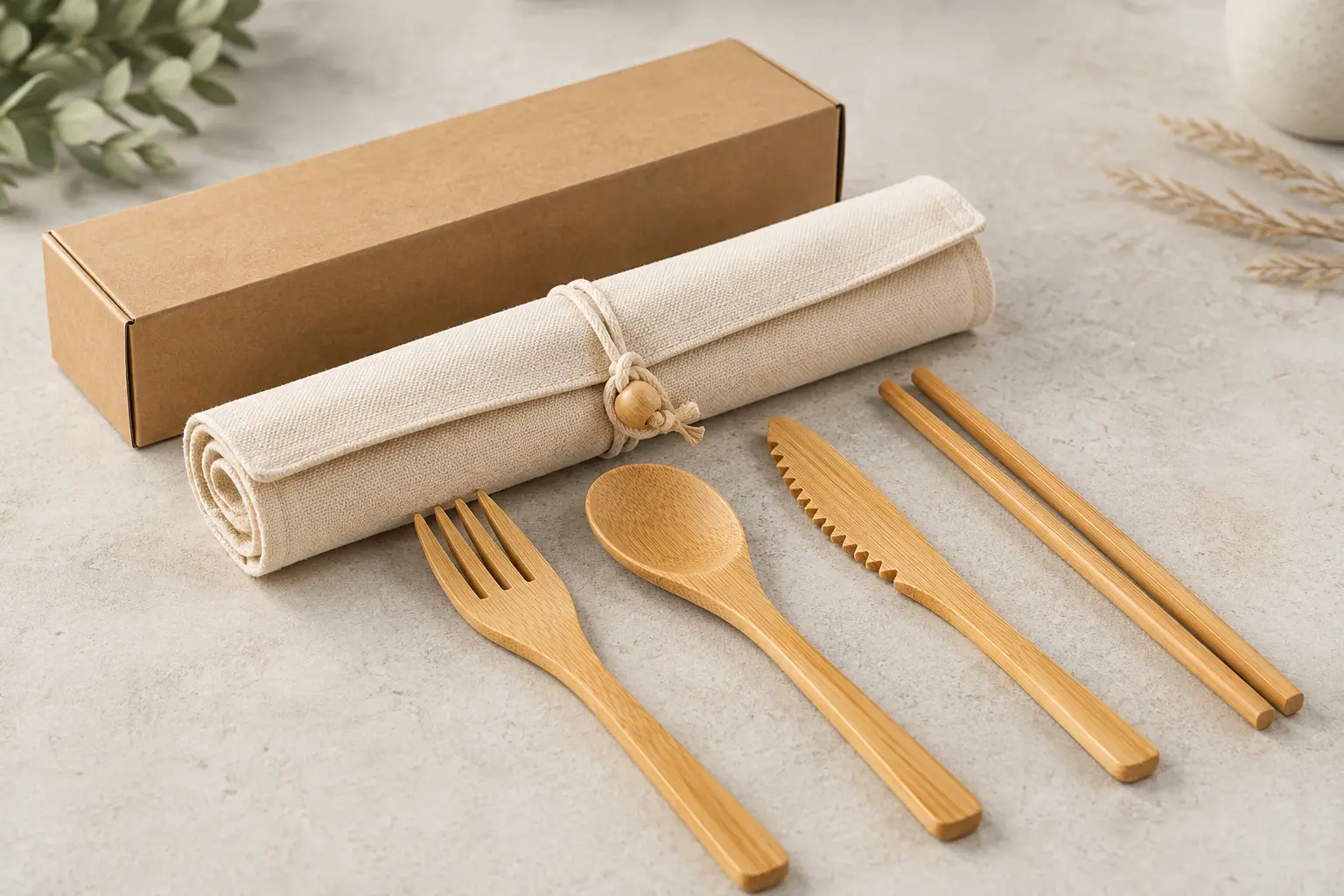
Bamboo cutlery wholesale programs are no longer limited to one plain fork, spoon and knife. A modern collection can include compact travel kits, reusable tableware, branded gift sets, children’s utensils, food-service pieces and hybrid designs that combine stainless steel working ends with bamboo handles. Each version tells a different product story, and each requires different decisions about shape, finish, cleaning, packaging and intended use.
This article explores how a bamboo cutlery set moves from material selection to everyday use. It also explains the practical differences between all-bamboo utensils, stainless-steel-and-bamboo combinations, travel sets and bamboo cutlery bulk supply—without treating every product as interchangeable or making vague environmental claims.
One Material, Several Bamboo Cutlery Set Stories
The words “bamboo cutlery” can describe several product formats. A fully bamboo utensil is shaped primarily from bamboo and can be developed either for repeated use or for a defined single-use food-service application. A reusable set normally has thicker profiles, smoother contours and a storage solution. A hybrid set uses bamboo where customers hold the utensil while stainless steel performs the cutting, scooping or piercing function.
These formats should not be compared only by unit price. Product thickness, fork-tine geometry, spoon depth, knife-edge design, surface finishing, moisture control and packaging all influence the user experience. A promotional kit carried in a backpack has different priorities from tableware sold in a homeware collection or disposable utensils packed for a takeaway meal.
| Product Format | Typical Use | Common Set Components | Development Priority |
|---|---|---|---|
| Reusable all-bamboo set | Home, office, gifting and lifestyle retail | Fork, spoon, knife and optional chopsticks | Comfort, finish, durability and care instructions |
| Bamboo travel set | Commuting, lunch bags, camping and events | Utensils plus roll pouch, case or sleeve | Compact storage, cleanliness and portability |
| Stainless steel with bamboo handles | Dining, giftware and premium retail | Metal fork, spoon and knife with bamboo grips | Joint construction, balance and metal specification |
| Food-service bamboo cutlery | Takeaway, catering and hospitality | Individual pieces or wrapped fork-spoon-knife sets | Consistent dimensions, packing efficiency and intended-use compliance |
From Reusable Tableware to Portable Travel Sets
Reusable Bamboo Cutlery Set for Everyday Tableware
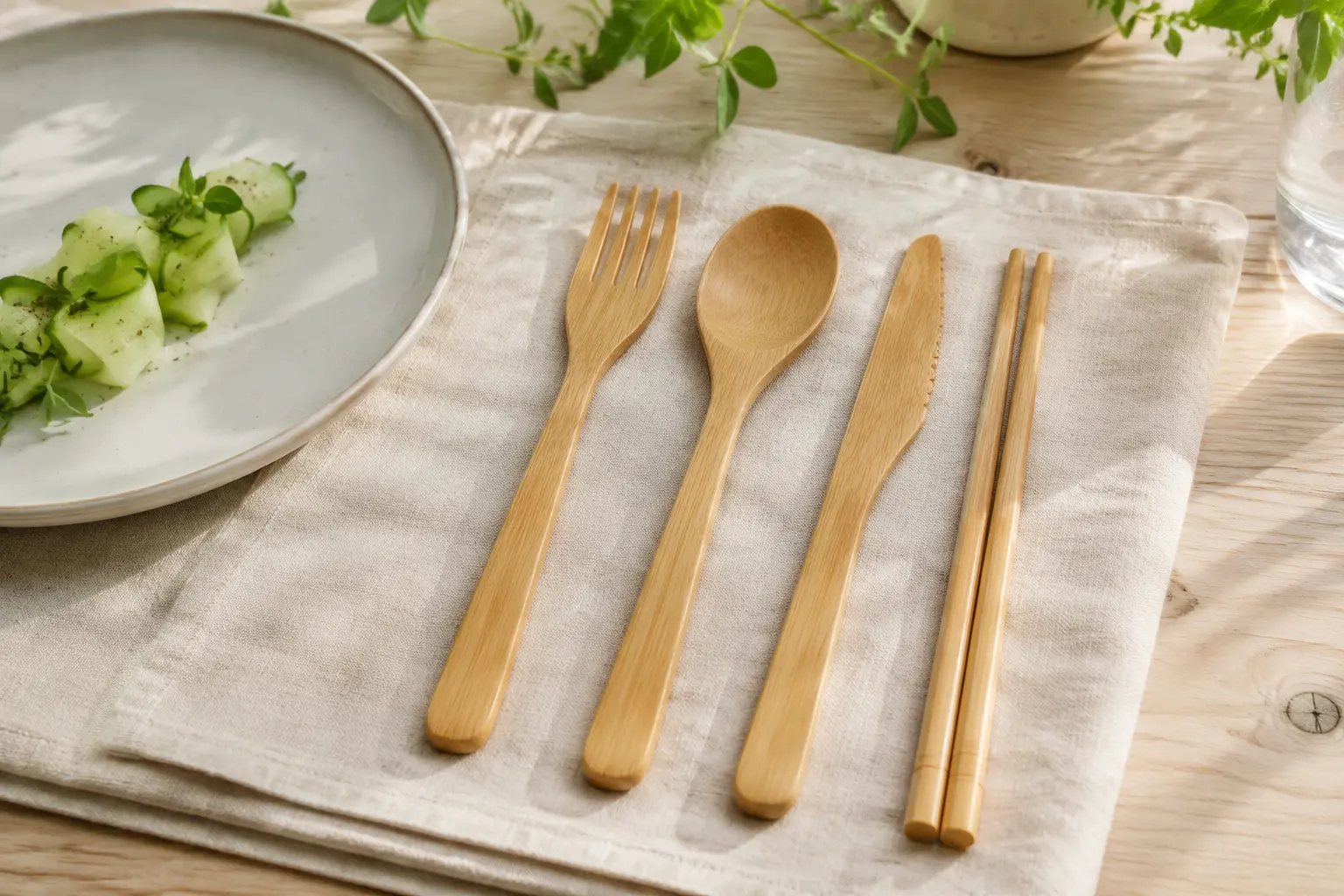
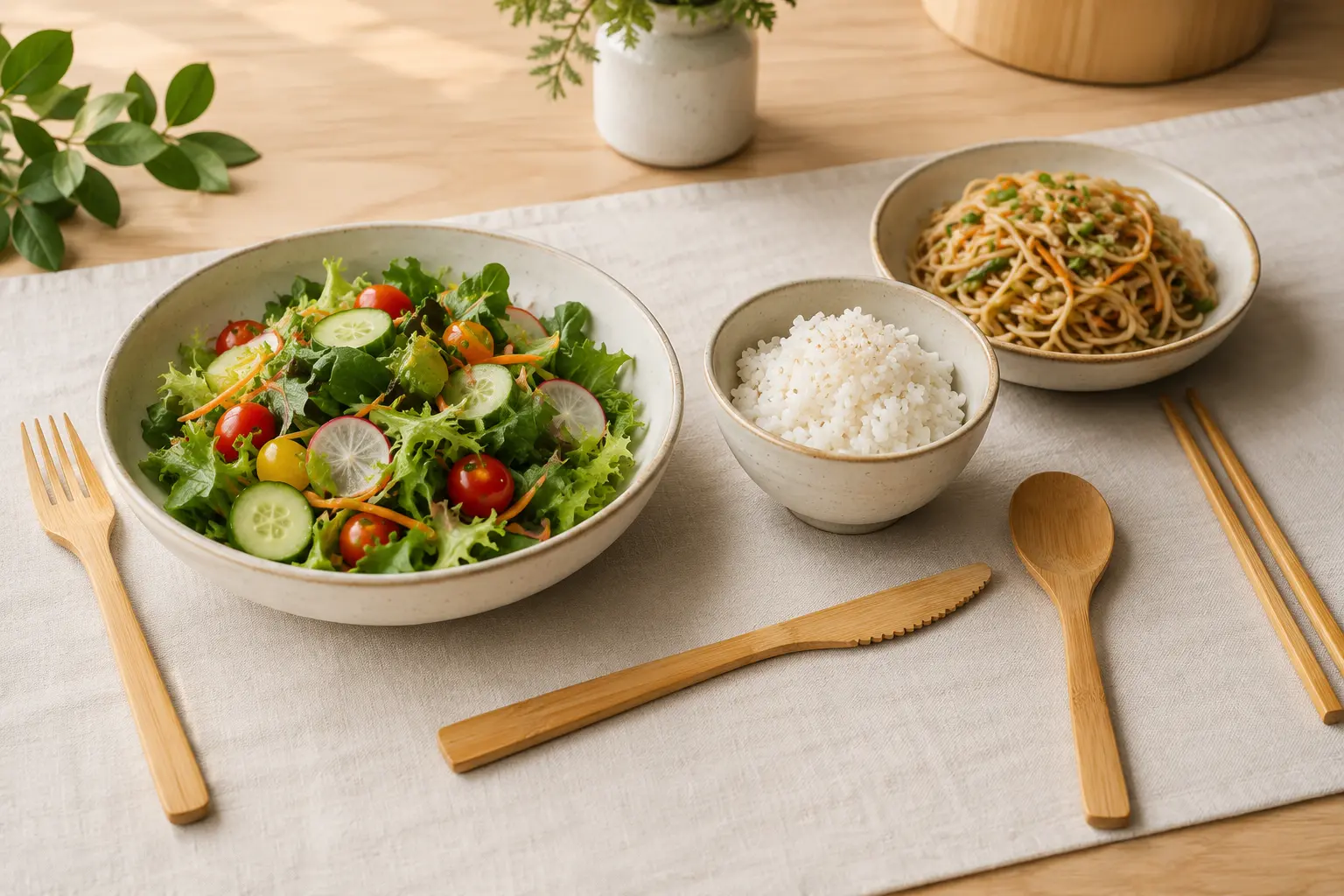
A reusable bamboo cutlery set is designed around repeated handling rather than a single meal. Rounded edges, a comfortable handle section and a carefully sanded food-contact surface matter more than decorative complexity. The set can be presented as minimalist kitchenware, a lunch accessory or a coordinated product within a wider bamboo tableware range.
Some catalog searches describe this category as a tableware bamboo cutlery set. In merchandising terms, the useful question is whether the utensils visually and functionally belong with plates, bowls, trays or lunch boxes in the same collection. Matching bamboo tone, handle proportions and packaging style can make separate products feel like one deliberate range.
Bamboo Travel Cutlery Set for Life Away from Home
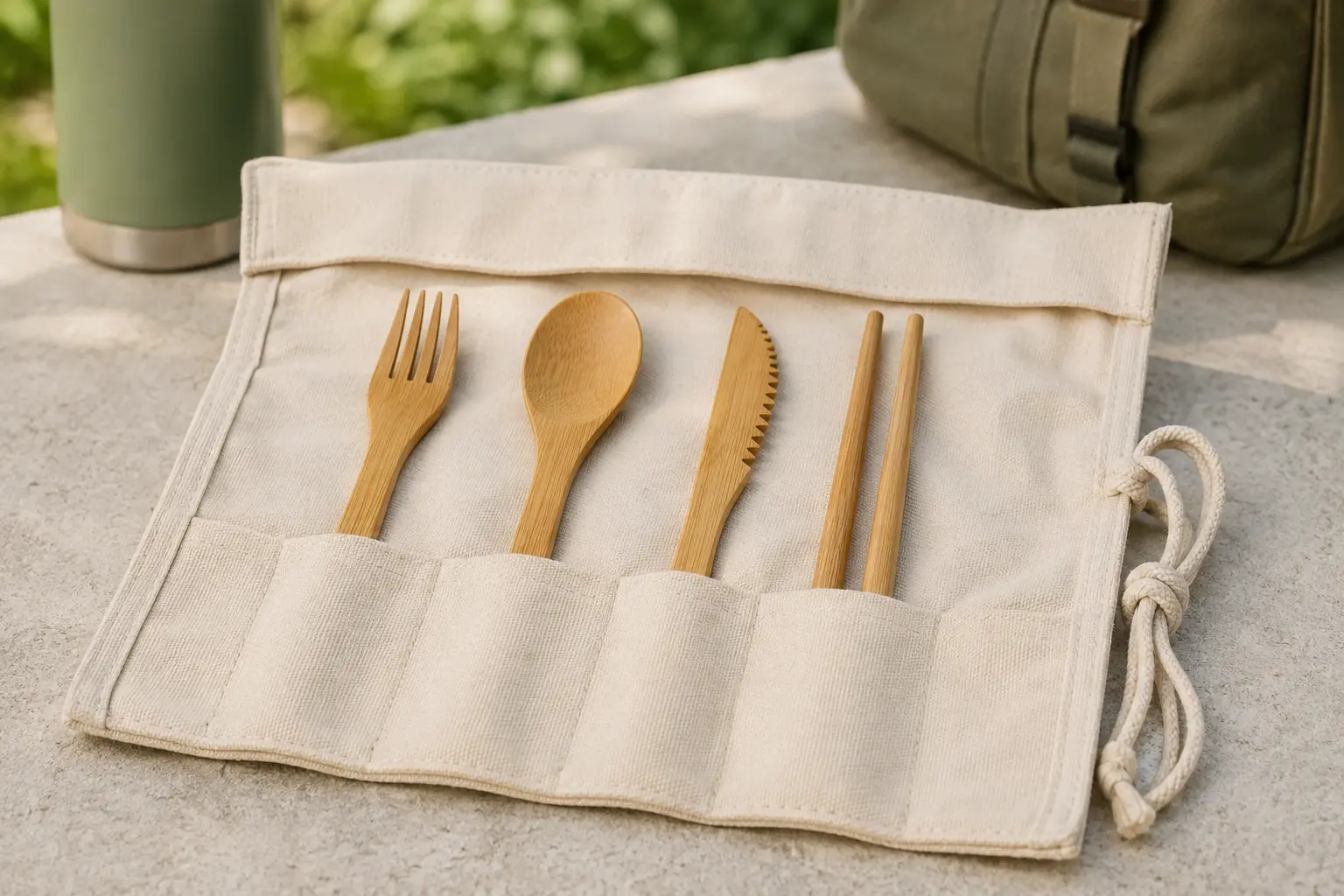
A bamboo travel cutlery set adds portability to the basic utensil concept. A cotton roll, fitted case or washable sleeve keeps the pieces together in a work bag, lunch tote or camping kit. The pouch should fit the actual utensils without excessive movement, and the design should make it easy to see whether every piece has been returned after use.
Searches such as travel cutlery set bamboo usually signal interest in the complete carry solution, not only the utensils. Buyers should therefore develop the pouch, closure, care label and retail presentation as parts of the product. A compact kit may include a fork, spoon, knife, chopsticks, straw or cleaning brush, but more pieces are not automatically better; the assortment should match the target user.
Cutlery Stainless and Bamboo: A Hybrid Product Category
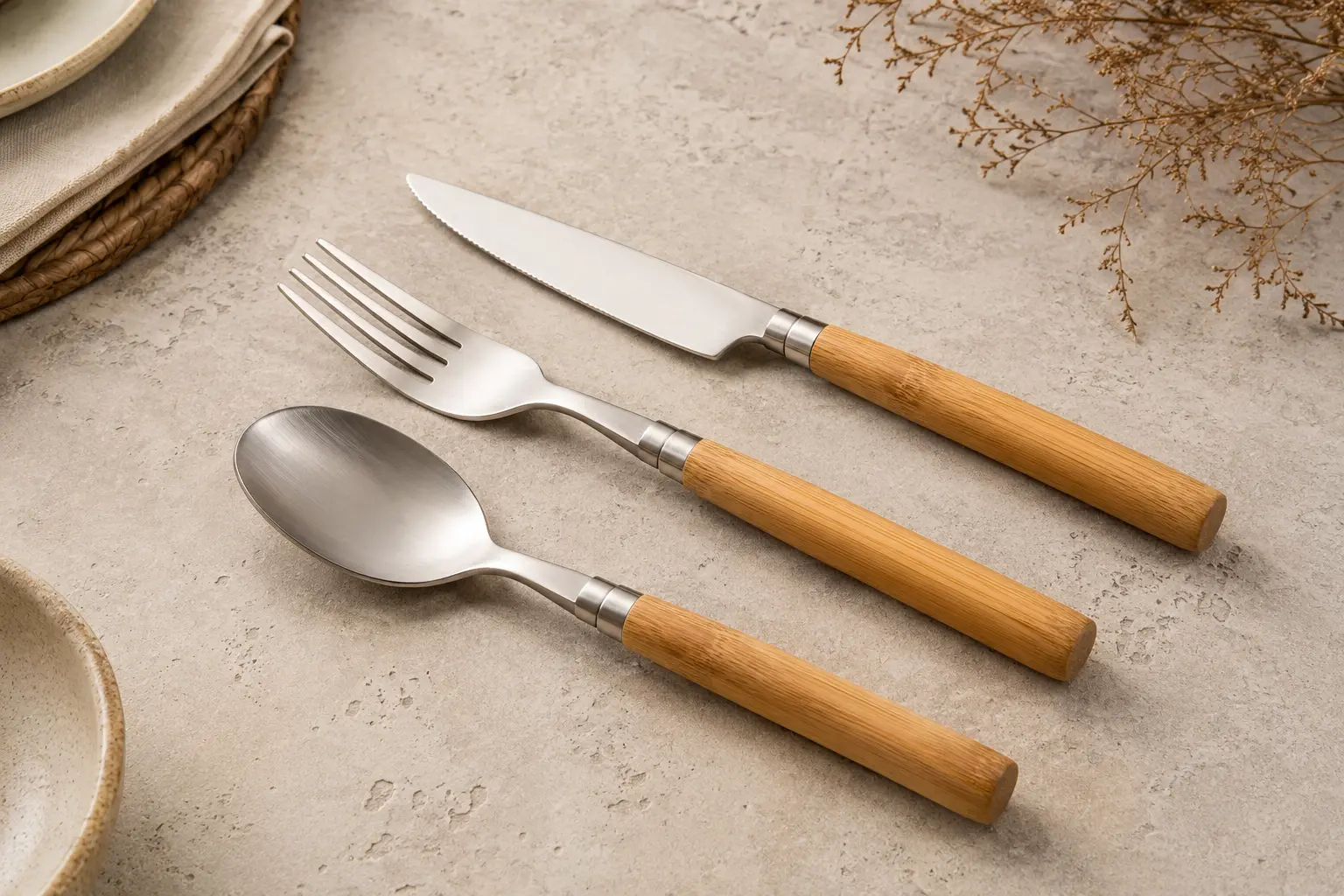
The phrase cutlery stainless and bamboo generally refers to metal utensil heads combined with bamboo handles. This format offers the familiar performance of stainless steel while retaining a warm natural grip and a distinctive shelf appearance. It should not be described as an all-bamboo product.
For a hybrid design, the stainless-steel grade, metal thickness, polishing level, handle connection, adhesive or mechanical fixing method, balance and corrosion testing all need to be defined. The bamboo handle also requires an agreed moisture range, finish and workmanship standard. A strong visual concept cannot compensate for a loose joint or an uncomfortable weight distribution.
Bamboo Cutlery for Food: Performance Begins at the Surface
Bamboo cutlery for food must be designed for its expected contact conditions. A spoon used with soup, a fork used with salad and a knife used for a soft lunch item place different demands on the product. Buyers should define the intended foods, contact time, temperature range, repeated-use expectation and cleaning method before approving a material and finish.
The surface should be smooth and free from splinters, cracks, glue marks, sharp corners or residues. Fork tines need useful spacing, spoons need sufficient depth, and knife edges must suit the intended food without being dangerously sharp. Natural grain and color variation are normal, but an approved sample should establish acceptable appearance boundaries.
Material descriptions must also be precise. A utensil formed from bamboo, a laminated bamboo article, a metal utensil with a bamboo handle and a plastic product filled with bamboo powder are different constructions. The European Commission has specifically warned about unauthorized bamboo and other plant-based additives in certain plastic food-contact products; that issue should not be confused with an article made entirely from bamboo. The bill of materials, product label and testing scope should describe the actual construction. See the Commission’s official explanation of bamboo-plastic food-contact products.
Food-contact requirements depend on the finished article, its coatings or adhesives, intended use and destination market. The U.S. FDA explains that substances used in food-contact materials must have an appropriate regulatory basis for their intended conditions of use. In the European Union, kitchenware and tableware fall within the food-contact-material framework and must meet applicable safety and good-manufacturing requirements. Buyers can review the official FDA food-contact guidance and the European Commission food-contact-material overview, then confirm the specific testing plan for the chosen construction.
How to Make Bamboo Cutlery: From Bamboo Blank to Finished Utensil
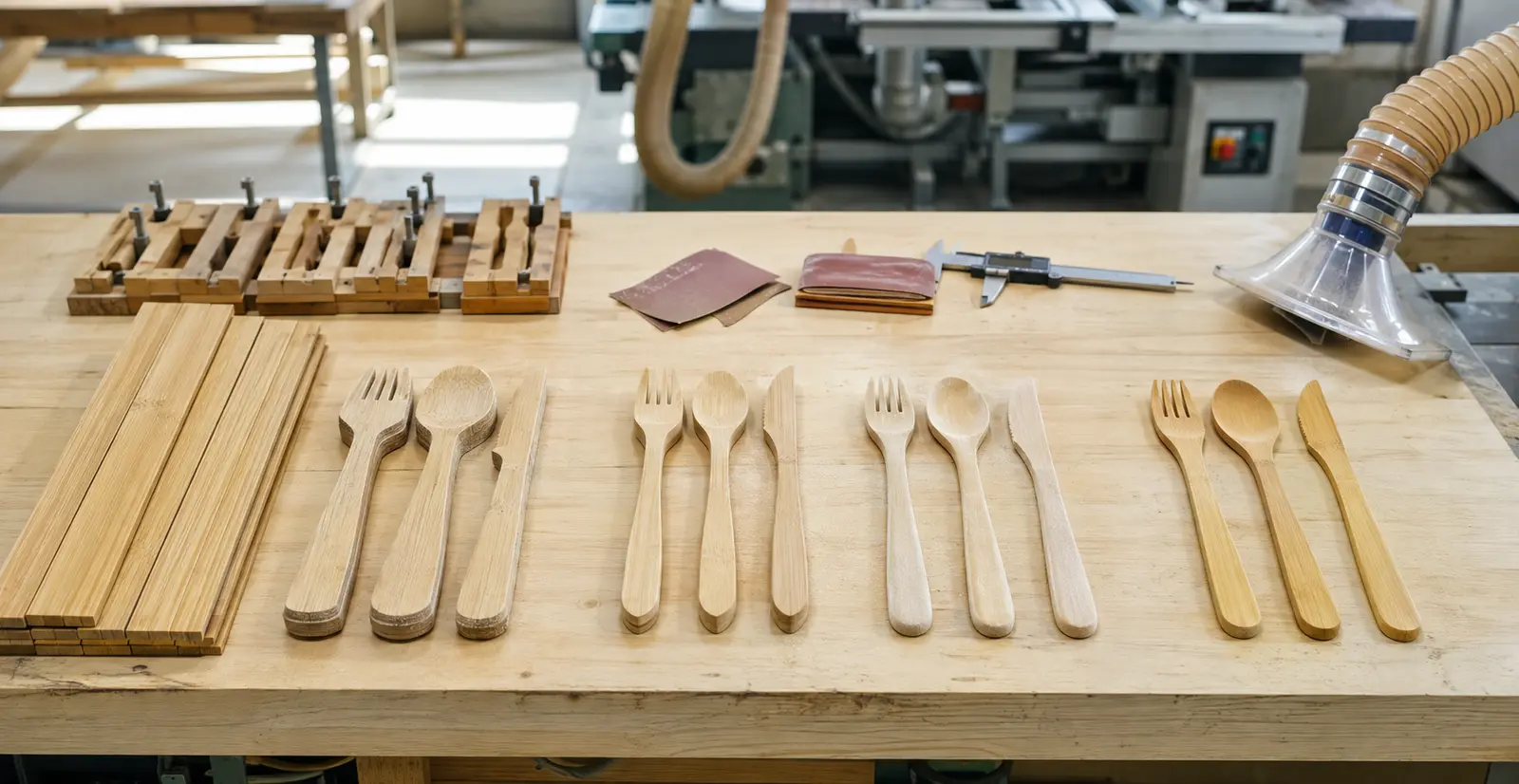
People searching how to make bamboo cutlery are often curious about more than carving a spoon. In factory production, the goal is repeatable geometry, stable material and consistent surface quality across an order. The exact process varies by product design and equipment, but a typical development route includes the following stages.
- Material selection and conditioning: Bamboo stock is selected for the required dimensions and appearance, then conditioned to a controlled moisture range suitable for machining.
- Blank preparation: The material is split, cut or laminated as required and prepared into blanks that match the utensil layout.
- Forming and machining: Fork, spoon, knife or chopstick profiles are cut or molded with tooling developed for consistent outlines and thickness.
- Detail shaping: Spoon bowls, fork tines, handle curves and edges are formed to the approved geometry.
- Sanding and surface refinement: Multiple finishing steps remove machining marks and create comfortable edges, especially around tines and spoon rims.
- Cleaning, drying and finishing: Dust is removed, the product is dried as required, and an approved food-contact finish may be applied when the specification calls for one.
- Inspection and packing: Dimensions, appearance, surface smoothness, set contents, branding and packaging are checked against the approved standard.
Moisture management is important throughout the process. Packaging a damp product can create quality problems later, while overly aggressive drying may contribute to checking or deformation. Production controls should be written around the actual bamboo, geometry, finish and destination conditions rather than copied from an unrelated utensil.
What “Bamboo Cutlery Reusable” Should Mean in Practice
Keywords such as bamboo cutlery reusable and bamboo reusable cutlery set express a clear customer expectation: the product should remain useful through repeated meals and cleaning cycles. “Reusable” should be supported by the product design, sample testing and realistic care instructions, not used as a decorative claim.
Care guidance must match the tested product. Many bamboo utensils benefit from prompt washing, limited soaking and thorough drying before storage. Dishwasher suitability, boiling-water treatment or microwave use should never be promised unless the complete product has been validated for those conditions. Hybrid pieces may need additional care around the metal-to-handle joint.
Consumers should be advised to stop using a utensil if it develops cracks, splinters, a loose connection or a damaged finish. There is no credible universal lifespan for every reusable bamboo set because frequency of use, food type, washing method, storage humidity and construction all differ.
Building a Bamboo Cutlery Set Wholesale Collection
A strong bamboo cutlery set wholesale program begins with a coherent assortment. Instead of adding every possible accessory, define a clear role for each set: daily lunch, premium gifting, family tableware, hotel amenities, food service or outdoor travel. The number of pieces, utensil size, packaging and branding can then support that use case.
Set Composition and Product Dimensions
Confirm the exact fork, spoon, knife and chopstick dimensions; handle thickness; spoon capacity; tine shape; weight range and pouch size. If a straw or brush is included, it should have its own material and care specification. Children’s products require a separate review of dimensions, edges, foreseeable use and market requirements rather than simply shrinking an adult set.
Branding Without Overloading the Product
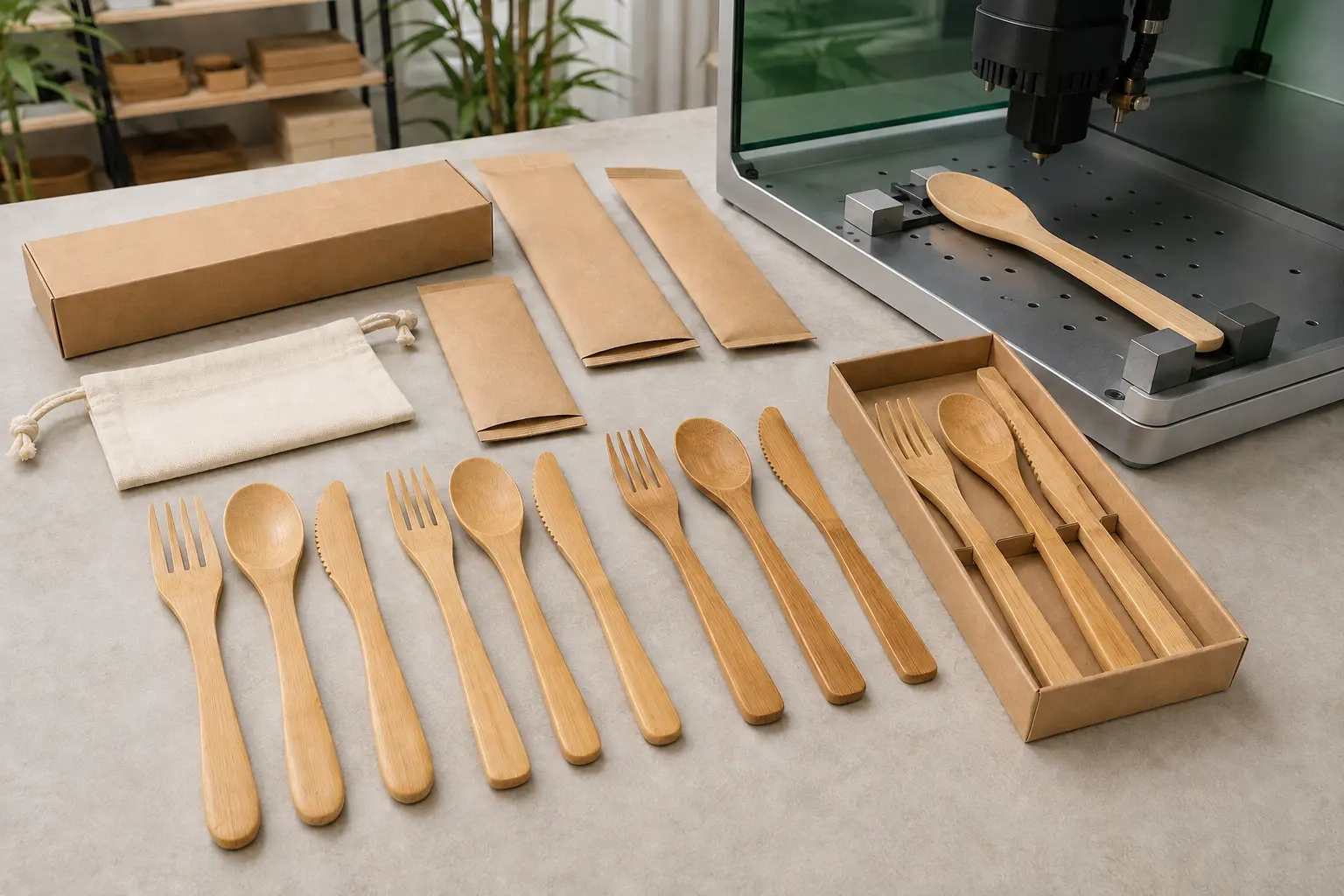
Laser engraving can create a discreet mark on a handle, pouch tag or box, while printing may suit packaging and care cards. Logo contrast changes with natural bamboo grain, so the artwork, size, position and acceptable appearance should be approved on a physical sample. Variable names and mass-production logos require different proofing and packing workflows.
Bamboo Cutlery Bulk Packing and Logistics
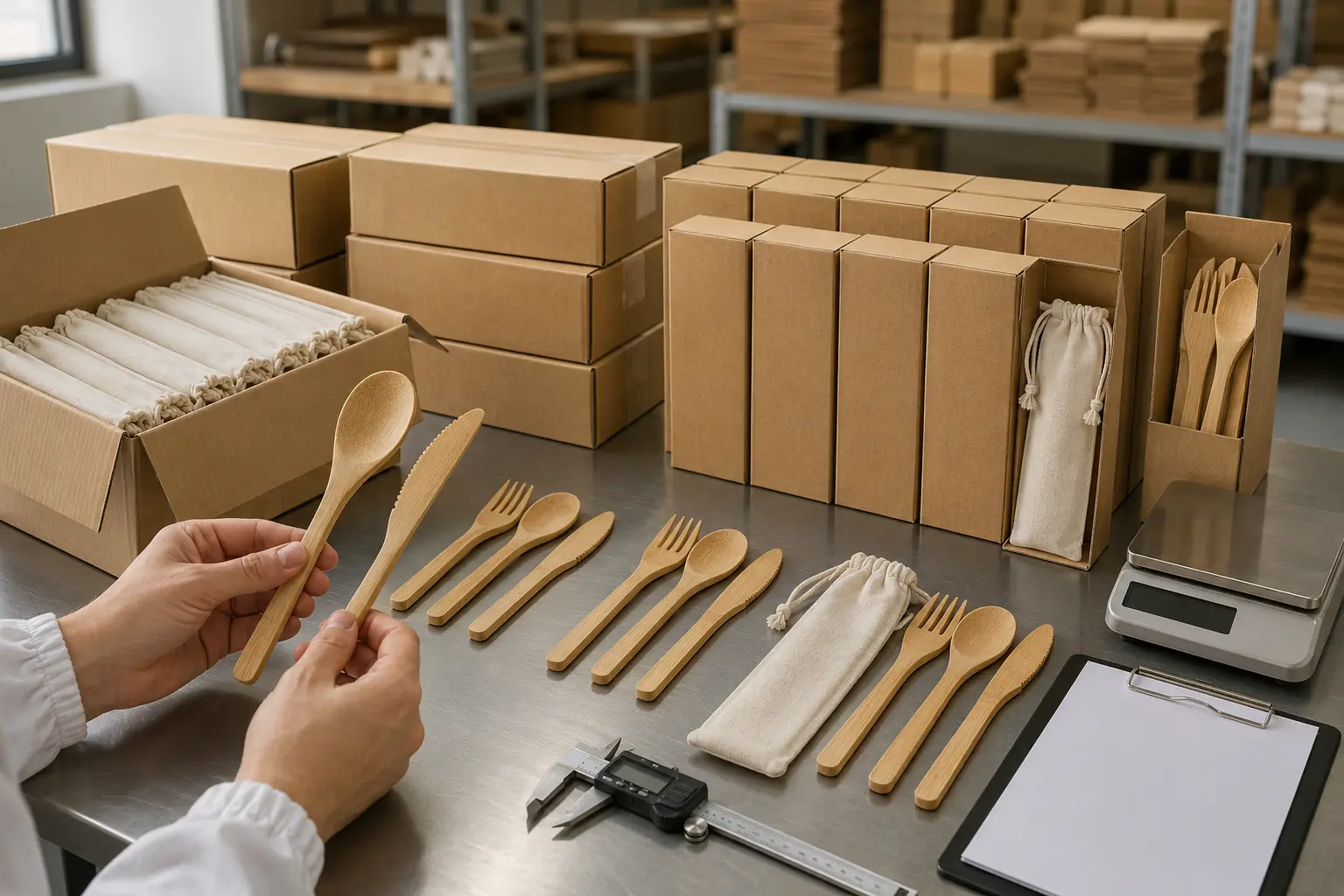
Bamboo cutlery bulk can mean loose utensils for food-service packing, complete sets in inner boxes, or individually wrapped kits packed into export cartons. These configurations have different hygiene, counting, protection and labeling needs. An RFQ should state the unit of sale, pieces per set, inner quantity, carton quantity, barcode or label requirements and whether the buyer will repack after import.
For e-commerce and retail sets, the package should protect fork tines, knife edges, bamboo surfaces and pouch presentation. For high-volume food service, packing efficiency and reliable count control may matter more than a display box. Neither format should be assumed from the word “bulk.”
Sustainability Claims Need Specific Evidence
Bamboo can support an appealing natural-material story, but terms such as “eco-friendly,” “biodegradable,” “compostable” and “zero waste” should not be used as automatic synonyms. The complete product may include a finish, adhesive, textile pouch, metal component, label or mixed-material packaging. Its end-of-life route also depends on local collection and composting infrastructure.
A more credible product description identifies the actual materials, explains whether the design is intended for repeated use and gives practical care information. If a compostability or degradability claim is important, it should be based on suitable evidence for the complete product and qualified for the disposal conditions. The U.S. Federal Trade Commission’s Green Guides summary explains why broad environmental claims require substantiation and, in many cases, clear qualification.
Quality Control Behind a Simple-Looking Utensil
A bamboo utensil looks uncomplicated, but several small defects can affect the entire user experience. A practical inspection plan may cover dimensions, moisture, warping, cracks, splinters, sanding quality, odor, color range, logo placement, set completeness and packaging cleanliness. For hybrid products, joint security, metal finish and corrosion-related requirements should also be defined.
Sampling should include real handling and the intended food and cleaning conditions. Golden samples, measurable tolerances and defect photographs give production and inspection teams a clearer standard than instructions such as “high quality” or “smooth finish.” Testing scope and documentation should be confirmed for each construction and target market; one report should not be assumed to cover every bamboo, coating, adhesive, metal and packaging combination.
Where Bamboo Cutlery Fits in the Market
- Home and lifestyle retail: coordinated tableware, giftable packaging and clear care information;
- Travel and lunch accessories: compact storage, lightweight design and easy set counting;
- Corporate and promotional programs: restrained branding, presentation boxes and proof-controlled personalization;
- Hospitality and food service: consistent supply, efficient packaging and well-defined intended use;
- Private-label collections: coordinated dimensions, finishes and packaging across multiple bamboo products.
The same basic fork-and-spoon idea can therefore become very different products. Successful development comes from deciding where the set will be sold, how it will be used and what evidence supports the claims on the package.
Frequently Asked Questions
Is a bamboo cutlery set suitable for hot and cold food?
Suitability depends on the bamboo construction, finish, adhesives if any, contact temperature, time and food type. Define the intended conditions and confirm the relevant testing instead of making a universal claim.
Can reusable bamboo cutlery go in a dishwasher?
Only describe a product as dishwasher-safe when that specific construction and finish have been tested accordingly. Otherwise, provide the care method validated for the approved sample.
What is the difference between full bamboo and stainless-steel bamboo cutlery?
Full bamboo utensils use bamboo for the working end and handle. Hybrid utensils normally use stainless steel for the working end and bamboo for the handle, creating different performance, construction and care requirements.
Can a bamboo travel cutlery set be customized?
Depending on the design, customization may include utensil size, set composition, bamboo tone, logo placement, pouch material, retail box, labels and instructions. Feasibility should be confirmed against the order quantity and production route.
What information is needed for a bamboo cutlery wholesale quotation?
Provide the product format, dimensions, set contents, intended use, finish, branding artwork, packaging, quantity, destination market, required documentation and delivery target. Reference images can clarify a function, but an original specification is more useful than requesting an exact copy of another brand.
Create a Cutlery Collection with a Clear Purpose
Whether the project is a reusable tableware range, a compact travel kit, a hybrid stainless-steel set or high-volume food-service packing, a bamboo cutlery wholesale program should be built around a defined user and use condition. Fujian Xianxu Bamboo & Wood Co., Ltd. supports OEM/ODM bamboo and wooden product development through its China and Vietnam production network. Learn more about our manufacturing capabilities, review the Vietnam factory, or send us your bamboo cutlery project requirements.