
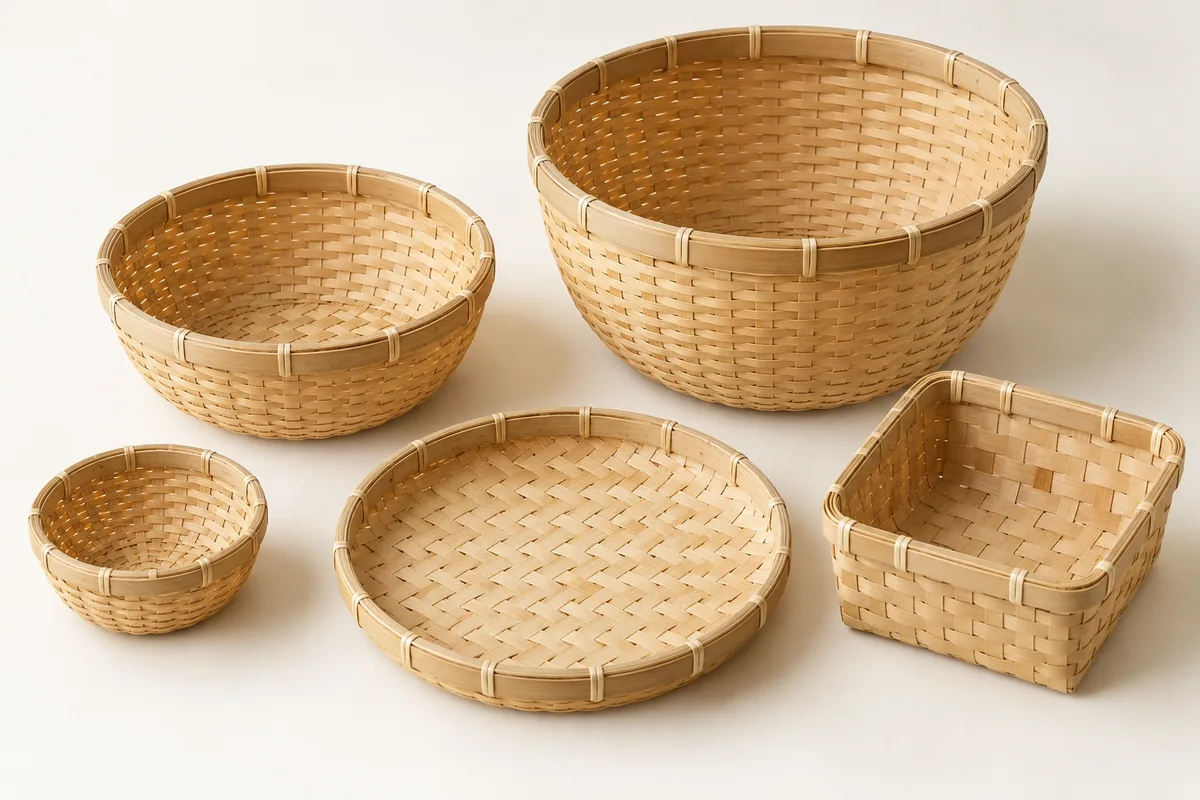
Searching for a bamboo basket in a big size is only the beginning of a useful comparison. “Large,” “small,” and “mini” do not tell you whether a basket will fit your cupboard or hold the objects you have in mind. Measure the contents and the available space first, then compare the basket's shape, opening, base, and overall dimensions. A well-chosen smaller basket can be more useful than a large one with an inconvenient opening.
Start with three sets of measurements
First, measure the place where the basket will live. For a shelf, record its clear width, depth, and height. For a floor position, consider nearby doors and walking space. For a gift arrangement, lay out the packaged items in their intended positions and measure that layout.
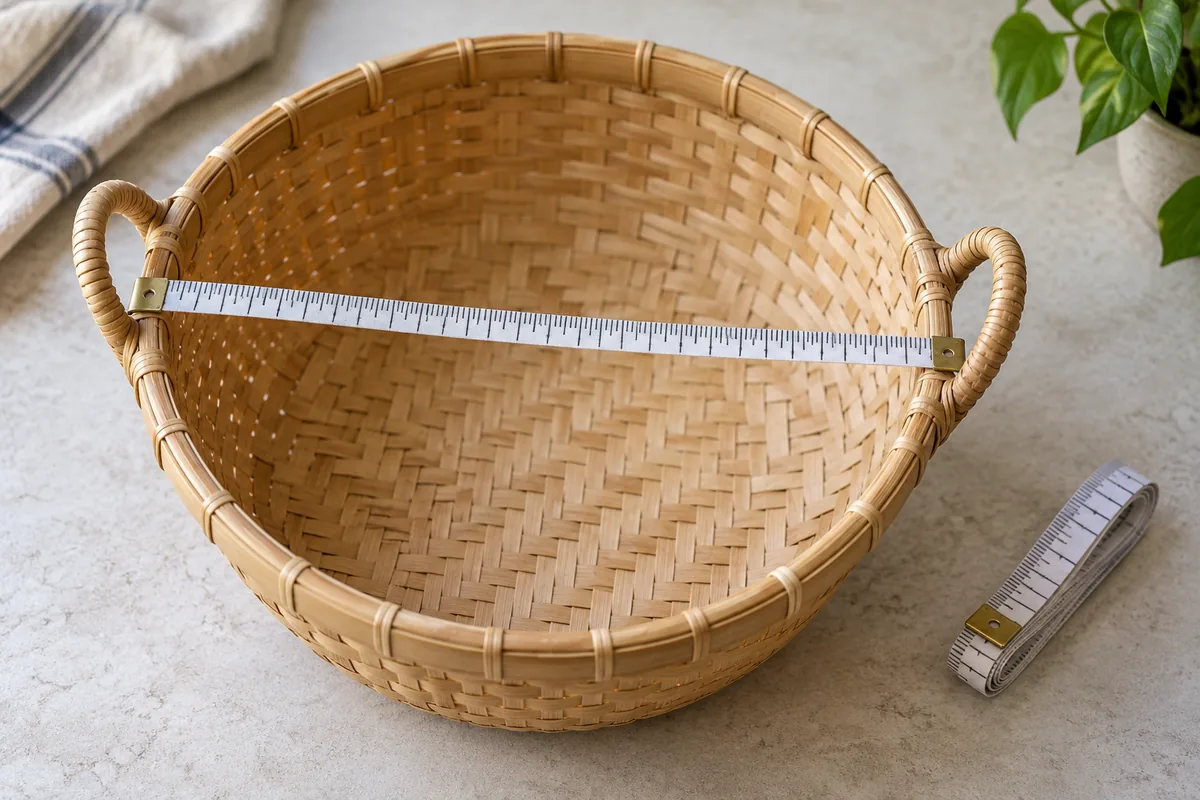
Second, ask for external dimensions at the widest points. Handles, a flared rim, a foot ring, and a lid knob may extend beyond the main body. Third, check internal measurements and the opening. A narrow mouth can stop a large object entering even when the middle of the basket appears wide enough.
What different shapes do well
| Shape | Consider it for | Check before ordering |
|---|---|---|
| Round | Rolled throws, a freestanding display, grouped accessories | Diameter at the rim and widest point |
| Square or rectangular | Shelf compartments and organized rows | Corner shape, depth, and internal width |
| Tall | Items that can be stored upright | Base stability and access to the bottom |
| Flat or shallow | A visible arrangement of small objects | Usable base area and rim height |
| Mini | Small gifts or individual accessories | Actual opening rather than the size label |
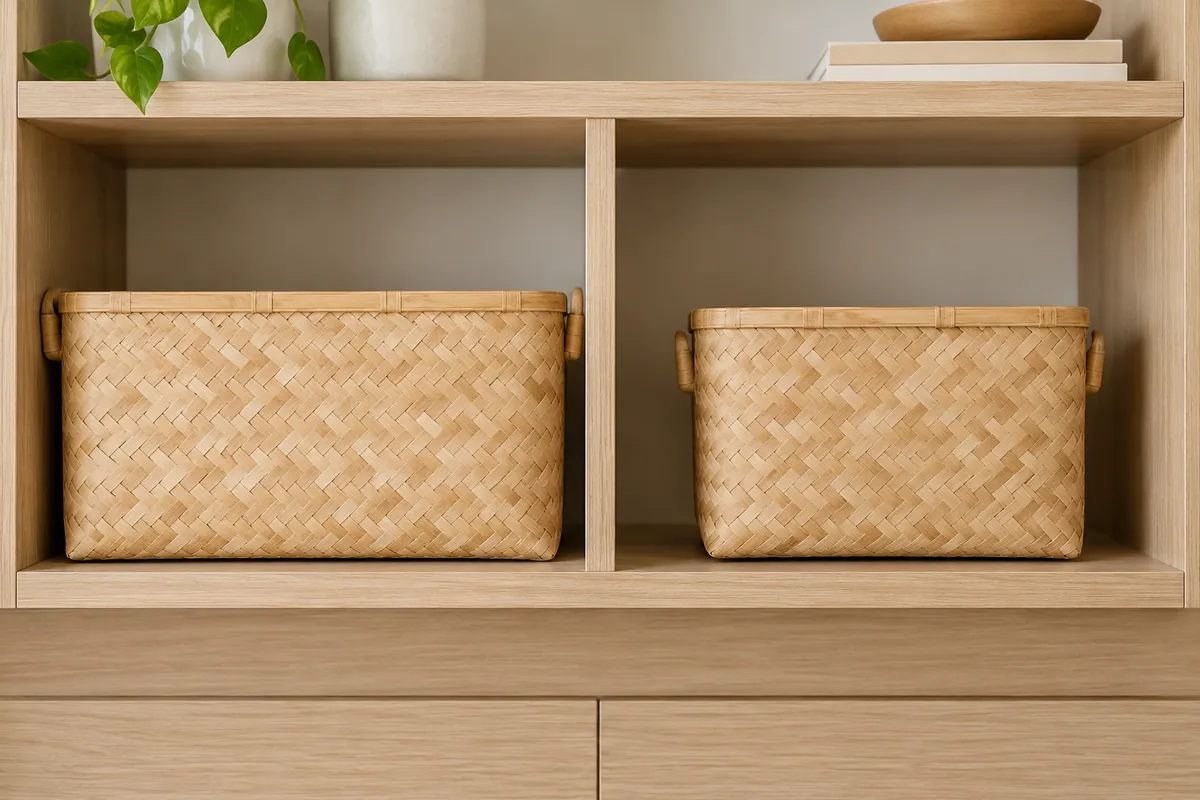
A square bamboo basket can make a tidy row on rectangular shelving, but rounded corners may leave less usable floor area than its outside measurements suggest. A bamboo round basket has no corners to position, yet its broadest point can use more shelf space than expected. Sketch the footprint of each option on paper when space is tight.
Check the seller's measurement method
Measurement labels need context. burton + BURTON's measuring guide distinguishes outside width and depth from inside opening measurements and includes the handle when measuring overall handled height. The Basket Company's FAQ uses outside-edge dimensions and gives its own size-variation allowance. Ask your seller for its method and tolerance; another company's allowance is not a universal basket standard.
A worked shelf-fit example
These hypothetical measurements demonstrate a buying check; they are not product specifications or recommended universal clearances. Imagine a compartment with 42 cm clear width, 36 cm depth, and 30 cm height. Your candidate basket has a 38 cm body width, 30 cm depth, and 24 cm body height.
| Check | Example calculation | Result |
|---|---|---|
| Outside width plus handles | 38 cm body + 1 cm projection per side = 40 cm | Only 2 cm total remains in the 42 cm opening |
| Planned finger access | 40 cm overall + your chosen 2 cm per side = 44 cm | Fails this access plan |
| Overall height | 24 cm body + 3 cm lid knob = 27 cm | Fits below the shelf, but opening the lid still needs a trial |
| Usable inside width | 30 cm measured inside; folded contents are 31 cm wide | Contents do not fit without changing their arrangement |
The basket can enter the opening yet fail both hand access and storage fit. Choose a different model or rearrange the contents, then test the sample. Compare centimeters consistently; one inch equals 2.54 cm.
Large bamboo baskets need practical access
A big bamboo basket can gather several bulky items in one place, but check how you will use it when full. Will it remain on the floor or be moved regularly? Can you reach the bottom comfortably? Will a lid stay clear of the wall?
Ask the supplier about intended contents and any stated carrying limits. Size does not establish strength, and handles are not automatically designed for heavy loads. If the purpose is blankets, test your folded stack with a simple cardboard box of similar internal dimensions before selecting the basket.
Small, mini, and nesting baskets
A small bamboo basket can keep one category of objects easy to see. For gifts, allow space for protective packing rather than filling every gap. For accessories, check whether the weave is open enough for tiny pieces to slip through; a suitable removable insert may be useful.
With bamboo nesting baskets, distinguish storage during shipping from everyday use. Ask which basket fits inside which and whether the pieces are intended to nest when empty. A bamboo basket set might simply contain coordinated sizes. Count the pieces, verify every dimension, and confirm whether each basket includes its own lid.
Frequently asked questions
What size counts as a large bamboo basket?
There is no useful universal answer for shopping. Treat “large” as a seller's description and compare the exact measurements. Ask for a photograph beside a measuring tape when the listing leaves the scale unclear.
Is a tall basket better for a small room?
It can use a compact floor area, but height affects reach and stability. Consider what goes inside and how often you need it. A tall basket that is awkward to empty may solve the floor-space problem while creating an access problem.
Should I buy round or square baskets for shelving?
Compare their full footprints with the shelf opening. Square or rectangular baskets often align conveniently in rows; round baskets can work well in open displays. Leave enough room to grip and remove either shape without scraping adjacent pieces.
What should I ask when ordering several handmade baskets?
Request the expected dimensional variation, measurement method, and whether the supplier can select a coordinated group. Confirm quantity, lids, liners, and packaging in the order details. If exact shelf fit matters, request actual measurements before dispatch.